

9 Amazing Things to Draw to Boost Your Creativity in 2025
Welcome to a journey where your pen, pencil, or stylus becomes a powerful tool not just for creativity, but for mental wellbeing. In a world where mental health is a growing concern, finding healthy outlets for expression is paramount. Research shows that around 1 in 6 children in the UK has a probable mental health condition, a figure that highlights the urgent need for supportive, creative outlets. Drawing offers a unique escape and a method of processing complex emotions, serving as a vital form of mindful relaxation.
This article explores a curated list of amazing things to draw, connecting each idea to the benefits of creative expression and emotional development. We will provide practical drawing prompts suitable for various skill levels, from atmospheric space scenes to expressive animal portraits, all designed to inspire and calm the mind. To further spark your imagination and explore innovative visual concepts, consider exploring powerful AI image prompt examples.
Please remember, while art is a therapeutic activity, this advice does not replace professional medical help. I am not a mental health professional; if you have concerns about your own or a child's mental health, it is vital to consult a doctor or a qualified professional. Let's explore how we can use art to build resilience and find moments of peace.
1. Dragons and Mythical Creatures: Externalising Big Feelings
Drawing fantastical creatures is one of the most amazing things to draw not just for its creative challenge, but for its powerful emotional benefits. Creating beings like dragons, griffins, or unicorns offers a unique way to externalise big, complex feelings. For a child, a fiery dragon can become a symbol for overwhelming anger, while a shadowy beast might represent a persistent worry. A practical example could be a child drawing a 'worry monster' and then locking the drawing away in a box, giving them a tangible sense of control over their anxiety.
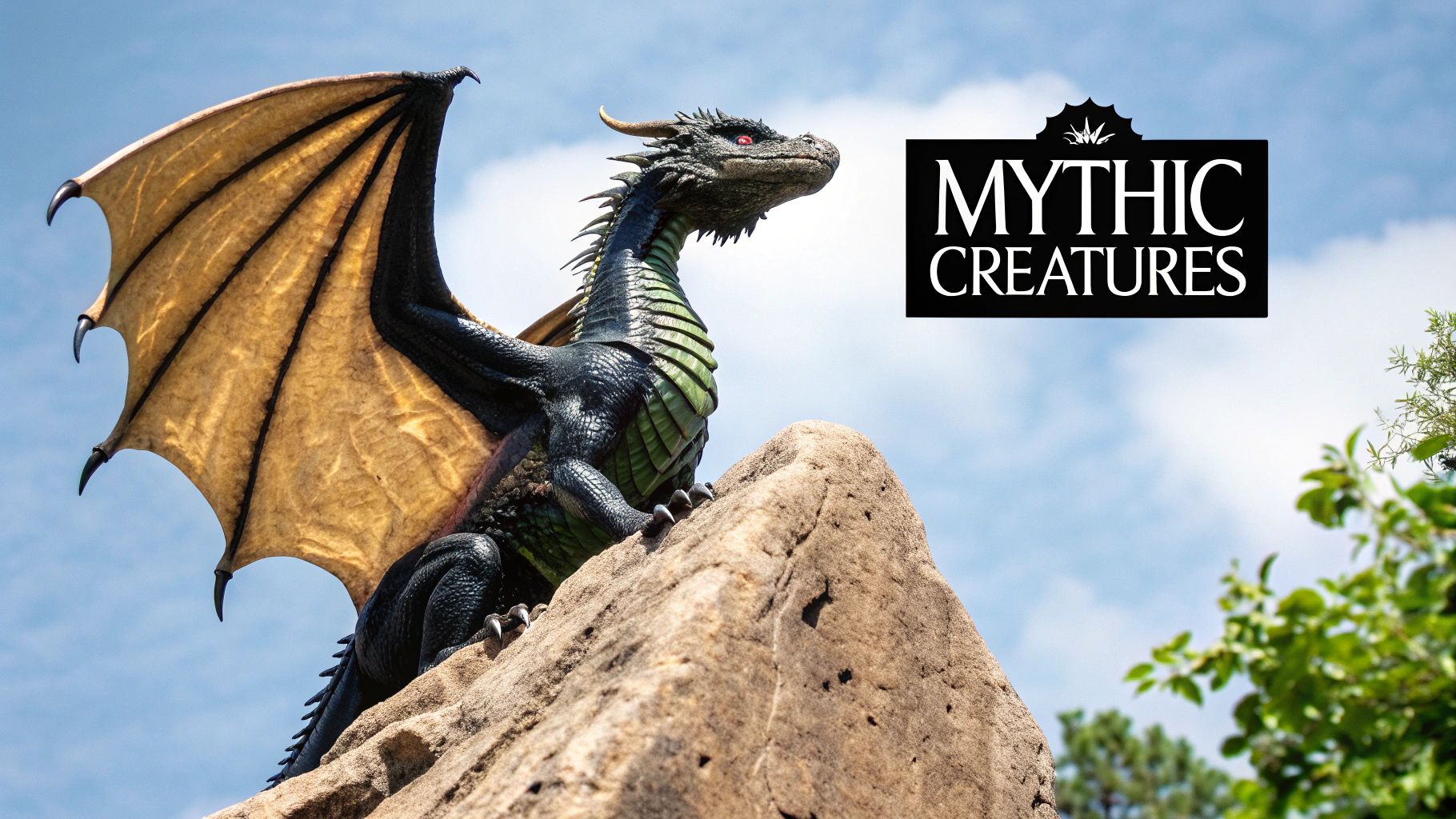
This process, a cornerstone of art therapy, allows children and adults alike to give a tangible form to their internal struggles. By putting the emotion onto paper, it becomes something separate from themselves, something they can observe, understand, and even control. Giving the creature a backstory adds another layer of therapeutic exploration. Is it a misunderstood beast needing kindness, or a fierce guardian protecting something precious? This externalisation is a vital step in addressing mental health, as it makes abstract feelings concrete and manageable.
Practical Tips for Drawing Your Creature
- Study Real Anatomy: Base your creature on real animals. Look at lizard skeletons for dragons or bird wings for griffins to make them believable.
- Start with Basic Shapes: Begin with simple circles, ovals, and rectangles to build the creature's form before adding complex details like scales or fur.
- Research Cultural Meanings: Dragons symbolise different things across cultures. A European dragon might be destructive (like Smaug), while a Chinese Lung dragon is a symbol of luck and power.
- Master the Fundamentals: To bring these expressive beings to life, it helps to master character design fundamentals, which will improve your ability to create unique and compelling figures.
This technique reinforces the idea that acknowledging our inner 'dragons' is a sign of strength. Mental health apparel, like the Komodo Dragon T-shirt from Little Fish Books, celebrates this concept, turning a symbol of power into a wearable reminder of one's own resilience and sparking conversations about mental wellbeing.
2. Realistic Eye Studies: Capturing Emotion and Focus
Practising realistic eye studies is one of the most amazing things to draw for developing technical skill and emotional perception. Often called the "windows to the soul," eyes convey a vast spectrum of feeling without a single word. Drawing them in detail, from the subtle colours in the iris to the reflection in the cornea, is a meditative process that hones an artist's ability to observe and replicate nuance, a skill essential for capturing personality and emotion.

This intense focus is a powerful form of mindfulness, helping to quiet a busy mind by concentrating on a single, intricate task. For children and adults alike, this can be a grounding exercise, reducing feelings of anxiety and overwhelm. The practice, championed by artists from Leonardo da Vinci to contemporary hyperrealists like Diego Fazio, teaches patience and the importance of seeing beyond the obvious. It’s an act of truly looking at a subject, understanding its form, and translating its life onto the page. For relaxation, try putting on some calming music, focusing solely on your breathing and the page in front of you, shutting out all other distractions.
Practical Tips for Drawing Realistic Eyes
- Start with the Pupil: Establish your darkest point first with the pupil. This will serve as an anchor for the rest of your tonal values.
- Observe Iris Colours: The iris is rarely a single flat colour. Look closely for the subtle specks, lines, and gradients of different hues within it.
- Include Wetness and Reflection: Don't forget the small details that bring an eye to life, such as the tear duct, the waterline, and the bright highlight (catchlight) reflecting a light source.
- Blend for Softness: Use blending stumps or a soft cloth to create smooth gradations, especially for the skin around the eyelids, to give it a realistic, fleshy texture.
- Study the Anatomy: Understanding the underlying structure, like how the eyelid wraps around the eyeball, will make your drawings far more convincing and three-dimensional.
3. Architectural Landmarks and Cityscapes: Building Focus and Structure
Drawing famous buildings, bridges, and bustling cityscapes is more than just an exercise in technical skill; it's a powerful lesson in structure, patience, and finding order in chaos. For a mind that feels cluttered or overwhelmed, focusing on the clean lines and geometric precision of architecture can be incredibly grounding. Capturing the grandeur of the Eiffel Tower or the intricate detail of the Colosseum demands a high level of concentration, pulling the artist into a state of flow that can quieten anxious thoughts.
This methodical process teaches the artist to break down a complex, intimidating whole into manageable parts. A towering skyscraper becomes a series of simple rectangles, a grand bridge a pattern of repeating triangles. This translates well into a life skill, helping individuals learn to approach overwhelming personal challenges one step at a time. For instance, by breaking down a large project into smaller, drawing-like steps, the task becomes less daunting. The satisfaction of completing a detailed architectural drawing reinforces the idea that patience and a structured approach can build something incredible, both on paper and in life.
Practical Tips for Drawing Your Landmark
- Master Basic Perspective: Before tackling a full cityscape, practise one-point and two-point perspective. This is fundamental to making buildings look three-dimensional and realistic.
- Start with Geometric Shapes: Block out the entire structure using simple squares, cylinders, and triangles. This helps establish correct proportions before you add any intricate details like windows or arches.
- Use Photo References Wisely: Work from a photograph but don't be afraid to simplify details or change the lighting to create a more dramatic mood. Focus on capturing the essence, not every single brick.
- Consider Time of Day: The same building can look completely different at sunrise, midday, or night. Experiment with long, dramatic shadows or the glow of city lights to add atmosphere and emotion to your piece.
4. Surreal Dream Landscapes: Navigating the Subconscious
Drawing surreal dream landscapes is one of the most amazing things to draw because it offers a direct portal into the subconscious mind. These scenes blend reality with fantasy, featuring impossible architecture, floating objects, and distorted perspectives that allow artists to explore thoughts and anxieties that are difficult to put into words. This can be especially powerful for young people navigating the often-confusing landscape of their own emotions, where a melting clock or a floating rock can represent feelings of lost time or instability.
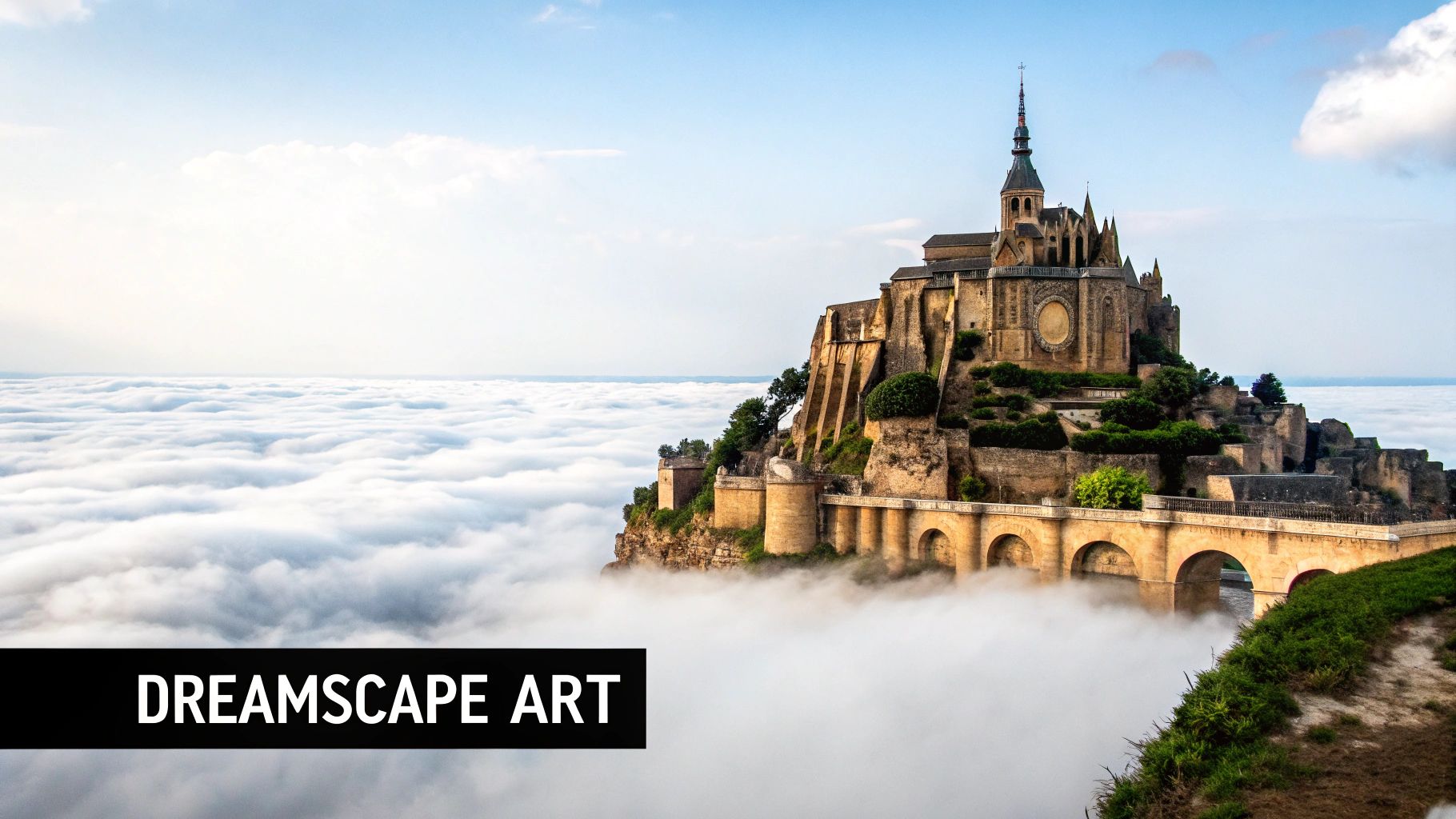
This creative process encourages a non-judgmental exploration of the inner world, a key aspect of developing emotional intelligence. By creating a visual representation of a dream or a strange feeling, the artist can analyse it from a safe distance. This practice helps to normalise complex emotions and reinforces the idea that what happens in our minds, no matter how bizarre, is valid. Artists like Salvador Dalí and René Magritte used surrealism to question reality and delve into the subconscious, a technique anyone can use to better understand themselves. If you are struggling to express a difficult feeling, try drawing the first image that comes to mind, no matter how strange, and see where it takes you.
Practical Tips for Drawing Your Dreamscape
- Start with an Impossible Element: Centre your drawing around one object that defies logic, such as a fish swimming through the sky or a tree growing out of a book.
- Maintain Consistent Lighting: Even in a fantasy world, consistent lighting and shadows will make the scene feel cohesive and believable.
- Use Familiar Objects Unusually: Place everyday items like chairs, teacups, or doors in unexpected contexts to create a classic surrealist effect.
- Create Depth with Layers: Use overlapping elements and atmospheric perspective (where distant objects are lighter and less detailed) to give your landscape a sense of vastness.
This form of expression serves as a reminder that our minds are complex and fascinating places. Engaging with our subconscious through art is not just a creative exercise; it's a profound act of self-care and mental exploration.
5. Detailed Botanical Illustrations: Finding Calm in Natural Patterns
Creating detailed botanical illustrations is one of the most amazing things to draw for its ability to foster mindfulness and a deep connection to the natural world. This practice involves drawing plants with scientific accuracy, focusing on their intricate patterns, textures, and life cycles. It shifts the artist's focus from broad concepts to the minute, beautiful details of a single leaf, petal, or stem.
This meticulous process acts as a powerful form of meditation, demanding intense concentration that quiets a busy or anxious mind. By observing the subtle symmetry and organic growth of a plant, one can find a sense of order and peace in a seemingly chaotic world. The practice encourages patience and a slower, more deliberate way of seeing, which can be a welcome relief from the constant stimulation of daily life. For a simple relaxation exercise, try spending five minutes just observing a single flower or leaf, noticing every detail before you even start to draw.
Practical Tips for Drawing Your Botanicals
- Work from Life: Whenever possible, use a live plant or flower as your subject. This allows you to observe its three-dimensional form, texture, and how it interacts with light in real-time.
- Study the Structure: Understanding the underlying structure of a plant is crucial for accuracy. Learning about the art of bonsai cultivation and pruning can offer profound insights into how plants grow and can be shaped, improving your ability to depict them realistically.
- Layer with Patience: Whether using coloured pencils or watercolours, build up your tones gradually. This technique will create realistic depth and vibrancy, capturing the delicate translucency of petals and leaves.
- Include Scientific Details: Add elements like cross-sections, seed pods, or root systems to elevate your drawing from a simple sketch to a comprehensive botanical study, as seen in the work of historical artists like Maria Sibylla Merian.
6. Dynamic Action Poses and Movement: Capturing Life's Energy
Learning to draw dynamic action poses is one of the most amazing things to draw because it teaches an artist to capture the essence of life itself: movement. Depicting a figure frozen in a moment of intense action, whether it’s a dancer mid-leap, a martial artist in a powerful stance, or a superhero soaring through the air, is a profound challenge. This practice goes beyond static anatomy, focusing on energy, weight distribution, and the story told by the body’s posture.
Tackling this subject can be an incredible boost to an artist's confidence. The focus required to understand the mechanics of movement can be a form of mindfulness, demanding full concentration and pulling one away from daily anxieties. Successfully capturing a fleeting moment of action provides a powerful sense of accomplishment, reinforcing the artist’s ability to observe and interpret the world with precision and flair.
The process of drawing action poses can be broken down into a manageable workflow. The following diagram illustrates a foundational approach used by animators and illustrators to build dynamic figures from the ground up.
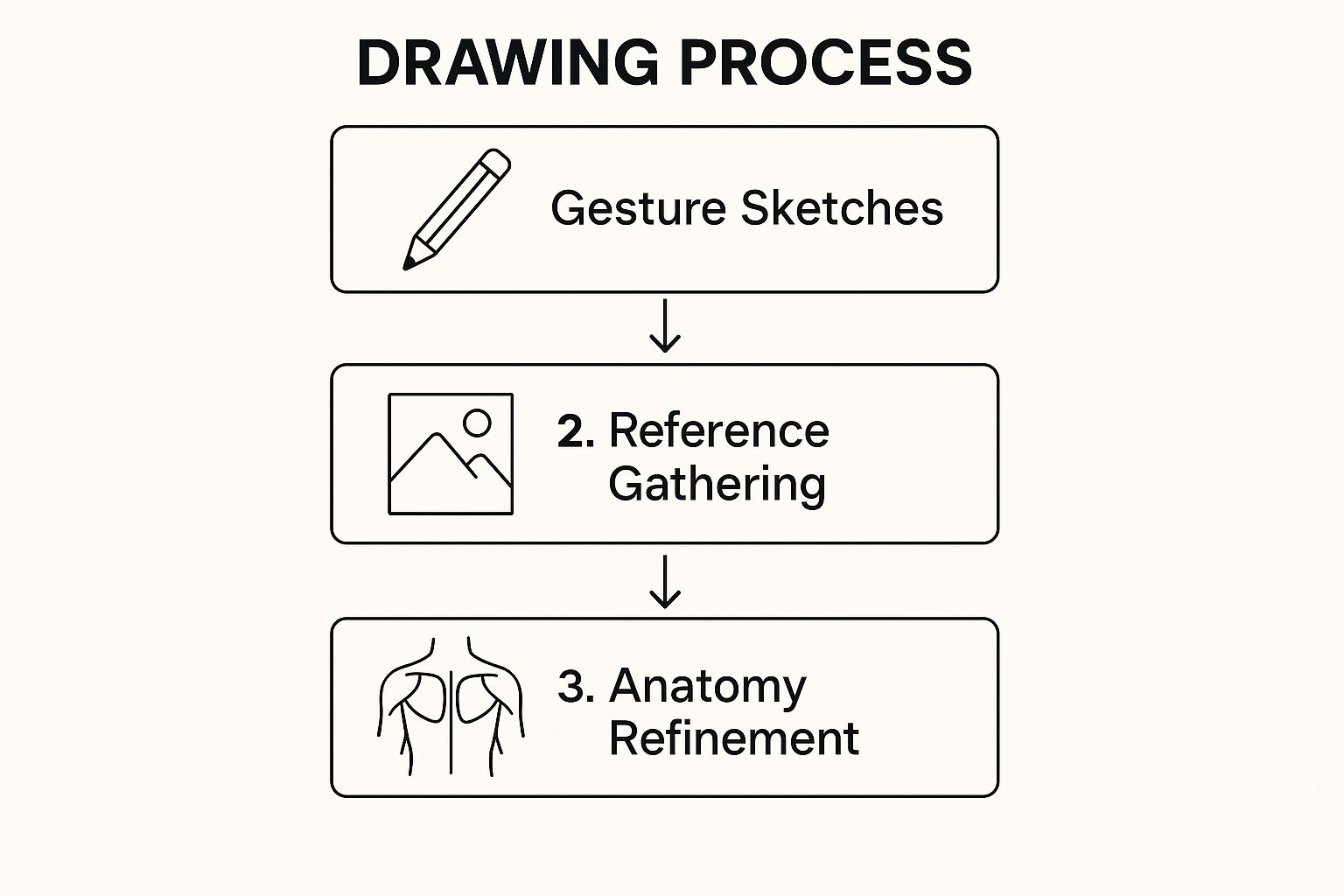
This structured method ensures that the final drawing retains the initial energy of the pose while being grounded in believable anatomical structure.
Practical Tips for Drawing Your Action Poses
- Start with Gesture Drawings: Begin with quick, loose sketches (30-60 seconds) to capture the overall flow and energy. Don't worry about details; focus on the line of action.
- Use Video and Photo References: Study photo sequences of athletes or use slow-motion video to understand how the body moves from one position to the next.
- Understand Balance: Pay close attention to the centre of gravity. A figure in motion is often off-balance, and correctly showing this creates a sense of believable movement.
- Exaggerate for Effect: Slightly exaggerating the curve of the spine or the extension of a limb can make a pose feel more dynamic and less stiff.
Learning from masters who have perfected this skill can provide invaluable insights into the nuances of capturing movement on a static page.
7. Intricate Mandala and Geometric Patterns: A Mindful Drawing Practice
Drawing mandalas and other intricate geometric patterns is one of the most amazing things to draw because it merges artistic expression with a powerful mindfulness practice. These circular, symmetrical designs, rooted in spiritual traditions like Tibetan Buddhism and Hinduism, guide the creator through a meditative process. The repetition and precision required can help quiet a busy mind, making it an excellent tool for managing stress and anxiety.
This form of art is not just about the final product; the creation itself is a journey of focus and calm. For children and adults struggling with overstimulation, perhaps from social media or school pressures, the structured nature of drawing a mandala offers a welcome retreat. As psychologist Carl Jung noted, creating mandalas can be a deeply personal process, representing the self and promoting a sense of inner order. It provides a safe, contained space on the page to organise thoughts and feelings.
Practical Tips for Drawing Your Mandala
- Start from the Centre: Always begin with a central point and work your way outwards. This anchors the design and helps maintain symmetry throughout.
- Use Precision Tools: A simple compass and ruler are your best friends for creating the underlying geometric grid. This structure allows for more creative freedom later.
- Plan Your Patterns: Lightly sketch your repeating patterns in one section before committing. This helps ensure the design flows and connects seamlessly around the circle.
- Consider Colour Theory: Think about what feelings you want the colours to evoke. Cool blues and greens can be calming, while vibrant reds and oranges can be energising.
Focusing on these intricate designs is a fantastic way to practise mindfulness and improve concentration. It's a testament to how creative expression can be a powerful tool for mental well-being, a principle we wholeheartedly support as we celebrate your child's creativity and its positive impact.
8. Atmospheric Space and Cosmic Scenes: Exploring the Infinite
Drawing atmospheric space scenes is one of the most amazing things to draw because it taps into our innate sense of wonder and helps contextualise our place in the universe. Creating cosmic landscapes, from swirling nebulae to distant planets, can be a profoundly calming and meditative experience. It encourages a shift in perspective, making personal worries feel smaller against the backdrop of infinite space.
This artistic practice allows for a unique blend of scientific accuracy and creative freedom, inspired by artists like Chesley Bonestell and imagery from the Hubble Space Telescope. For anyone feeling overwhelmed by daily pressures, focusing on the vast, quiet beauty of the cosmos offers a powerful mental escape. The process of blending colours to form a galaxy or stippling a starfield requires patience and focus, serving as a mindful distraction from anxious thoughts and promoting a state of calm.
Practical Tips for Drawing Your Cosmic Scene
- Study Real Imagery: Use photographs from NASA and the Hubble telescope as a reference for colour, texture, and light. This will help make your cosmic creations feel more authentic.
- Master Blending Techniques: For soft nebulae and galactic clouds, practise blending with pastels, charcoal, or digital brushes. This is key to achieving a sense of depth and atmosphere.
- Use Contrast for Scale: Place small, bright objects (like a distant star or a tiny spacecraft) against vast, dark backgrounds to create a powerful sense of immense scale and distance.
- Layer Transparent Colours: Build up your colours in thin, transparent layers to give nebulae a luminous, three-dimensional quality, as if they are glowing from within.
This technique is a fantastic way to engage in a relaxing activity that sparks curiosity and awe. Products like the Komodo Dragon T-shirt from Little Fish Books can complement this feeling, representing the powerful, almost otherworldly forces found both in nature and within ourselves.
9. Expressive Animal Portraits: Capturing Soul and Personality
Drawing expressive animal portraits is one of the most amazing things to draw because it moves beyond simple replication to capture the unique soul of a creature. This practice involves not just technical skill in rendering fur or feathers, but a deep empathy for the subject, allowing artists to convey emotion and personality. A portrait of a wise old elephant, like those painted by David Shepherd, or the intense gaze of a wolf can evoke powerful feelings in the viewer.
This artistic pursuit encourages a mindful connection with the natural world, fostering patience and observational skills. For many, it's a meditative process that reduces stress by focusing intently on the subtle details that make an animal an individual, from the twitch of an ear to the light in its eye. It’s a way to honour the animals we share our planet with, seeing them not just as subjects, but as beings with their own inner lives and emotions.
Practical Tips for Drawing Your Animal Portrait
- Start with the Eyes: The eyes are the window to the soul. Capturing their expression, reflection, and depth is crucial for establishing an emotional connection with the viewer.
- Study Anatomy and Behaviour: Understanding the underlying bone and muscle structure will make your drawings more believable. Observing how an animal behaves will help you capture its authentic personality.
- Use High-Quality References: A clear, well-lit photograph is essential. Pay close attention to the direction of light and how it creates shadows and highlights on the animal’s form.
- Practise Different Textures: Spend time practising techniques for drawing different types of fur, feathers, and scales. Layering, short strokes, and varying pencil pressure are key.
This focus on emotional expression can be a powerful tool for exploring feelings, much like the ‘I’m Surprised’ Mental Health Art Print from Little Fish Books, which uses imagery to articulate complex emotional states. By capturing an animal's character, we often reflect and better understand our own.
Comparison of 9 Amazing Drawing Subjects
| Item | Implementation Complexity 🔄 | Resource Requirements 💡 | Expected Outcomes 📊 | Ideal Use Cases 💡 | Key Advantages ⭐ |
|---|---|---|---|---|---|
| Dragons and Mythical Creatures | High – complex anatomy & texturing | High – knowledge of multiple animal anatomies, cultural research | Strong emotional impact, cross-cultural appeal | Fantasy illustration, storytelling | Unlimited creativity, anatomical skill development |
| Realistic Eye Studies | Medium – detailed but focused | Moderate – patience and blending tools | Highly impactful, teaches light/shadow mastery | Portrait details, standalone art | Develops observation, universal appeal |
| Architectural Landmarks | High – requires perspective mastery | High – photo references, precision tools | Technical skill showcase, cultural education | Architecture, travel art, portfolios | Teaches perspective, strong portfolio pieces |
| Surreal Dream Landscapes | High – complex compositions & lighting | Moderate – imaginative references | Memorable, engaging, highly creative work | Fantasy art, social media, personal expression | Complete creative freedom, imagination boost |
| Detailed Botanical Illustrations | Medium – demands accuracy and detail | Moderate – live specimens preferred | Educational, timeless appeal | Scientific illustration, nature art | Patience & observation, suitable for all skill levels |
| Dynamic Action Poses | High – anatomy in motion, perspective | Moderate – video/photo references | Energetic, emotional drawings | Animation, comics, sports art | Develops anatomy and movement skills |
| Intricate Mandala and Geometric Patterns | Medium – precision and symmetry driven | Low to Moderate – compass, ruler | Meditative, precise artwork | Mindfulness art, cultural patterns | Relaxing, develops patience and precision |
| Atmospheric Space and Cosmic Scenes | Medium to High – atmospheric effects | Moderate – space references, colour mastery | Inspiring, visually impactful | Sci-fi art, space illustration | Unlimited creativity, teaches atmospheric perspective |
| Expressive Animal Portraits | Medium to High – anatomy & texture | Moderate – reference photos, texture study | Emotional connection, naturalistic portraits | Wildlife art, pet portraits | Universal appeal, develops texture skills |
Your Creative Path Forward
The journey through this extensive list of amazing things to draw, from the mythical scales of a dragon to the intricate veins of a botanical illustration, is more than just a collection of prompts; it's a map to your own creative potential. We've explored how drawing realistic eyes can deepen your understanding of human emotion and how sketching dynamic action poses can teach you about the energy of the human form. Each idea serves as a distinct gateway, not just to improving your artistic technique, but to enhancing your focus, patience, and ability to observe the world with a more curious and detailed eye.
The true value of a sketchbook filled with these diverse subjects is the story it tells about your growth. You are not just learning to draw a cityscape; you are learning to see structure, perspective, and the interplay of light and shadow in your own environment. You are not just creating a mandala; you are engaging in a meditative practice that calms the mind and organises chaotic thoughts into beautiful, symmetrical harmony.
From Blank Page to Emotional Wellbeing
Embracing art as a regular practice provides a powerful tool for navigating the complexities of modern life. In the UK, the prevalence of mental health challenges among young people is a growing concern. The rise of social media has a significant impact, often leading to increased anxiety, poor body image, and feelings of isolation. Drawing offers a constructive and accessible outlet—an offline way to process feelings without words and to build a sense of accomplishment on your own terms.
The importance of addressing mental health cannot be overstated. For businesses, poor mental health among employees is estimated to cost UK employers up to £56 billion a year. By fostering creative outlets and encouraging open conversation, we build a more resilient and productive society. This practice is a form of self-care, a quiet rebellion against the constant noise of the digital world. The key takeaways from our exploration are:
- Diversity is Your Strength: Don't limit yourself to one subject. Drawing a range of items, from expressive animal portraits to surreal landscapes, builds a more versatile skill set and keeps your creative spark alive.
- Process Over Perfection: The goal is not a flawless masterpiece every time. The real benefit lies in the act of creating, the focus it demands, and the emotional release it provides.
- Art is a Lifelong Skill: The ability to translate ideas onto paper is a resource you can turn to at any age for relaxation, problem-solving, and self-expression.
Your Next Masterpiece: Putting Pencils into Practice
Your creative path forward is a personal one, paved with the lines, shades, and colours you choose to put down. Let this list be your starting point, not your boundary. Combine ideas, invent your own, and, most importantly, keep your sketchbook close. The next time you feel overwhelmed or uninspired, remember the simple power of a pencil and a blank page. You have an infinite universe of amazing things to draw, each one a step towards becoming a more observant, resilient, and expressive individual. Remember, if you are ever worried about your own or someone else's mental health, seeking advice from a GP or a qualified mental health professional is a crucial first step.
If you're looking for more ways to blend creativity with emotional wellbeing, explore the resources at Little Fish Books. Our collection of children's mental health books and activities is designed to help children and adults use art and storytelling to understand their feelings and build resilience. Books like The Magical Tree of Feelings and The Boy with the Big Blue Hair provide gentle ways to start important conversations. Visit Little Fish Books to discover tools that can help turn a simple drawing session into a meaningful conversation about mental health.