
Books about emotions for toddlers: Nurture empathy with simple stories
Giving your toddler books about emotions is one of the simplest, most powerful things you can do to build their emotional wellbeing from the ground up. These stories are the very first items in their ‘emotional toolkit’, helping them make sense of big, complicated feelings in a way that’s safe, gentle, and easy to grasp.
Why Reading About Feelings Is a Game Changer for Toddlers
Talking to a toddler about their feelings isn't a chore; it’s an incredible gift. Think of it as helping them build a ‘feelings toolkit’. Just as you’d give a child building blocks to construct a tower, books about emotions give them the essential tools to build a healthy inner world.
Each story about anger, joy, sadness, or fear adds a new tool to their kit. A book about a grumpy lion gives them a ‘tool’ for understanding what frustration feels like. A story about a happy bunny gives them one for recognising joy. This isn't about diving into complex psychology; it’s about giving feelings a name and a face, which makes them far less scary and much more manageable.
The Growing Need for Early Emotional Support
Across the UK, we’re becoming more aware of how vital children's mental health is, and for good reason. Our early experiences shape our emotional wellbeing for life, and the statistics paint a clear picture of why addressing mental health early matters so much.
For example, a recent NHS survey found that one in five children and young people in England now have a probable mental health condition. This really highlights the urgent need for positive, early support right from the toddler years. You can read more about the impact of reading on children's mental wellbeing to see just how powerful it can be.
By introducing these topics through gentle stories, we create a safe space for toddlers to explore big feelings without becoming overwhelmed. It’s a proactive step towards building resilience.
Practical Steps for Building a Foundation
The impact of this early foundation stretches far beyond childhood. Poor mental health doesn't just affect individuals; it has a significant cost for businesses and wider society. Deloitte estimates that poor mental health costs UK employers up to £56 billion a year. Helping children become emotionally literate today helps create more stable, empathetic, and resilient adults tomorrow. With the added pressures of social media's impact on mental health, these skills have never been more critical.
Here are a few simple ways you can start:
- Make it a routine: Just a few minutes each day with a book about feelings can make a huge difference.
- Talk about the pictures: Point to the characters’ faces and ask questions. "Look, he seems a bit sad. I wonder why?"
- Model your own feelings: You can say things like, "Mummy feels a bit tired today," which helps normalise expressing emotions.
- Relax together: Cuddling up with a book is a wonderful opportunity for quiet, calming connection. Try some gentle belly breathing: pretend your tummy is a balloon, breathing in to make it big and out to make it small.
While books and positive conversations are incredibly powerful, it's important to remember that I am not a mental health professional. This guide is here to offer supportive advice. If you have serious concerns about your child's mental health or wellbeing, please seek help from your doctor or a qualified professional. Building this emotional toolkit is a journey, and these books are a brilliant first step.
How Stories Teach the Language of Feelings
Learning about feelings is a lot like learning a new language. For a toddler, abstract ideas like ‘frustration’ or ‘sadness’ are as foreign as words from another country. This is where simple picture books come in – they act as the perfect translator, turning confusing internal signals into something a child can finally see, name, and understand.
Through colourful illustrations and relatable tales, toddlers start to connect the dots. They see a character with a downturned mouth and droopy shoulders, and the story names this feeling ‘sad’. All of a sudden, that jumbled sensation they get when they miss a parent has a name and a face. This simple connection makes the feeling less scary and less overwhelming. It’s the very first, vital step in building their emotional vocabulary.
These stories also provide a safe, detached space to explore really big emotions. When a toddler sees a storybook character get angry because their tower of blocks fell over, it validates their own flashes of temper. It sends a powerful message: you are not alone in feeling this way. This validation is essential for building healthy self-awareness and confidence.
Building Empathy and Self-Awareness
Reading books about emotions for toddlers builds the two cornerstones of emotional intelligence: empathy and self-awareness. Empathy is about understanding how someone else might be feeling, while self-awareness is the skill of spotting your own emotions as they pop up.
A story about a lonely squirrel who wants a friend doesn’t just entertain; it gently encourages a child to step into the squirrel’s shoes. They begin to grasp what loneliness might feel like for someone else. This is the very seed of empathy, a skill that will help them build strong, healthy relationships for the rest of their lives. You can explore this connection further in our article explaining what is emotional literacy and why it matters so much.
By watching characters navigate their feelings, a child learns that emotions are temporary. They see that sadness can be followed by happiness, and anger can fade. This is a foundational concept for developing resilience and coping skills.
Picture books that tackle emotions are especially effective for UK toddlers. Research has shown that storybooks are directly linked to the growth of empathy. Studies reveal that between the ages of three and five, children are hungry for stories that help them make sense of both positive and negative feelings. This makes these books a vital tool for laying a strong emotional foundation.
From Story to Real-Life Application
The lessons learned from these simple stories don't just stay on the page; they become practical tools that toddlers can actually use in their day-to-day lives. After reading a book about sharing, for instance, a child is better equipped to handle a similar situation at the playground.
Here’s how it works:
- Naming Feelings: They can start to say, "I feel sad" instead of just crying or lashing out.
- Understanding Others: They might notice a friend is being quiet, remember the story about the shy rabbit, and be prompted to offer a kind word.
- Problem-Solving: Books often show characters using simple coping strategies, like taking a deep breath when they feel cross, which kids can then try themselves.
This bridge between fiction and reality is where the real magic happens. Of course, stories aren't the only tool. Creative outlets can be hugely beneficial, too. Resources on art therapy activities for children offer fantastic ways for little ones to express complex feelings they might not have the words for yet.
By combining storytelling with creative play, you give your child a rich and varied emotional toolkit that will support them for years to come.
Choosing the Best Emotional Books for Your Toddler
Walking into a bookshop to find a book about feelings for your toddler can be a bit overwhelming. The shelves are packed, and every cover looks bright and promising. So, how do you pick out the stories that will genuinely connect with your little one and actually help them with their emotional wellbeing?
The trick is to know what you’re looking for. A truly great book on this topic does more than just tell a story; it acts as a gentle, reassuring friend. It validates all those big, confusing emotions swirling around inside a toddler and shows them that feelings, even the scary ones, can be managed. It’s about creating a safe space in the pages of a book where a child sees their own experiences reflected back at them. This helps them understand that feeling sad, cross, or frightened is completely normal, and there are good ways to handle it.
This simple flowchart breaks down how a storybook can plant the seed of understanding, which then blossoms into genuine empathy.
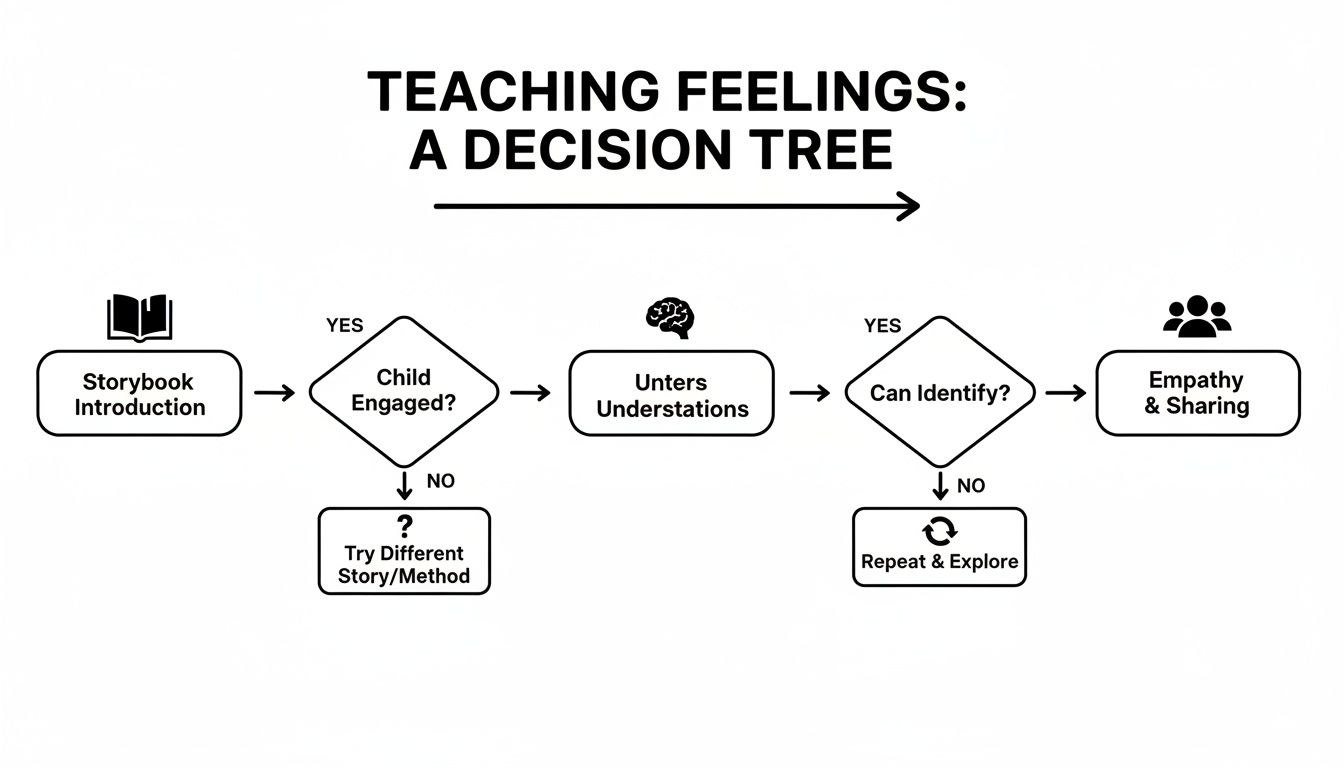
As you can see, it all starts with a simple story. That story helps build a mental picture of what a feeling is, which eventually helps a child connect with how other people might be feeling, too.
Key Features to Look For
When you're flicking through potential new books, keep an eye out for a few crucial elements. These are the things that make a story engaging, clear, and supportive for a developing mind. Getting these right means you’re building a library that really nurtures emotional literacy.
To make it easier to spot the winners on the shelf, here’s a quick checklist of what to look for in a great book about feelings for toddlers. These features work together to create a story that’s not just fun to read but genuinely helpful.
Feature Checklist for Selecting Toddler Emotion Books
A guide to the key elements to look for when choosing books about feelings for young children, helping you identify the most effective and engaging titles.
| Feature | Why It's Important for Toddlers | What to Look For |
|---|---|---|
| Relatable Scenarios | They learn best when they see their own world in the story. It makes the lesson stick. | Simple, everyday situations like sharing toys, feeling scared of the dark, or missing a parent. |
| Clear, Simple Language | Toddlers are still building their vocabulary. Complex words or ideas will just fly over their heads. | Short, repetitive sentences. Books that name feelings directly, for example, "The monster felt grumpy" or "The girl was very happy." |
| Expressive Illustrations | The pictures do most of the talking for pre-readers. They need to be bold and obvious. | Big, clear facial expressions and easy-to-read body language. A character with slumped shoulders for sadness or wide eyes for surprise. |
| Interactive Elements | It turns reading into an active, playful experience, which helps them stay engaged and absorb the concepts. | Lift-the-flaps, touch-and-feel textures, or prompts in the story that ask the child a question, like "How do you think they feel?" |
| Focus on Validation | It teaches them that their feelings are valid and normal, building a foundation of self-acceptance. | A message that it’s okay to feel any emotion, without judgement. The story shouldn’t make a character feel bad for being angry or sad. |
| Constructive Coping | It separates the feeling from the action, showing them they can feel angry without hitting or screaming. | Characters who find healthy ways to deal with big feelings, like taking deep breaths, asking for a hug, or finding a quiet space. |
| Diverse Representation | All children need to see themselves in stories to feel valued and learn to appreciate the diverse world around them. | Characters from different racial and ethnic backgrounds, various family structures (e.g., two mums, a single dad), and differing abilities. |
Paying attention to these details can make all the difference between a book that's simply read and one that's truly felt and understood. It’s about building a collection that grows with your child, offering comfort and guidance along the way.
Feelings Are Okay, Behaviours Can Be Worked On
One of the most powerful jobs of a book about emotions is to validate what a child is feeling. The core message should always be that all feelings are okay, but not all behaviours are. A good story might show a character who feels so furious they want to throw a toy, but then they discover a better way to let that anger out, like stomping their feet or telling a grown-up, "I'm cross!"
This distinction is absolutely crucial. It teaches children that their internal emotional world is normal and accepted, while gently guiding them towards constructive—rather than destructive—ways of acting on those feelings.
This approach lays the groundwork for self-regulation and empathy. It helps a child make sense of their impulses without feeling ashamed of them. The long-term impact of this is huge, contributing to better mental health and resilience as they grow up.
Every Child Deserves to See Themselves in a Story
It’s so important for children to see themselves and their families reflected in the books they read. When you’re choosing stories about emotions, make a conscious effort to find titles that feature diverse characters.
This means looking for representation across:
- Race and ethnicity
- Family structures (like single-parent families, same-sex parents, or multigenerational homes)
- Abilities and disabilities
When children see characters who look like them, it sends a powerful message that they matter and that their experiences are valid. Just as importantly, seeing characters who are different from them builds empathy and an appreciation for the wonderful diversity of the world we live in. This exposure normalises differences from a very young age, which is a fantastic way to foster an inclusive and accepting mindset.
For more guidance on finding the perfect story, you can explore our tips on choosing empowering children's picture books.
Turning Story Time into Meaningful Conversations
Simply reading the words in a book about feelings is only the first step. The real magic happens afterwards, in the gentle, curious conversations that turn a simple story into a powerful learning experience. This is where you shift from being a reader to becoming a guide for your child’s emotional growth, helping them connect the dots between the characters on the page and their own big feelings.
These chats don't need to be complicated. In fact, for toddlers, the simpler, the better. It’s all about creating a bridge between the story’s world and their own. This shared exploration builds trust and shows your child that their feelings, no matter how big or messy, are safe to talk about with you.
Sparking the Dialogue
After you've finished a story, or even during a pause, a few simple questions can open up a whole new level of understanding. The goal isn't to quiz them but to gently invite them to reflect and share. Think of these as little nudges that encourage them to think about emotions in a personal way.
Here are a few practical examples to get you started:
- Pointing to a picture: “The little fox looks frustrated here. What does your face do when you feel that way?”
- Connecting to their life: “Remember when your tower fell over yesterday? You felt a bit like this bear, didn’t you?”
- Exploring solutions: “The squirrel was feeling lonely, so she asked her friend for a hug. What helps you feel better when you’re sad?”
These simple questions transform passive listening into active engagement. They help your child build the crucial skill of self-reflection, which is a cornerstone of good mental health. Becoming a guide in these conversations is a key part of what is sometimes called emotional coaching. You can learn more about developing these skills with our detailed guide on emotional coaching for parents.
From the Page to Playtime
Meaningful conversations can also extend beyond just talking. Creative follow-up activities are a brilliant way to solidify the lessons from books about emotions for toddlers. Play is the natural language of childhood, and using it to explore feelings makes the concepts tangible and fun.
An activity doesn’t have to be elaborate. Just a few minutes of focused play can reinforce the ideas from a story in a powerful, memorable way.
By connecting the story to a hands-on activity, you help your child process the information physically and creatively. This makes the emotional concepts less abstract and more concrete in their developing minds.
Here are some creative ideas to try:
- Draw 'Feeling Faces': Get out some paper and crayons and ask your child to draw what a happy face looks like, then a sad face, then an angry one. This helps them link the emotion to a specific visual expression.
- Create a 'Calm-Down Corner': Inspired by a book where a character finds a quiet space, you can create one in your own home. Fill a small corner with soft cushions, a favourite blanket, and a few calming books or sensory toys. You can introduce it by saying, "This is our cosy corner for when we feel a bit overwhelmed, just like the little badger in our book."
- Act it Out: Role-playing is a fantastic tool. If you read a book about sharing, you can practise taking turns with a toy, using phrases from the story like, "My turn, please," and, "Your turn now."
These simple, practical activities build real-world skills that extend far beyond the page. They equip your child with a toolkit of strategies they can actually use when they encounter challenging feelings in their daily lives. By turning story time into a launchpad for conversation and play, you’re not just reading a book; you’re actively building their resilience and emotional intelligence.
It’s easy to feel like you’re just reading a simple board book, but what you’re really doing is building the emotional bedrock for a resilient, well-adjusted adult. It might feel like a huge leap from story time to their future happiness, but this foundation is one of the most profound investments you’ll ever make.
Every story you share is a stepping stone. The skills they pick up during these quiet moments are the very ones they'll use to navigate playground politics, handle exam stress, and build healthy, lasting relationships later on. A toddler who learns to name their frustration is better equipped to handle disappointment as a teen. A child who feels for a storybook character is learning the empathy they'll need to be a compassionate friend.
Building Resilience for a Complex World
Today's world isn't always simple, and with growing concerns around social media's impact on mental health, building resilience from the ground up is more important than ever. Children with higher emotional intelligence are just better at handling life’s inevitable bumps in the road. They have an inner strength that helps them bounce back from setbacks and manage stress in a healthy way.
This early focus is a powerful, preventative measure. The statistics are clear: poor mental health comes at a significant cost, not just for individuals but for businesses and the wider economy. By nurturing mental wellbeing in early childhood, we’re helping raise a generation of adults who are more emotionally stable, communicative, and capable.
Investing in emotional literacy now is like planting a tree. You're giving your child the strong roots they need to weather any storm they face as they grow.
The Power of EQ over IQ
Here in the UK, we're seeing a real shift. There’s a growing understanding that emotional intelligence (EQ) is a key predictor of life success, moving us away from seeing IQ as the only thing that matters. Compelling research has shown that a child’s early emotional development can predict their future wellbeing even more accurately than their cognitive abilities.
This is backed up by findings showing that highly literate children have three times higher mental wellbeing than their peers who read less. This powerful link shows exactly why using books about emotions for toddlers is so vital. You’re not just reading a story; you’re actively building the foundations for a happier life. You can discover more insights about EQ and future success from some fascinating educational research.
Fostering a More Empathetic Society
On a bigger scale, teaching emotional literacy helps to challenge those outdated social norms that have often discouraged open emotional expression, especially in men. When we give all children the language of feelings, we help create a more empathetic and emotionally open society for the next generation. We start normalising conversations about mental health, right from the very beginning.
To help reinforce that calm, connected feeling after reading, why not try a few of these simple relaxation tips together?
- Belly Breathing: Ask your little one to pretend their tummy is a balloon. Breathe in slowly to make it big, and then breathe out to make it small again.
- Gentle Stretches: You could both pretend to be a cat stretching after a nap, reaching your arms up high before curling into a little ball.
- A Quiet Hug: Sometimes, just holding each other for a moment in silence is all you need. Focus on that feeling of being safe and calm together.
Please remember, while I’m incredibly passionate about this, I am not a mental health professional. If you ever have any worries about your child’s emotional wellbeing, it is always best to seek help from your doctor or a qualified expert. The effort you put in now is truly a beautiful, lasting gift to your child.
Building Your Family's Emotional Toolkit
Creating a home where feelings are understood and supported is a journey, not a destination. We see our role at Little Fish Books as your partner along the way, helping you gather the supplies for your family’s emotional toolkit. Our resources are here to build on the wonderful work you're already doing.
We spend a lot of time thoughtfully choosing our collection of books about emotions for toddlers. It’s not just about a charming story; it’s about finding books that can spark those small but meaningful chats between you and your child. These mental health books become the foundation for creating a shared language of feelings in your home.
Ongoing Support for Your Family
To keep the conversation going, our membership options give you exclusive access to new resources and materials as they arrive. Think of it as a way to keep your family’s emotional toolkit topped up with fresh, engaging content. Alongside the magic of stories, things like fun emotions worksheets for preschoolers can give toddlers hands-on ways to practise naming and showing their feelings.
Building emotional literacy is an ongoing process. Having a steady supply of new books and activities keeps the learning fresh and exciting for your toddler as they grow and encounter new emotional milestones.
We also know that professionals and organisations are committed to fostering emotional health on a much bigger scale. That’s why we’ve made our wholesale ordering process really straightforward. This allows schools, nurseries, and therapy practices to easily get their hands on our curated mental health books, helping to spread this vital support throughout the community.
Modelling Emotional Wellbeing for Adults
Little eyes are always watching us. To help parents and carers model the same self-compassion they're teaching, we’ve created a line of positive affirmation apparel. Our mental health apparel for adults is designed to be a gentle reminder to look after your own emotional needs, too.
Here’s how our resources all fit together to support your family:
- Curated Books: We find high-quality stories that form the foundation of emotional learning.
- Membership & Resources: We offer ongoing support to help you adapt as your child grows.
- Wholesale Options: We partner with professionals to extend this support into educational and care settings.
- Adult Apparel: We help you model the positive emotional habits you want to instil.
Just a little note: I am not a mental health professional, and this guide is intended for informational purposes. If you are worried about your child's mental health, please seek help from your doctor. Our goal is to provide tools that can complement professional advice, creating a complete support system for nurturing emotionally healthy children and adults alike.
Got Questions? We’ve Got Answers.
Stepping into the world of books about emotions for toddlers is a brilliant move for your child's development, but it’s completely normal to have a few questions pop up. Let's tackle some of the most common ones parents ask when they're just getting started.
At What Age Should I Start Reading Books About Emotions?
Honestly, you can start as early as 18 months. Around this age, toddlers begin to feel a whole whirlwind of emotions but just don't have the words to express them yet. Simple board books with big, clear pictures of facial expressions are a fantastic first step.
The aim isn't for them to understand everything straight away. It's all about gentle, consistent exposure to the language of feelings, building a positive and comfortable foundation from the very beginning.
What if My Child Gets Upset by a Book About Sadness or Anger?
First of all, don't panic! This is actually a golden opportunity for connection and learning. Your first move is to validate what they’re feeling. You could say something like, "It looks like that part of the story made you feel a little bit worried."
Gently reassure them that it’s okay to feel that way, and point out how the character in the story found a way to feel better. If you notice a particular book consistently causes distress, it might just be a bit too advanced for now. There's no harm in putting it away for a few months and trying a simpler story instead. The whole point is for this to be a safe, supportive experience.
Just a little reminder: I am not a mental health professional. This content is for informational purposes. If you are ever worried about your child's mental health, please seek help from your doctor or a qualified professional for guidance.
How Can These Books Help with Behaviour Like Tantrums?
This is where these books can be a real game-changer. The key is to be proactive. Find a book where a character experiences an emotion that often leads to tantrums in your house, like frustration or anger. The trick is to read it together during a calm, quiet moment—definitely not in the middle of a meltdown.
While you're reading, talk about what the character did to handle their big feelings. You could try saying:
- "Do you remember how the little bear took a big, deep breath when he felt cross?"
- "Why don't we practise that together now?"
Doing this gives your toddler a real, concrete tool they can eventually use when they feel overwhelmed. Over time, it helps them build that crucial bridge between feeling a big emotion and choosing a constructive way to respond.
Ready to build your family's emotional toolkit? Little Fish Books is here to help. Come and explore our hand-picked collection of books and resources, all designed to nurture your little one's wellbeing.