
Finding the Right Books for Dyslexia
For a child with dyslexia, staring at a page of dense, jumbled text can feel like an impossible mountain to climb. It's an experience that can feel isolating and deeply frustrating. The right books for dyslexia, however, can completely change this narrative, turning reading from a source of anxiety into an exciting adventure. These books aren't just about reading; they're about building confidence, nurturing a genuine love for stories, and supporting a child's mental wellbeing.
Helping Your Child Rediscover the Joy of Reading
Picture a standard book page as a busy, noisy high street. For a reader with dyslexia, trying to navigate that chaos of letters and words is utterly exhausting. A dyslexia-friendly book, on the other hand, is like a quiet, calm park—it’s simply easier to focus, process what’s happening, and find your way through the story.
The magic isn't just about using simpler words. It’s about thoughtful, clever design that reduces visual stress and the sheer cognitive effort required to decode the text. This approach empowers your child, giving them the tools they need to unlock their own imagination and potential, one page at a time. It’s about proving to them that reading can be an enjoyable escape, not a frustrating chore.
Understanding the Scale of Dyslexia in the UK
It’s so important to realise you are not alone on this journey. Here in the United Kingdom, dyslexia affects an estimated 10% of the population, with around 4% experiencing the condition in a more severe way. That translates to millions of children and adults who face daily challenges with reading, writing, and spelling.
Knowing just how common dyslexia is helps us understand the urgent need for accessible resources and support. You can find more detailed information on dyslexia statistics over at Dyslexia UK. By providing the right tools, we can genuinely change a child’s educational path and set them up for future success.
Dyslexia-friendly books are so much more than a reading aid; they are a bridge to confidence. When a child can follow a story without constantly battling the mechanics of reading, they can finally get lost in the characters, the ideas, and the incredible worlds waiting inside the pages.
Fostering a Positive Reading Environment
Creating a supportive, encouraging atmosphere at home is just as crucial as choosing the right books. It’s all about celebrating effort over perfection and focusing on the simple joy of discovery. Reading together, chatting about the story, and letting your child pick books that genuinely excite them are all powerful ways to build a positive connection with reading.
The journey to becoming a confident reader involves a few key steps:
- Emphasise Choice: Let your child lead the way. If they love football, fantasy, or animals, find books that tap into those passions.
- Create a Routine: Set aside a calm, consistent time for reading each day. Make it a cosy, comfortable time, free from pressure or other distractions. For example, you could try ten minutes of shared reading on the sofa before bedtime.
- Focus on Fun: Make reading feel like a shared adventure. Talk about the pictures, ask silly questions about the plot, and connect the story to their own life.
Ultimately, the goal is to remove the barriers that make reading feel like a test. With a bit of patience and the right books for dyslexia, you can help your child build a lasting, positive relationship with the written word.
What Makes a Book Dyslexia Friendly
So, what exactly turns a regular book into one that a reader with dyslexia can genuinely enjoy? It’s not magic, but a really thoughtful mix of specific design choices. These all work together to cut down on the visual stress and confusion that can make reading so tough.
Think of it like this: a standard page of text can feel like a dense, tangled forest for someone with dyslexia. Dyslexia-friendly books, on the other hand, are designed to be an open, clearly marked path. They calm the ‘noise’ on the page, letting the brain focus on the story instead of fighting to decode the words.
The Power of Print and Paper
One of the first things you’ll probably notice is the paper itself. Many dyslexia-friendly books are printed on thick, off-white or cream-coloured paper. This simple switch dials down the harsh glare from bright white pages, which can make letters blur or seem to dance around – a common problem known as visual stress.
The font is just as important. You won't find old familiars like Times New Roman here. Instead, these books use specially designed typefaces with a few clever tricks up their sleeve.
- Unique Letter Shapes: Letters that often get mixed up, like ‘b’ and ‘d’ or ‘p’ and ‘q’, are designed to be distinct, non-mirrored shapes. This little tweak makes a huge difference in cutting down on common reading errors.
- Heavier Bottoms: Lots of these fonts have a slightly thicker base. This helps to anchor the letters to the line and stops them from feeling like they’re “swimming” on the page.
- Increased Spacing: The gaps between letters and words are deliberately wider. This prevents the text from feeling crowded and helps each word stand out as its own clear, readable unit.
These fundamental choices create a stable and visually comfortable base for the reader, directly tackling the physical challenges of processing text. It's a massive step in building reading confidence. Taking a moment to understand why reading books is important really brings home how these accessible formats unlock such crucial benefits.
Strategic Layout and Structure
It’s not just about what the words look like; how they’re arranged on the page plays a massive role, too. Cluttered pages with long, dense paragraphs can be a huge roadblock for a reader with dyslexia.
To get around this, accessible books use a very particular layout. You’ll often find much shorter paragraphs – sometimes just a sentence or two long – and chapters broken down into smaller, more manageable chunks. This gives the reader natural points to pause and process what they’ve read without feeling overwhelmed. Plus, finishing a chapter feels like a real win, which is incredibly motivating.
This image highlights just how much of an impact dyslexia-friendly fonts and audio support can have on reading speed and comprehension.
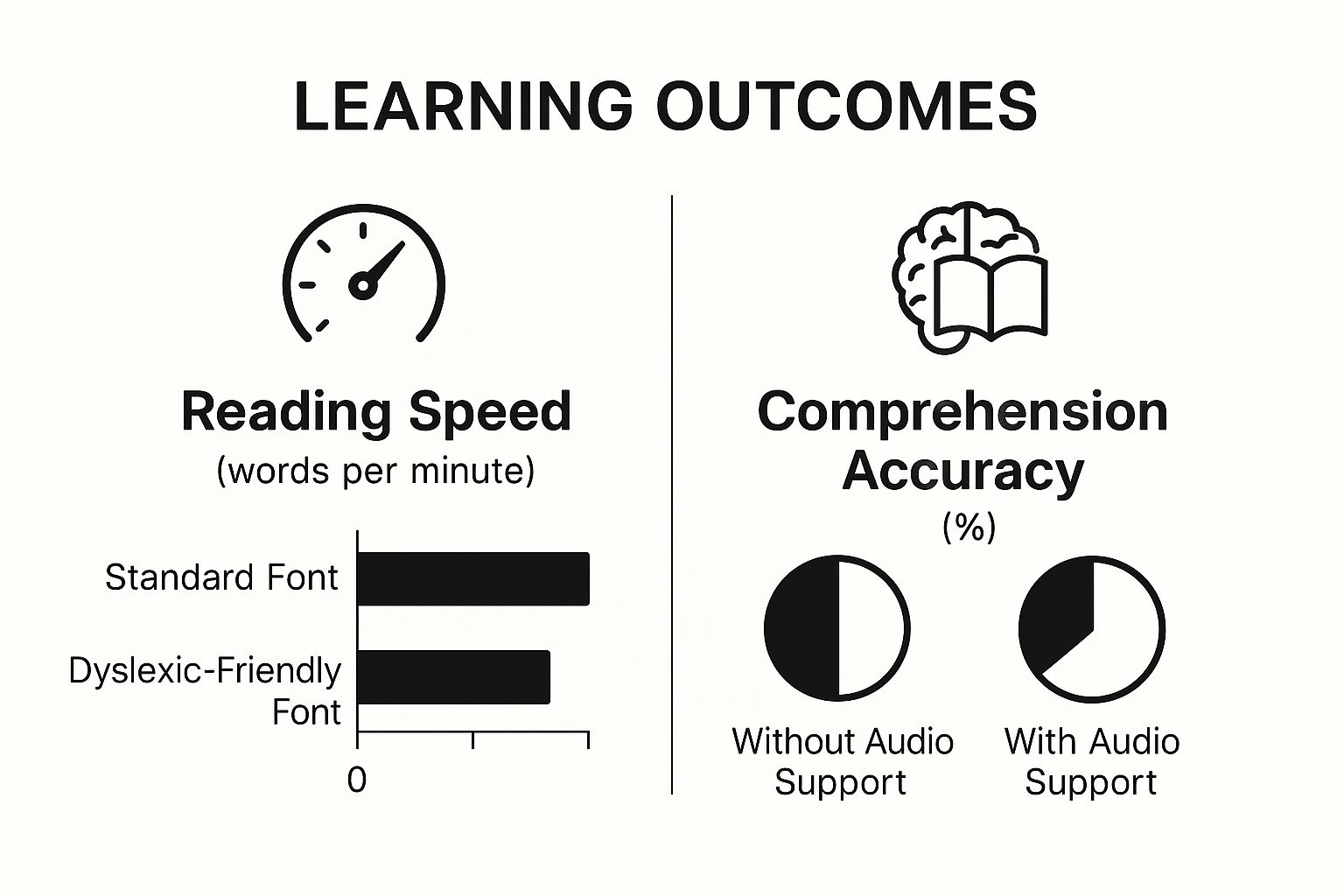
The numbers make it clear: these thoughtful design choices lead to a measurable improvement in both how fast and how accurately someone can read.
To help you spot these books in the wild, here’s a quick comparison of what to look for versus what you’d find in a standard book.
Key Features of Dyslexia-Friendly Books
| Feature | Standard Book Format | Dyslexia-Friendly Format |
|---|---|---|
| Paper Colour | Bright white, often with high contrast and glare. | Off-white, cream, or matte to reduce visual stress. |
| Font Style | Serif fonts (e.g., Times New Roman) with uniform letter shapes. | Sans-serif, dyslexia-specific fonts with unique letter shapes. |
| Letter Spacing | Tightly packed letters and words, which can blur together. | Increased spacing between letters and words to improve clarity. |
| Line Spacing | Standard spacing, often making lines appear crowded. | Generous spacing between lines (1.5 or more) to guide the eye. |
| Paragraphs | Long, dense blocks of text that can be overwhelming. | Short, digestible paragraphs with frequent breaks. |
| Text Alignment | Justified text, creating uneven word spacing ("rivers of white"). | Left-aligned text with a ragged right edge for consistent spacing. |
| Illustrations | Can be placed anywhere, sometimes interrupting the text flow. | Often placed opposite the text to avoid visual distraction. |
Looking out for these features can make all the difference in finding a book that supports, rather than frustrates, a developing reader.
Simply put, a dyslexia-friendly book is one where every design element—from the colour of the paper to the space between the lines—is chosen with the reader's cognitive load in mind. It's about removing obstacles so the reader can focus on the best part: the story.
The Real Impact of Accessible Reading
Choosing the right books for dyslexia makes a difference that goes way beyond simply helping a child to read. Imagine the constant, draining struggle a child with dyslexia faces with a standard book. When you hand them one they can finally read without that fight, the boost to their self-esteem is enormous. It's a game-changer for their mental wellbeing.
This simple switch helps to dial down the anxiety and frustration that so often get tangled up with schoolwork. Instead of feeling like they’re failing, they get to feel a sense of accomplishment. This nurtures a much more positive and resilient mindset, helping them see themselves as a capable learner, not someone defined by their challenges.
Nurturing Mental Wellbeing Through Stories
Once reading is less of a battle, a child can actually get lost in the story itself. This is where the real magic happens. They start picking up new words, their natural curiosity sparks to life, and they begin to build critical thinking skills by exploring new worlds and different points of view.
Sadly, reading for pleasure is on a steep decline. Here in the UK, only about one in three children aged 8 to 18 say they enjoy reading in their spare time, a figure that's dropped sharply since 2005. For children with dyslexia, this trend really shines a light on how urgently we need inclusive books that can reignite that spark.
Providing inclusive and engaging books is one of the most powerful ways we can support our children's emotional health. It ensures they feel capable and confident in their learning journey, which is a cornerstone of positive mental wellbeing.
The Broader Impact on Confidence and Health
There's a very real connection between struggling to read and a child's mental health. Facing constant difficulty at school can easily lead to feelings of inadequacy, social anxiety, and a general reluctance to even join in with class activities. Shockingly, around one in five children in the UK have a probable mental health condition. By tackling reading problems at its root with accessible books, we can help dismantle these negative feelings before they take hold.
The pressure is intensified by the world we live in. Social media, for instance, can create a constant feeling of comparison and pressure to be perfect, which is especially tough for children already feeling insecure about their learning.
Even simple relaxation techniques can help manage the anxiety that often comes with learning challenges:
- Mindful Breathing: Just taking a few slow, deep breaths before opening a book can really help calm the nervous system. For example, try "box breathing": breathe in for four seconds, hold for four, breathe out for four, and hold for four.
- Short Breaks: Encourage them to take frequent breaks to stretch or do something fun for a few minutes.
- Positive Affirmations: Using simple phrases like "I am a clever and capable learner" can help reframe negative thought patterns. Seeing these messages on mental health apparel, like a t-shirt or wristband, can also be a positive daily reminder.
Ultimately, it’s all about building a supportive environment where children feel safe to learn at their own pace.
Please remember, while this advice can be helpful, I am not a mental health professional. If you are worried about your child’s mental health, it is essential to seek help from your doctor or a qualified professional for guidance and support.
How To Choose The Perfect Book
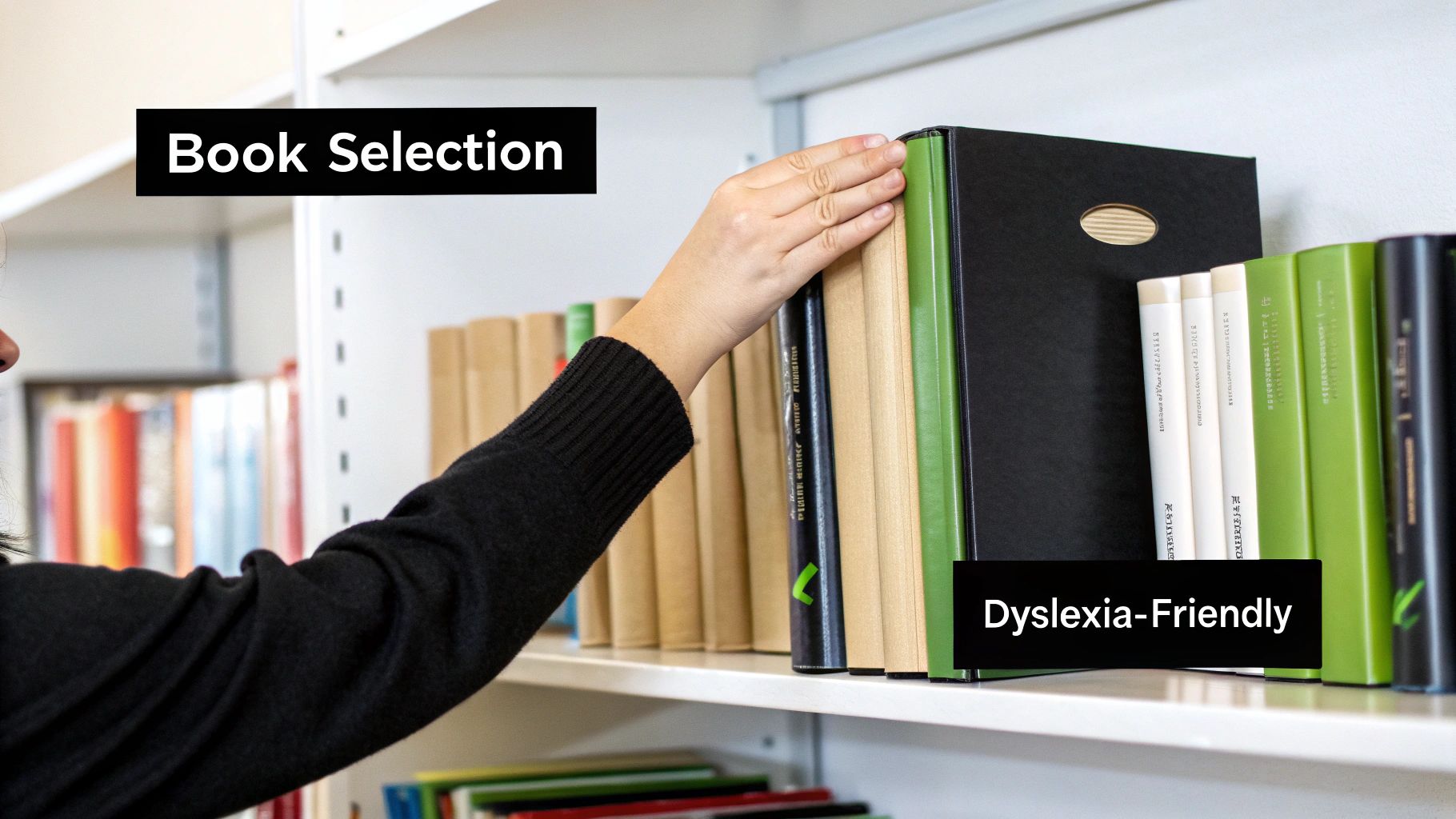
Trying to find books for dyslexia that your child will genuinely love can sometimes feel like an impossible task. But the secret to getting it right is actually pretty simple: just follow their lead. A book about their favourite video game, a creature they’re fascinated by, or a hobby they can’t get enough of will always win out over something that feels like homework.
When a child is truly invested in the topic, their desire to overcome reading hurdles goes through the roof. It’s what turns reading from a chore into a real pleasure. And it’s not just a gut feeling; research shows that when children get to choose books they’re passionate about, their understanding and engagement skyrocket.
It’s a brilliant reminder that letting interest guide learning isn’t just a nice thought—it’s a seriously effective strategy. One study found that when children pick their own books, their quiz accuracy can jump to an impressive 94%, even when the book is technically above their reading level. You can find more insights on this at Renaissance UK.
Putting the power of choice in your child's hands is one of the best things you can do to help them become a happy, confident reader.
Practical Strategies For Finding Great Books
Knowing where to start your search can make all the difference. Instead of wandering aimlessly through a bookshop feeling overwhelmed, a more focused approach will help you pinpoint titles that are both exciting and accessible.
Here are a few practical ideas to get you going:
- Explore Specialist Publishers: Keep an eye out for UK-based publishers who really know their stuff. Barrington Stoke, for instance, is brilliant at creating high-quality, dyslexia-friendly books with fantastic stories that never feel dumbed down.
- Talk to a Librarian: Your local or school librarian is your secret weapon! They’re often experts on accessible reading collections and can give you personalised recommendations based on your child’s specific interests and reading ability.
- Use Curated Online Lists: Lots of trustworthy websites and literacy charities put together lists of recommended books for dyslexia. These can save you a mountain of time and introduce you to brilliant authors you might have otherwise missed.
Matching Books To Different Ages
Of course, the right book for a six-year-old is going to look very different from what a teenager wants to read. As your child grows, their needs and tastes will change.
For younger kids, books packed with illustrations are a fantastic starting point. The pictures offer vital context clues that reinforce the text, helping them follow the story and build up their confidence. Plus, the vibrant visuals just make the whole experience more fun and a lot less intimidating.
As they head into their teenage years, their interests will naturally become more mature, but they might still benefit from text that’s straightforward to process. This is where high-interest, low-vocabulary (hi-lo) books are an absolute game-changer. These books tackle more grown-up themes and complex plots but are written with simpler language and clear formatting, respecting their intelligence while supporting their reading needs.
When hunting for that perfect book, many parents also think about how it can help build their child's vocabulary. It's worth looking into good vocabulary books that can sit alongside their other reading.
Ultimately, reading is also an incredible way to build emotional literacy. Exploring stories about feelings can be a powerful tool for wellbeing, which is why a good collection of mental health books can be invaluable. To explore this idea further, check out our article on the power of reading mental health books.
Top Dyslexia-Friendly Books for Every Age
To help you get started, we've put together a list of some fantastic, engaging books that have been specifically chosen with dyslexic readers in mind. Think of it as a handy shortcut to save you time and help you make confident choices on your next trip to the library or bookshop.
We’ve broken our recommendations down by age group and explained exactly what makes each book work so well. It might be the publisher's thoughtful formatting, a gripping plot that keeps a reader hooked, or characters they can really connect with. Whatever the reason, these titles are tried-and-true winners.
For Ages 5-8
At this age, the main goal is simply to make reading feel like a fun and positive adventure. Books that use strong visual storytelling, rhyme, and repetition are absolutely brilliant for building those early skills without causing any frustration.
- Meet the Dyslexia Club! by Margaret Rooke: This is a wonderful book that celebrates the unique talents of children with dyslexia. It introduces a group of young characters who share their challenges but, more importantly, show off their amazing strengths in things like storytelling, art, and problem-solving. It’s even printed on dyslexia-friendly paper, helping kids feel understood and a little less alone.
- The Frog and Toad series by Arnold Lobel: These classic stories are just perfect for early readers. The sentences are simple, the humour is gentle, and the clear illustrations provide fantastic support. It all comes together to let children follow the story with ease and build up their confidence.
These kinds of titles offer a fantastic way in, helping young children forge a happy relationship with books from the very beginning.
For Ages 9-12
As kids head towards their pre-teen years, they start looking for more complex stories and characters they can see themselves in. This is where high-interest, low-vocabulary (hi-lo) books really shine, offering mature themes without overwhelming readers with dense text.
- Fish in a Tree by Lynda Mullaly Hunt: This is a really powerful story about a bright, creative girl who has managed to hide her struggles with reading. It’s a deeply moving and relatable book that explores feelings of inadequacy and the importance of asking for help, making it a brilliant choice for building empathy and self-acceptance.
- Percy Jackson & The Lightning Thief by Rick Riordan: The hero of this series, Percy, has both dyslexia and ADHD, which are cleverly reframed as the signature traits of a demigod. The plot is packed with action and the chapters are short and punchy, keeping readers totally engaged and turning reading into an exciting quest rather than a chore.
Finding stories where characters face similar struggles can be incredibly validating for a child. It reinforces the message that dyslexia is a different way of thinking, not a barrier to being a hero.
For Teens
Teenagers need books that respect their intelligence and speak to their own experiences. Dyslexia-friendly titles for this age group often feature compelling plots and sophisticated themes, just presented in a more accessible way.
- Books from Barrington Stoke: This UK publisher is the gold standard for dyslexia-friendly fiction. They work with leading authors to create brilliant, age-appropriate stories printed with their unique font, generous spacing, and on gently tinted paper. Their teen collection has it all, from page-turning thrillers to contemporary fiction.
Choosing the right book can make all the difference. For more ideas, you can explore our other children's books recommendations to find even more stories your child will get lost in.
Your Questions About Dyslexia-Friendly Reading
Taking the first steps into the world of accessible reading can feel a bit overwhelming, and it’s natural to have questions. Let’s tackle some of the most common practical concerns that parents and teachers have when trying to find and use books for dyslexia.
Where Can I Find Dyslexia-Friendly Books in the UK?
Thankfully, finding these books is much easier than it used to be. Many high-street bookshops and local libraries now have dedicated sections for accessible reading, so it's always worth asking.
Specialist publishers like Barrington Stoke are a brilliant starting point; their entire catalogue is designed from the ground up with dyslexic readers in mind. You can also find curated lists and buy direct from online retailers and the websites of literacy charities.
It’s so important to remember that addressing reading difficulties early can stop long-term issues from developing, especially when it comes to a child's mental health. Persistent struggles at school are closely linked to anxiety in children, making these accessible books a crucial tool for emotional wellbeing as well as literacy. Addressing mental health early is vital for a child's overall development and future happiness.
Are These Books More Expensive?
Not usually, no. In general, dyslexia-friendly books are priced much like any other new paperback. While you might find some specialist editions cost a little more because of their specific design and printing needs, the difference is typically very small.
And don't forget, libraries are a fantastic, cost-free way to access a huge range of these titles.
When you think about the long-term cost of unaddressed mental health challenges, which can often stem from learning difficulties, the investment is tiny. For example, poor mental health in the UK workforce costs businesses up to £56 billion a year. Helping a child build their confidence and skills early is one of the most proactive things we can do for their future.
Can Audiobooks and E-Readers Help?
Absolutely! They can be a total game-changer. Audiobooks are a wonderful way for a child to enjoy stories without the stress of decoding text, helping them build up their vocabulary and comprehension skills along the way. It lets them experience the pure joy of a good story, which can be the perfect motivation to tackle the print version later on.
E-readers are also incredibly helpful. Most of them have features that let you change the font, increase the spacing between lines, and even alter the background colour. This flexibility can effectively turn almost any e-book into a more dyslexia-friendly format.
Disclaimer: It's vital to remember that I am not a mental health professional. This guide is for informational purposes only. If you are worried about your child's mental health or wellbeing, please seek advice from your GP or a qualified professional.
Finding the right support is all about building a positive, happy relationship with reading. With a bit of gentle encouragement, celebrating the small wins, and using a mix of different formats, you can help transform reading from a source of frustration into a lifelong pleasure.
At Little Fish Books, we are passionate about providing resources that support a child's emotional growth and confidence. Explore our curated collection of mental health books and mental health apparel to help nurture a positive mindset on their learning journey. Visit us at https://thatsokay.co.uk to find the perfect tools for your family.