
Feelings Wheel for Kids: How to Use One at Home and in the Classroom
Share
A feelings wheel is a simple circle divided into sections, each showing a different feeling. Children turn it, point to it or colour it in to show how they feel. It is one of the easiest tools for helping young children name their emotions, and it works just as well on the fridge at home as it does in a classroom calm corner.
What is a feelings wheel?
Adult feelings wheels can have dozens of words arranged in rings. For children aged 3 to 8, simpler is better: a handful of clear feelings, each with a face or character, so children can recognise the feeling even before they can read the word. Common feelings to include are happy, sad, angry, worried, excited, calm, scared, proud and confused.
Why feelings wheels help children
- They give children the words. Many meltdowns happen because a child can't explain what they feel. Pointing to a picture is much easier than finding a word in the moment.
- They show that feelings change. Turning the wheel reminds children that feelings come and go, and that no feeling lasts forever.
- They make talking about feelings normal. Using the wheel every day turns feelings into an everyday topic, not something that only comes up when things go wrong.
- They support children with SEND. Visual tools are especially helpful for autistic children and children with speech and language needs.
How to use a feelings wheel at home
- Morning check-in. Ask "Where are you on the wheel today?" over breakfast.
- After school. Children often can't answer "How was your day?", but they can point to a feeling.
- Bedtime. Talk about which feelings came up today and what helped.
- In the moment. When a big feeling hits, offer the wheel before words. Once the feeling is named, move on to something calming, like slow breaths.
How to use a feelings wheel in the classroom
- Morning registration. Children place a peg or name card on their feeling as they arrive. It's a quick way to spot who might need a quiet word.
- Circle time. Turn the wheel and talk about a time you each felt that way.
- Calm corner. Keep a wheel in your calm space so children can identify how they feel before choosing a calming strategy.
- Stories. Stop during a story and ask how a character might feel, using the wheel to choose.
Tips for success
- Model it yourself: "I'm feeling a bit worried today because..."
- Accept every answer. There's no wrong feeling, and every feeling is okay.
- Keep it where children can reach it and use it on their own.
- Pair it with a simple next step, like a breathing card or a hug, so naming a feeling leads to feeling better.
A printable feelings wheel for kids
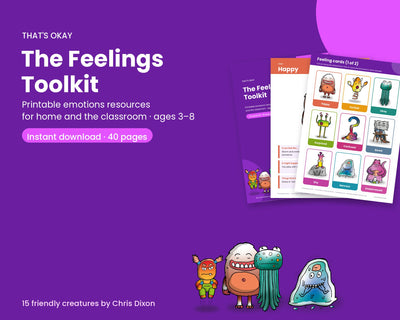
The That's Okay Feelings Wheel is an instant PDF download starring the 15 friendly feelings creatures from the That's Okay picture books, designed for ages 3 to 8. It includes a colour wheel with all 15 creatures, a top cover with a window so one feeling shows at a time, pointer arrows as an easier option for little ones, a colour-your-own wheel where children draw a creature for each feeling, and a feelings wheel check-in worksheet. All you need is card, scissors and a split pin. Print it on A4 or US Letter for home or the classroom.
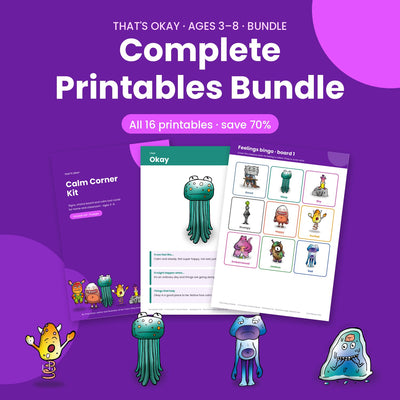
Want a full set? The Complete Printables Bundle includes the Feelings Wheel alongside posters, check-in charts, feelings cards, bingo and more. Buying for a whole school? See our resources for schools. Or try the free Feelings Starter Pack first.