How to Help a Child Name Their Emotions: 7 Simple Ideas for Home and School
Big feelings are hard for young children. Anger, worry, jealousy and embarrassment can all feel the same from the inside: overwhelming. When a child doesn't have the words for what is happening, the feeling often comes out as a meltdown, a slammed door or complete silence.
Helping a child name their emotions is one of the most useful things we can do. Once a feeling has a name, it becomes something you can talk about together instead of something that just happens. These are the ideas I've seen work best with families and schools who use the That's Okay books.

1. Give every feeling a face
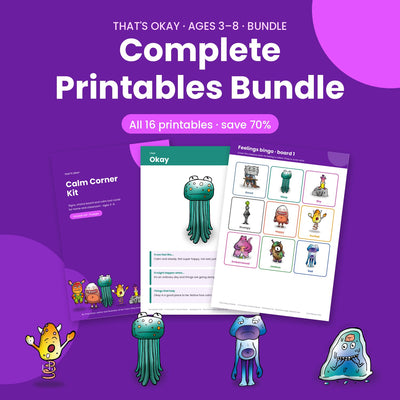
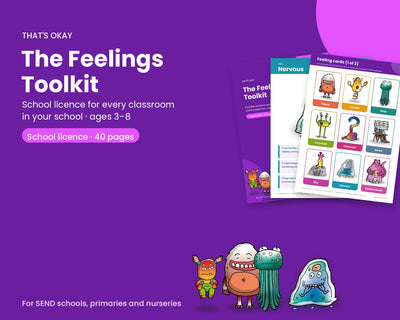
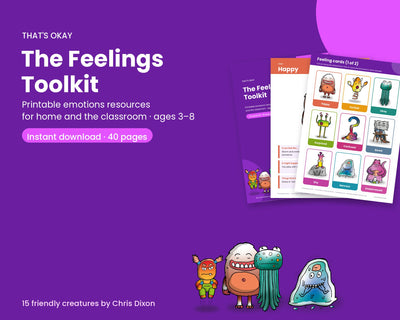
Abstract words like "frustrated" or "anxious" mean little to a four-year-old. A picture does. That's why the That's Okay books give each of 15 feelings its own creature, from Happy and Sad to Nervous, Jealous and Embarrassed. A child who can't say "I feel nervous" can often point to the nervous creature.
2. Name your own feelings out loud
Children learn most by watching us. Try narrating your own feelings in simple words: "I'm feeling a bit grumpy because we're running late. I'm going to take a big breath." It shows that adults have feelings too, and that there is always something you can do about them.
3. Say that every feeling is okay
There are no bad feelings, only difficult ones. Being angry is okay. Hitting isn't. Separating the feeling from the behaviour helps children stop hiding what they feel. Every page of That's Okay ends with the same line, "and that's okay", and children quickly start saying it along with you.
4. Try a two-minute daily check-in
Once a day, ask "Which creature are you today?" and let your child point or choose from a chart. It takes two minutes at breakfast, after school or at bedtime. Over a few weeks you'll notice patterns, and your child gets lots of low-pressure practice. The Feelings Check-In Chart that comes with the Complete Feelings Collection is made for exactly this.
5. Read together, then ask one question
Picture books are a gentle way into feelings because the character is having the feeling, not your child. After reading, ask one open question: "When have you felt like that?" or "What helps you when you feel like this?" Then listen. There's no need to turn it into a lesson.
6. Use colouring and drawing
Some children find it easier to talk while their hands are busy. Colouring in a creature and writing or saying how it feels is a calm way to open a conversation. The That's Okay colouring book pairs each creature with prompts about how you might feel and what you might do.
7. Build a calm-down routine
Naming a feeling is the first step. The second is knowing what to do next. Simple breathing ("breathe in… and out…"), a quiet corner or a hug all help. Our guide to calming breathing exercises for kids has some easy ones to try.
Where to start
Pick one idea and do it every day for a week. Small, regular moments matter far more than one big conversation. If you'd like to see the books first, you can download free previews here.
Want everything in one place? See The Complete Feelings Collection: 4 picture books, the colouring book, a Parent & Teacher Guide and instant digital extras, with free UK delivery.