
How to Help a Child With Anger: Calm-Down Strategies That Work
Share
Anger is one of the biggest feelings young children have, and one of the hardest for adults to sit with. A child who is shouting, hitting or throwing things isn't choosing to be difficult. Their body has been flooded by a feeling they don't yet have the tools to manage. The good news is that those tools can be taught, and small, repeated practice makes a real difference.
This guide covers why children get angry, what to do in the moment, and the calm-down strategies that work best for children aged 3 to 8, at home and in the classroom.
Why young children get so angry
Anger usually sits on top of another feeling. A child who explodes at bedtime may be tired. A child who kicks off after school may be overwhelmed, hungry or worried about something that happened at lunch. Anger is often the feeling that shows, while disappointment, embarrassment, jealousy or fear sit underneath.
Young children also have a thinking brain that is still developing. When a big feeling hits, the part of the brain that plans, reasons and remembers the rules goes offline for a while. That's why talking or reasoning in the middle of a meltdown rarely works. Calming the body has to come first.
What to do in the moment
- Keep everyone safe. Move breakable things or other children away if you need to. Safety comes before anything else.
- Stay calm yourself. Lower your voice and slow your breathing. Children borrow our calm before they can find their own.
- Use very few words. "You're really angry. I'm here." is enough. Save questions and lessons for later.
- Name the feeling. Putting a name to anger helps a child start to notice it. A picture or character can help when words are too much.
- Offer one calming choice. "Shall we do dragon breaths together, or squeeze the cushion?" A small choice gives back a bit of control.
- Reconnect afterwards. Once your child is calm, a hug, a drink of water or a quiet moment together repairs the connection.
Calm-down strategies that work for children
The best strategies are simple, physical and practised when a child is already calm, so they're easier to reach for when anger arrives.
- Dragon breaths. Breathe in through the nose, then breathe out slowly like a dragon blowing smoke. Slow out-breaths calm the body quickly.
- Squeeze and let go. Squeeze fists, a cushion or a stress ball as tight as possible for five seconds, then let go and feel the difference.
- Wall push. Pushing hard against a wall gives angry energy somewhere safe to go.
- Stamp it out. Stamping feet or jumping on the spot can help some children release anger physically.
- Count down from ten. Counting slowly gives the thinking brain a moment to catch up.
- A calm space. A quiet corner with a cushion, a soft toy and a few calm-down cards gives a child somewhere to reset. It works best as a helping place, never as a punishment.
Use a feelings thermometer
A feelings thermometer is one of the most useful anger tools for young children. It shows anger as a scale, from a little bit cross at the bottom to really, really angry at the top. Children point to how big their feeling is, then choose a strategy that matches.
Our guide to the anger thermometer for kids explains the five levels in more detail, with a free printable thermometer and calm-down plan.
It teaches two important ideas. First, anger comes in sizes, and it's easier to calm a small feeling than a huge one. Second, there's something you can do at every level. Over time, children start to notice their anger earlier, while it's still small.
Make a calm plan together
A calm plan is a simple, personal list of what helps. Make it together when your child is calm, and keep it somewhere easy to see. It might include:
- What anger feels like in my body (hot face, tight fists, fast heart)
- Three things that help me calm down
- Who I can go to for help
- Where my calm space is
Children are much more likely to use strategies they chose themselves. Revisit the plan every few weeks and change anything that isn't working.
What to avoid
- Telling a child to "calm down". They would if they could. Show them how instead.
- Punishing the feeling. Anger itself is okay. It's what we do with it that we can learn to change.
- Long lectures afterwards. Keep the follow-up short: what happened, what we can try next time, and a reminder that you still love them.
When to get extra support
Most anger in young children is a normal part of development. If outbursts are very frequent, very intense, putting anyone at risk or not improving over time, talk to your GP, health visitor or your child's school or nursery. They can help you find the right support.
Printable anger management tools
The That's Okay When I Feel Angry Pack is an instant PDF download with everything above ready to print: angry and grumpy feeling posters, a feelings thermometer ("how big is my feeling, and what can I do?"), four calm breathing cards, a My Calm Plan worksheet and an angry colouring page. It stars the friendly feelings creatures from the That's Okay picture books and is designed for ages 3 to 8.
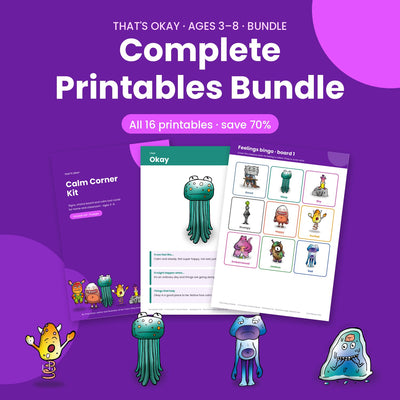
For a full calm space, see the Calm Corner Kit, or get every pack at once in the Complete Printables Bundle. You can also start with the free Feelings Starter Pack.