
How Interactive Books for Children Build Emotional Wellbeing
Imagine a child grappling with a whirlwind of big feelings they don't yet have the words for. Now, picture them finding a safe, gentle space to explore those very emotions, right inside the pages of an interactive book. These aren't just toys; they are incredibly powerful tools for building emotional literacy and wellbeing from the ground up.
The Gentle Power of Interactive Reading
Here in the United Kingdom, conversations around children's mental health are, quite rightly, becoming more urgent. Parents and educators are all looking for practical, supportive ways to nurture emotional resilience right from the start. This is exactly where interactive books for children come in, offering a gentle yet surprisingly effective approach. They transform reading from a quiet, passive activity into an active, hands-on experience.
These books give children a unique chance to touch, feel, and even influence a story. This makes abstract ideas like empathy, anxiety, or friendship feel real and manageable. When a child lifts a flap to see a character's expression change, or chooses a path for a hero facing a tough choice, they’re learning that feelings are normal and that their own choices matter. This simple process builds a vital foundation for emotional intelligence.
Why This Matters Now
The challenges our young people face today are immense. From the pressures of social media to everyday worries at school, children need a strong emotional toolkit more than ever. The impact of poor mental health isn't just personal; it has a significant economic cost. A 2022 Deloitte report found that poor mental health costs UK employers up to £56 billion a year. By fostering emotional wellbeing from childhood, we are investing in a healthier, more productive future workforce.
- Growing Concerns: An eye-opening one in five children and young people in England aged eight to 25 had a probable mental health condition in 2023. Early support is absolutely crucial to prevent these challenges from escalating.
- A Safe Starting Point: Books create a low-pressure space to talk about difficult feelings. A story about a nervous little bear can be the perfect bridge to a conversation about a child's own worries. For example, you could say, "Barnaby Bear is worried about starting school. Do you ever feel wobbly like that?"
- Building Connections: Sharing an interactive book is a powerful way to bond. It becomes a moment of shared discovery and a simple relaxation technique for both parent and child. If you'd like to dive deeper, you can explore the other benefits of reading in our detailed guide.
This guide is here to offer practical support and ideas for parents, caregivers, and educators. It's important to remember that I am not a mental health professional. If you have serious concerns about a child's mental health, please seek advice from your GP or another qualified professional.
Throughout this article, we'll explore the different kinds of interactive books, how to pick the right ones for every age, and how you can weave them into your daily routine to foster lifelong emotional wellbeing.
So, What Kinds of Interactive Books Are Out There?
When we talk about "interactive books for children," we're not talking about just one thing. It's a whole world of different formats, all built around one big idea: inviting a child into the story, not just letting them watch from the sidelines.
An interactive book turns the page from a flat surface into a playground of possibilities. It asks a child to do something—to touch, to choose, to discover. And when they get hands-on, the story's lessons really sink in.
While these books add exciting new layers, they still share the foundational parts that make up any book. Understanding these basics can give you a real appreciation for how cleverly book design has evolved to help our little ones learn and grow.
Simple Sensory Books for Early Years
For the tiniest of readers, interaction starts with the senses. These books are made to be explored by little hands, helping them connect physical actions with simple ideas and feelings. They are truly the building blocks of emotional literacy.
-
Lift-the-Flap Books: A classic for a reason. Lifting a flap might reveal a character's changing expression, teaching cause and effect in a way that’s all about emotions. A sad face hidden behind a pair of hands shows a child that feelings can sometimes be hidden, and then shared.
-
Touch-and-Feel Books: These books bring feelings to life with different textures. A soft patch of fur on a friendly animal or a rough, scratchy spot on an angry monster gives emotions a tangible quality. This is brilliant for helping toddlers connect abstract ideas like comfort or frustration to physical sensations.
This simple map shows just how central books are to a child's development, bridging literacy, feelings, and overall wellbeing.
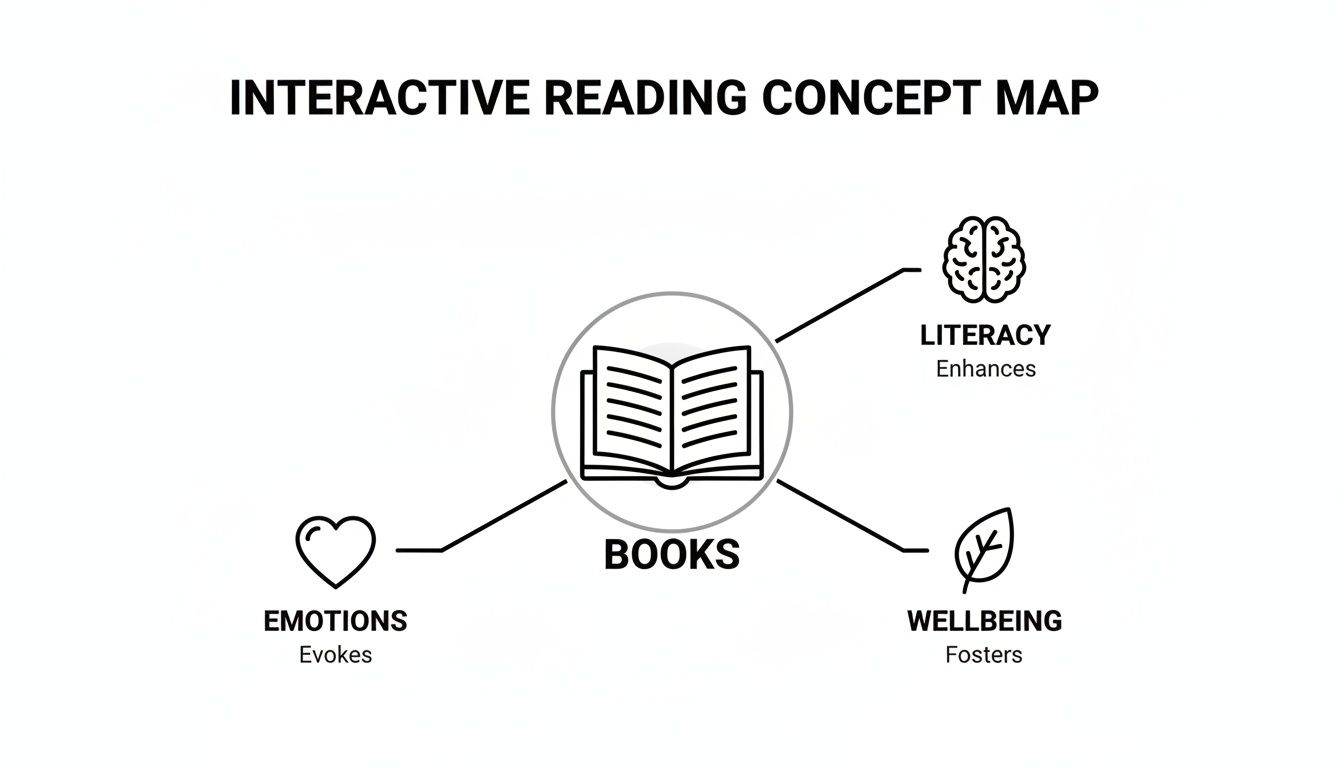
As you can see, reading isn't just about learning words; it’s a hub where emotional intelligence and a sense of wellness are nurtured.
Advanced Formats for Growing Minds
As children get older, their ability to grasp complex emotions grows right along with them. Interactive books evolve too, offering more sophisticated ways to engage with characters' problems and choices. These formats let children practise empathy and problem-solving in a safe, guided space.
This desire for more immersive reading isn't just a feeling; it's a huge market trend. In the UK, the personalised children's books market—which often features interactive elements—was valued at USD 160.43 million in 2024 and is expected to hit USD 253.88 million by 2032. It seems parents are actively looking for better tools to get their kids engaged, especially with recent dips in student reading engagement.
An interactive book gives a child agency. When they choose a path for a character, they are not just reading a story; they are learning that their decisions have outcomes and that they can help guide others through difficult moments.
Digital and Path-Driven Narratives
The next level of interactive storytelling often brings in technology or complex branching narratives that put the child firmly in the driver's seat. These books are fantastic for older children ready to navigate more nuanced social situations.
The table below breaks down how different interactive book types can specifically support a child's emotional growth.
Interactive Book Formats and Their Emotional Benefits
| Book Type | Description & Examples | Primary Benefit for Emotional Literacy |
|---|---|---|
| Tactile Books | Lift-the-flap, touch-and-feel, pop-up books. | Connects abstract feelings to physical sensations, teaching cause and effect (e.g., a rough texture for anger). |
| Choose-Your-Own-Path | Print or digital books where the reader makes choices that change the story's outcome. | Teaches consequences and perspective-taking. Children see directly how different choices lead to different emotional results. |
| Augmented Reality (AR) Books | Physical books that come to life with a smart device, creating interactive 3D animations or activities. | Makes coping strategies active and memorable. A child can interact with a character to practise breathing exercises. |
Each of these formats is designed to meet children where they are, giving them the right tools at the right time. Here’s a closer look at a couple of the more advanced types:
-
Choose-Your-Own-Path Books: These stories stop at key moments and ask the reader, "What should the character do next?" This is a brilliant way to teach consequence, resilience, and seeing things from another's point of view. A child learns that kindness can lead to a happier ending, and they can always go back and try again if a choice doesn't work out.
-
Augmented Reality (AR) Books: By blending a physical book with a smartphone or tablet, AR books make characters and scenes pop right off the page. A child could use the device to help a character practise calming breathing exercises, turning a wellness strategy into an active, unforgettable experience. To see this in action, you can read more about how an augmented reality experience can support mental health in our related article.
From the simplest textured patch to a complex digital choice, each of these formats plays a vital role in helping children understand their own feelings and the big, complicated feelings of others.
How These Books Support Your Child's Mental Wellbeing
Beyond teaching colours, numbers, and the alphabet, interactive books for children play a much deeper, more vital role. They serve as gentle guides into the often-confusing world of emotions, giving children the tools they need to understand themselves and connect with the people around them. This isn't just about learning to say "happy" or "sad"; it's about building a solid foundation for lifelong mental wellbeing.
The early years are a critical window for developing what's known as emotional literacy—the ability to recognise, understand, and talk about our feelings. An interactive story provides a safe, contained space where a child can practise these skills without any real-world pressure. They can explore what it feels like to be brave, nervous, or kind, all from the comfort of a loved one's lap.
This early support is more important now than ever. In the UK, concerns over children's mental health are on the rise, with a 2021 study identifying one in six children aged 5 to 16 as having a probable mental health problem. Providing tools that build emotional resilience from a young age is one of the most proactive and supportive things we can do, especially as it is estimated that 75% of mental health problems are established by the age of 24.
Building Empathy One Page at a Time
Empathy is our ability to understand and share what someone else is feeling. Interactive books are brilliant at nurturing this skill because they don't just tell a child how a character feels—they invite the child to step directly into that character's shoes.
When a story asks, "What should Leo do now that he feels left out?", it nudges your child to genuinely consider someone else's emotional state. They're no longer just a spectator; they become an advisor, a friend, a helper. This active participation helps them connect with the character's dilemma on a much more meaningful level.
Imagine a book with a character who's anxious about their first day at school. Through interactive elements, your child might help them pack their bag or choose a comforting toy to bring along. By doing this, they are actively taking part in a coping strategy, which makes the idea of managing anxiety feel tangible and much less frightening. A practical example would be a story that prompts the child to trace a 'calm-down spiral' on the page alongside the character, practising a real-world relaxation technique.
By guiding a character through a challenge, children learn that they have the power to make a positive difference in someone else's emotional state. This is the very heart of empathy in action.
A Safe Vocabulary for Big Feelings
One of the biggest hurdles for little ones is finding the right words for their powerful, overwhelming emotions. An interactive book can act as a translator, offering a simple, accessible vocabulary for complex feelings like frustration, jealousy, or disappointment.
The story provides the labels, and the interactive parts link those labels to specific actions and consequences. This connection is vital. It shows that feelings aren't just abstract things that happen to you; they are experiences you can name, understand, and, eventually, learn to manage.
- Naming Emotions: A book might feature a "feelings wheel" to spin or flaps that reveal different facial expressions, helping a child put a name to what they're feeling.
- Understanding Triggers: A choose-your-own-path story can clearly show how one action leads to a character feeling sad, while a different choice leads to them feeling proud.
- Learning Coping Skills: Interactive elements can guide a child through a simple breathing exercise alongside a character who is feeling overwhelmed. A useful tip is 'Square Breathing': breathe in for four, hold for four, breathe out for four, hold for four, just like tracing the sides of a square.
This whole process gives children a script they can start to use in their own lives. Instead of a tantrum born from pure frustration, they might eventually be able to say, "I feel cross like the little bear in our book." That's a huge step forward in emotional regulation.
Creating Moments of Calm and Connection
Finally, the simple act of sharing an interactive book is a powerful relaxation technique in its own right. In a world buzzing with distractions, sitting down together to focus on a shared story creates a quiet, pressure-free space. The focused, hands-on activity can lower stress for both child and adult, strengthening your bond.
This shared experience provides a powerful buffer against modern pressures, including the often-overwhelming influence of social media that children will encounter later. Building this foundation of open communication and emotional security at home is one of the best ways to prepare them for future challenges. Remember, I am not a mental health professional. If you are worried about your child's wellbeing, it is always best to speak with a doctor or another qualified expert.
Choosing the Right Interactive Book for Your Child
Picking out the perfect interactive book for children can feel like a massive task, but honestly, it’s simpler than it looks. The secret is to think beyond just their age and really consider where they are developmentally and what they need emotionally. A book that has a toddler mesmerised might not hold the attention of a seven-year-old, and that’s exactly how it should be.
This guide is here to help you navigate the shelves – whether in a bookshop or online – to find stories that will genuinely connect with your little one. We’ll look at what works best for different age groups and how to choose books that help with specific life lessons, from handling big feelings to figuring out what it means to be a good friend.
It’s no surprise that these wonderful resources are becoming more popular. The UK’s interactive children’s book market is part of Europe’s leading market share and is set to grow at a 7.8% CAGR from 2025 to 2035. This is partly because we’re all becoming more aware of children's mental health. With NHS data showing that 1 in 8 children aged 5-19 had a mental health disorder in 2023, the need for books that open up conversations about emotions has never been greater. You can find more insights into this growing market and its connection to emotional wellbeing.
Books for Toddlers (0-2 Years)
At this very early stage, it’s all about the senses. A toddler learns about their world by touching, seeing, and hearing everything they can get their hands on. The best books for this age group are tough, straightforward, and focus on the absolute basics of concepts and feelings.
Think sturdy board books that can handle being grabbed, chewed on, and having their pages turned with more enthusiasm than grace. The aim here is to make reading a fun, positive, sensory adventure.
- Format Focus: Go for touch-and-feel books with different textures (soft fur, scratchy sand, bumpy patterns) or simple lift-the-flap books with big, easy-to-grab flaps. These are fantastic for building fine motor skills and teaching the simple magic of cause and effect.
- Content Themes: Keep it simple with core emotions like happy, sad, or surprised. Books with clear, expressive faces are brilliant for helping toddlers connect a feeling with a facial expression. Animal sounds and simple rhymes are also guaranteed to keep their attention.
- Durability is Key: Board books are a must. Paper pages will get torn, which can lead to frustration and make them think books aren't much fun.
Books for Pre-schoolers (3-5 Years)
Pre-schoolers are starting to get their heads around more complicated social situations, and their imaginations are absolutely blossoming. They can follow a simple story and are beginning to understand that other people have feelings that might be different from their own. The right interactive book can be an amazing tool for exploring this new social world.
At this age, you can start moving past basic sensory books to ones that encourage a bit more thought and decision-making. This can include a whole range of children's picture books that often weave in interactive elements.
Choose books that invite your pre-schooler to be part of the story. Maybe it asks them to spot things on the page, make a choice for a character, or press a sound button to add to the atmosphere.
- Format Focus: Look for books with slightly more intricate pop-ups, sliding tabs, or simple choose-your-own-path options where the consequences are clear. Books with reusable stickers that let them build their own scenes are also a huge hit.
- Content Themes: This is the perfect time to introduce stories about making friends, learning to share, being kind, or feeling a bit jealous. Stories that show characters working through a small problem are particularly powerful.
Books for Early School-Aged Children (6-8 Years)
Children in this age group are dealing with much more complex social dynamics at school and can understand more subtle emotional journeys. They have the attention span for longer stories and are ready to think a bit more deeply about why a character is acting a certain way.
For this stage, interactive books for children can help them build resilience and problem-solving skills. Look for stories that mirror the kinds of challenges they might be facing themselves, like navigating disagreements with friends or feeling anxious about school.
- Format Focus: Choose-your-own-adventure books with multiple story paths are perfect for this age. Activity-based books that include space for journaling, drawing prompts, or puzzles related to the story's themes are also excellent choices.
- Content Themes: Friendship troubles, managing anger, building confidence, and understanding empathy are all fantastic topics. Books that gently introduce ideas like mindfulness or simple coping strategies can give them practical tools they can use every day.
- Accessibility Matters: Always keep your child's unique needs in mind. For a visual learner, a book with detailed illustrations or AR features could be perfect. For a child with sensory sensitivities, a clean, uncluttered layout without too many textures might be a much better fit. The goal is to make reading an enjoyable and empowering experience for every single child.
Bringing Interactive Reading into Your Daily Routine

Knowing which interactive books for children to pick is one thing, but weaving them into the fabric of everyday life is where the real magic happens. It’s not about grand gestures or complicated lesson plans. It’s about creating small, consistent rituals that transform reading from a task into a moment of genuine connection.
For parents, teachers, and therapists, these books are so much more than stories. They’re practical, gentle tools for nurturing emotional intelligence. By making them a regular feature, you create a reliable safe space for children to explore feelings, practise empathy, and learn vital coping skills they’ll carry with them for life.
The goal is simple: turn story time into a meaningful check-in, a moment where a child feels heard, understood, and supported. That consistency is what builds strong relationships and a foundation of emotional resilience.
Practical Tips for Parents at Home
Creating a reading routine at home can be an incredibly powerful way to reconnect with your child after a busy day. It offers a pocket of calm and a chance to gently unpack the day's highs and lows through the lens of a shared story.
Think of it as a shared relaxation technique. The simple act of focusing on a book together can lower stress for both of you and provides a welcome break from screens. This quiet time is invaluable for a child’s mental wellbeing.
- Create a ‘Feelings Check-In’ Ritual: Bedtime stories are a perfect opportunity to talk about emotions. Try asking something like, "The little bear felt worried today. Did anything make you feel a bit worried at nursery?"
- Role-Play the Dilemmas: If a character faces a choice, why not act it out together? This playful approach helps children understand different perspectives and consequences in a really low-pressure way.
- Link Stories to Real Life: Help them connect the book's themes to their own world. For instance, "Remember when you shared your toys just like the kind fox in this story? That made your friend feel so happy."
Ideas for Educators in the Classroom
For teachers, interactive books for children are a brilliant resource for any Social and Emotional Learning (SEL) curriculum. They provide a narrative hook that makes abstract concepts like empathy or resilience feel concrete and relatable to young learners.
Bringing these stories into the classroom can help you build a more compassionate, supportive culture. When children explore emotional challenges together through a book, it fosters a real sense of community and understanding.
Using an interactive story to start a discussion gives every child a common language to talk about big feelings. It helps normalise emotions and reduces the stigma around asking for help or admitting you're having a tough day.
- Circle Time Storytelling: Use an interactive book as the centrepiece for group discussions about feelings, friendship, and solving problems together.
- Create a ‘Calm-Down Corner’: Stock a quiet area with books that teach mindfulness and coping strategies. This empowers children to find the tools they need independently when they feel overwhelmed.
- Connect to Creative Arts: After reading, get the paints or crayons out. Encourage children to draw how a character was feeling or create their own ending to the story to reinforce the emotional lessons.
Strategies for Therapists and Counsellors
In a therapeutic setting, interactive books can be incredibly gentle, non-threatening tools for opening up difficult conversations. They act as a bridge, allowing a child to explore their own experiences by talking about a character's journey instead of their own.
This method can be especially helpful for children who find it hard to speak directly about their feelings. The story provides a safe distance, making it easier for them to engage with and process challenging emotions.
It’s crucial to remember that while these books are supportive, they are not a substitute for professional help. I am not a mental health professional, and if you have serious concerns about a child's wellbeing, please seek guidance from a doctor or a qualified therapist. They can provide the expert, tailored support your child needs.
Right, let’s wrap this up. Throughout this guide, we’ve dug into what makes interactive books for children so much more than just a good story. They are, in fact, powerful tools for helping our little ones make sense of the big, messy world of emotions.
From the simple delight of a lift-the-flap reveal to the thoughtful decisions in a choose-your-own-path story, every interaction is a building block for emotional intelligence. It’s a safe space for them to put a name to a feeling, find the words to express it, and practise empathy by walking in a character’s shoes for a page or two.
When a child guides a story’s hero through a moment of worry or helps them figure out a friendship puzzle, they’re learning coping strategies they can use in their own lives. This isn’t just reading; it’s hands-on learning for the heart.
Your Role in Their Emotional Journey
Leaning into interactive reading is a gentle, proactive way to support the next generation's mental wellbeing. You’re handing them a toolkit for resilience, kindness, and self-awareness – skills that have never been more important. With growing concerns around children’s mental health here in the UK, creating these small moments of connection is a powerful way to buffer them against future struggles.
Every story you share is another chance to strengthen your bond and open up a conversation. It makes talking about feelings normal and shows children that their inner world is important and worth listening to.
Investing time in shared reading is an investment in your child's lifelong emotional health. It’s a simple, powerful act that reinforces the message that no feeling is too big to talk about and that they are never alone.
As we finish up, I need to restate something really important. While these books are wonderful, supportive resources, I am not a mental health professional. They are designed to support your parenting and teaching, not to replace professional help.
If you have serious or ongoing worries about your child's mental or emotional wellbeing, please chat with your GP, a school counsellor, or a qualified professional. Reaching out for expert advice is a sign of incredible strength and the most loving thing you can do for your child. Your care makes all the difference.
A Few Common Questions
When you're first exploring the world of interactive books for children, it's natural to have questions. Here are some of the most common things parents and educators ask.
At What Age Should I Start Using Interactive Books for Emotional Literacy?
Honestly, you can start right from birth. It sounds early, I know, but simple, high-contrast board books with different textures are fantastic for sensory development. They help create those lovely, positive first experiences with books.
As they grow into curious toddlers, lift-the-flap books that reveal different facial expressions are brilliant for teaching basic emotions. The real secret is to just choose age-appropriate formats that grow right alongside your child.
Are Digital Interactive Books as Good as Physical Ones?
This is a great question, and the answer is that they both have their own magic. A physical book gives you that wonderful tactile, screen-free experience that's perfect for focused parent-child bonding and quiet moments.
Digital books, on the other hand, can offer dynamic animations and choices that are incredibly effective at teaching cause and effect. I've found that a healthy balance of both can be a real winner, depending on the child and the situation.
What if My Child Is Not Interested in a Book About Feelings?
The last thing you want to do is force it. If they're not into it, that's okay. Instead, try finding interactive books about topics they already adore, like animals or diggers, and gently weave the emotional questions into that story.
For example, you could say something like, "Oh, that little truck looks a bit sad. Why do you think he feels that way?" This approach folds emotional learning into their existing interests in a really natural, low-pressure way.
For anyone curious about how these wonderful books actually reach families, the business side of things is quite interesting. There are some detailed guides that explain the strategies for advertising books on Amazon and getting them into the hands of more readers.
At That's Okay, we pour our hearts into creating engaging stories and resources that are all about nurturing your child's emotional wellbeing. Come and explore our collection of beautiful mental health books, fun activities, and supportive mental health apparel to help build a foundation for lifelong emotional health.
Discover the perfect book to start the conversation at https://thatsokay.co.uk