
Raising an emotionally intelligent child in the UK: A practical guide
Raising an emotionally intelligent child isn't about some lofty, abstract goal. It’s about giving them the tools to recognise, understand, and manage their own emotions and, in turn, to notice and respond to the feelings of others. This is one of the most foundational skills we can teach them, setting them up with the resilience and empathy they’ll need for a complex world.
Why Emotional Intelligence Is Your Child’s Real Superpower
In a world filled with pressures from school, friendships, and the non-stop buzz of social media, helping our children become emotionally intelligent has never been more vital. This isn’t just a trendy buzzword; it's a practical toolkit for life.
Emotional intelligence is the ability to handle disappointment without crumbling, celebrate success with grace, and connect with people on a truly meaningful level. For our kids, it’s the difference between being completely overwhelmed by big feelings and learning how to ride their own emotional waves.

Let's be honest: children across the UK are facing a growing mental health crisis. Recent statistics from NHS Digital show that one in five children and young people aged 8 to 25 in England had a probable mental health condition in 2023. This rise underscores the urgent need to equip our children with strong emotional foundations from an early age.
Building a Foundation for Mental Wellbeing
Think of emotional intelligence as a protective buffer, one that helps children build resilience against life's inevitable setbacks. When we prioritise these skills, we’re not just aiming for better behaviour. We are making a long-term investment in their mental wellbeing.
The ripple effects are huge, even reaching into their future professional lives. Poor mental health is estimated to cost UK businesses up to £56 billion a year, which really highlights how crucial it is to equip the next generation with strong emotional foundations right from the start.
One of the most powerful ways to do this is through emotion coaching. It’s an approach that starts with validating your child’s feelings—showing them you understand—before guiding them towards figuring out a solution. It teaches them that emotions are normal and manageable, not something to be pushed down or feared.
This guide is here to offer you practical, supportive strategies you can start using today. However, it is so important to remember that I am not a mental health professional. The advice I share is for educational purposes. If you have serious concerns about your child's wellbeing, please seek guidance from your GP or a qualified professional.
For a deeper dive into the core concepts, you can explore our guide on what is emotional literacy.
Building an Emotionally Rich Home Environment
Creating a home where feelings are not just allowed but welcomed is the bedrock of raising an emotionally intelligent child. This isn't about grand, sweeping gestures. It’s about the small, consistent things you do every day, woven into your family's rhythm, that build a true foundation of emotional safety. It all starts with the language we use and how we react to life’s daily ups and downs.
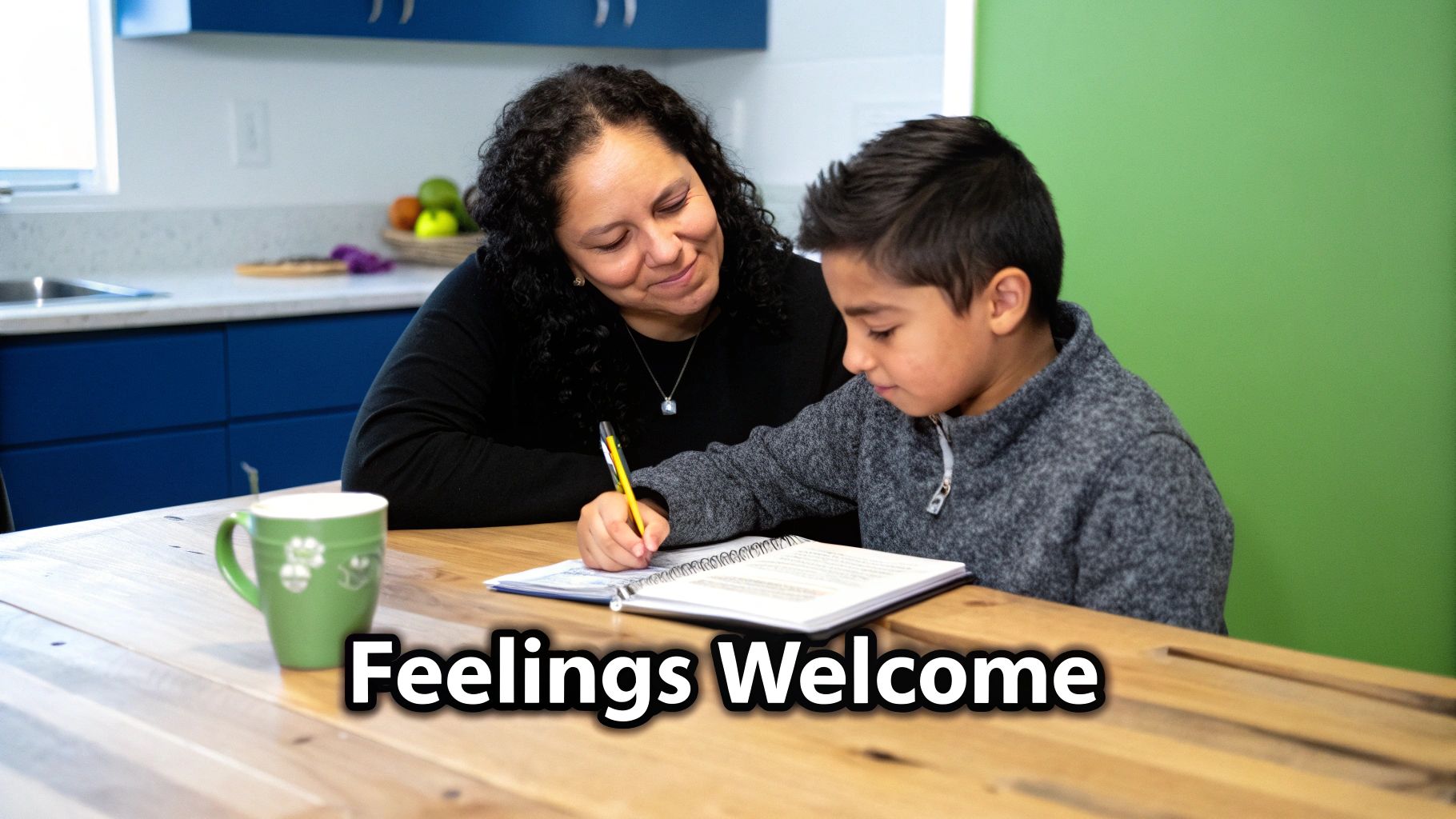
Many of us grew up hearing that good mental health meant hiding or ignoring difficult emotions. This has left a lot of adults struggling to talk openly about how they feel, and that silence naturally trickles down to our own kids. The good news? We can absolutely change this pattern. All it takes is a conscious shift in our approach.
The Power of Validating Language
The words we choose can either shut a child down or open the door for connection. It’s so easy to fall back on our instincts to 'fix' a situation with a quick "Don't cry," or "You're fine." While these phrases come from a good place, they can accidentally send the message that a child's feelings are wrong, over-the-top, or just plain unimportant.
But a simple switch in your phrasing can make all the difference. Try swapping out those dismissive phrases for ones that validate their experience:
-
Instead of: "Stop crying, it's not a big deal."
-
Try: "I can see you're really sad that the tower fell down. You worked so hard on it." For example, when my son's LEGO creation recently broke, saying this stopped his tears and led to him telling me exactly what had upset him.
-
Instead of: "You're overreacting."
-
Try: "It sounds like that was a really frustrating moment for you. Tell me what happened." This shows you’re on their side, ready to listen.
This doesn't mean you have to agree with the behaviour (like hitting a sibling out of frustration), but it shows you see and accept the feeling behind it. For a deeper dive into this, our article on emotional coaching for parents has more practical advice.
Children learn what they live. If a child lives with approval, they learn to value themselves. If a child lives with security, they learn to trust. Creating an environment where emotions are validated is the first step in building that security.
Modelling Your Own Emotional Regulation
Kids are emotional sponges. They learn far more from watching how we handle our own feelings than from any lecture we could ever give. This means our own moments of stress are actually incredible teaching opportunities. Think about it: when you spill coffee all over your shirt just as you’re rushing out the door, what’s your reaction?
Do you sigh, take a deep breath, and say out loud, “Oh, that’s so annoying! Okay, let me just take a minute to sort this out.”? Or do you fly off the handle? By narrating your own calm-down process, you're literally giving your child a script for managing their own big feelings. You’re showing them that emotions like anger and stress are normal and, most importantly, manageable.
Weaving Connection into Daily Routines
You don't need to carve out huge chunks of time for emotional learning. The most powerful moments are often the small ones you already have.
- Daily Check-in: Make it a habit at dinner or bedtime to ask, "What was the best part of your day and what was the trickiest part?" This makes talking about highs and lows a completely normal part of family life.
- Create a Worry Box: Find an old shoebox and decorate it together. This becomes a safe place where your child can post written or drawn worries. Set aside a regular time to open it together and talk through what’s inside, showing them their anxieties are heard and taken seriously.
These little rituals create predictable pockets of connection in your day. They constantly reinforce the message that in your home, all feelings are welcome. It’s these consistent, loving actions that build a resilient, emotionally intelligent child.
Practical Activities to Nurture Emotional Skills
All the theory and good intentions in the world are a great start, but real growth happens when we roll up our sleeves and put ideas into practice. Getting your child involved in hands-on activities is a brilliant way to build their emotional toolkit, turning abstract concepts like empathy and self-regulation into real, tangible skills they can use day in and day out. It’s all about meeting them where they are developmentally, with experiences that are fun and, most importantly, memorable.
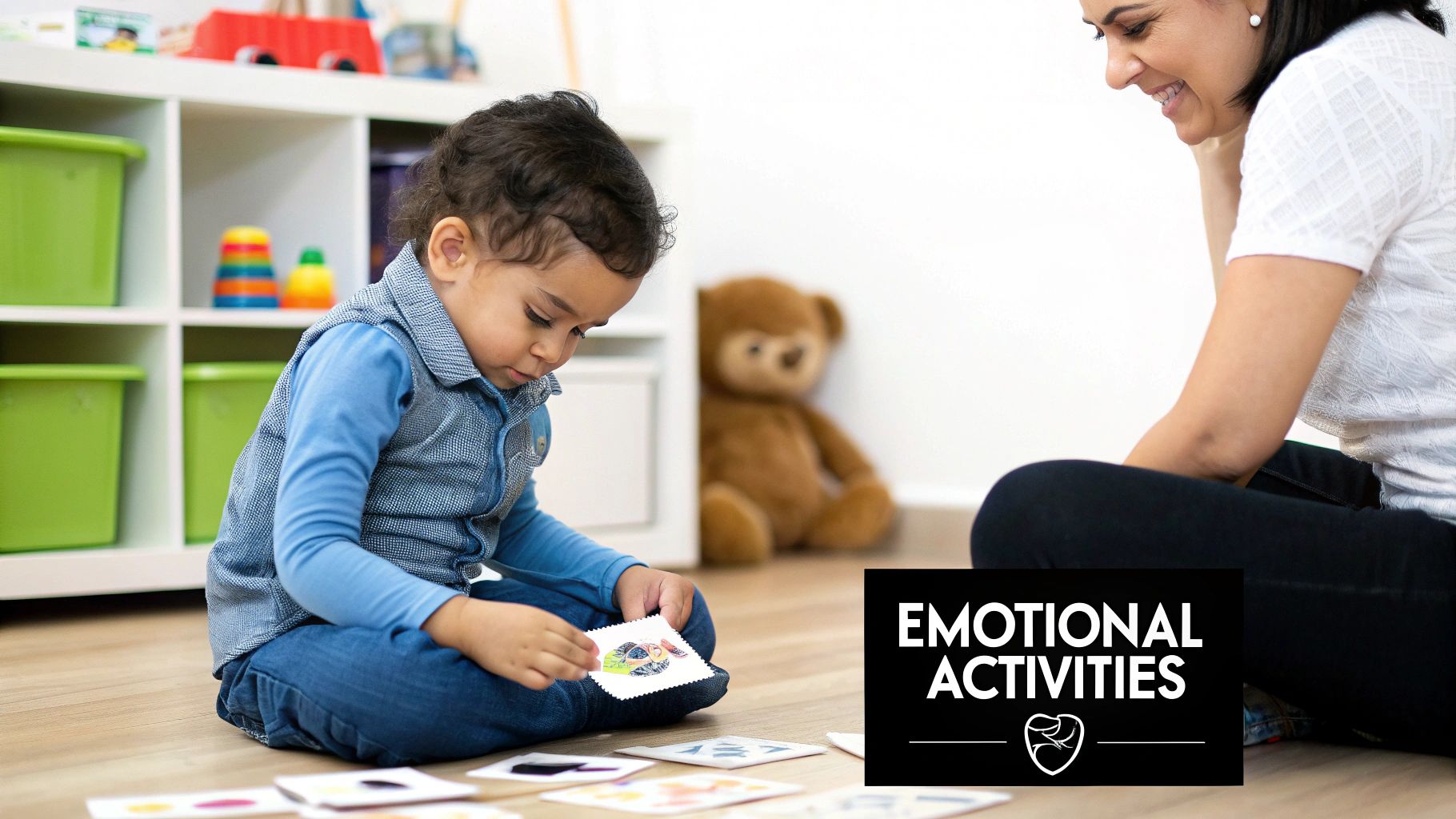
The need for these skills is becoming more obvious every year. It's projected that by 2030, two million more children and young people will require support for their mental health than in 2019. But the good news is that structured programmes really work. Take the NSPCC initiative in Glasgow primary schools, for example. It successfully boosted emotional resilience among pupils after the lockdown, proving that targeted activities build skills that stick.
Activities for Toddlers (Ages 2-4)
For toddlers, it’s all about building that foundational emotional vocabulary. They feel things so intensely but don’t have the words to explain what’s going on inside. That confusion often bubbles over into frustration and meltdowns.
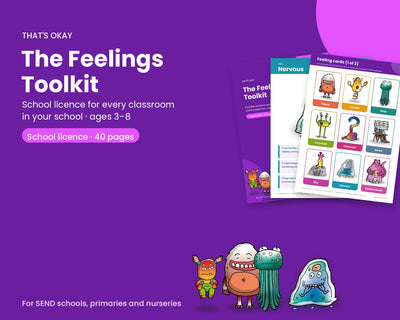
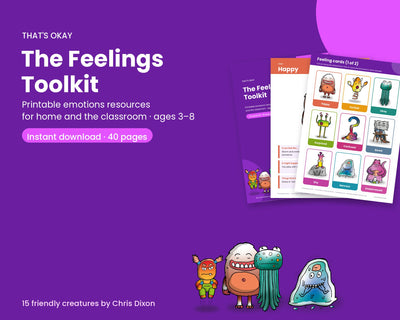
- Feeling Faces Flashcards: Use simple cards with faces showing happy, sad, angry, and surprised. Point to a card and say, "This face looks happy! When do you feel happy?" This starts to forge that crucial link between a feeling and a word.
- Emotion Charades: This one is always a hit. Act out a simple emotion like being sad (pout, pretend to cry) and have your toddler guess the feeling. It’s a playful way to show that all these different emotions are normal and okay to feel. For more practical ideas, have a look at these expert parenting tips for tackling tantrums and power struggles.
Ideas for Young Children (Ages 5-8)
At this stage, children are starting to grasp that other people have thoughts and feelings separate from their own. This is the perfect time to introduce activities that focus on empathy and solving social puzzles.
Role-playing is an incredibly powerful tool. It gives children a safe space to practise navigating tricky social scenarios without any of the real-world pressure or consequences. It builds both their confidence and their competence.
Grab some puppets or their favourite toys to act out common playground tiffs. Maybe one puppet snatches a toy from another. You can then pause the scene and ask your child, "How do you think the other puppet feels now? What could the first puppet do to make it right?" This simple exercise builds empathy and gets them thinking about solutions. For even more inspiration, check out our guide on emotional literacy activities.
Nurturing Pre-Teens (Ages 9-12)
As kids edge closer to their teenage years, their emotional world gets a lot more complicated. They’re suddenly grappling with nuance, figuring out their own identity, and navigating some pretty intricate social dynamics.
- Film and Book Discussions: After watching a film or reading a book together, ask open-ended questions about the characters. "Why do you think she reacted that way?" or "What do you think he was feeling when he didn't get invited?" This encourages them to analyse complex motivations and emotions from a safe, observational distance.
- Start a Shared Journal: All you need is a simple notebook to write notes back and forth. For a pre-teen, this can be a much less intimidating way to share worries or feelings they might be hesitant to say out loud. It opens up a gentle, private line of communication.
Emotional Intelligence Activities by Age Group
To make things a bit easier, here’s a quick-reference table that matches age groups with activities designed to build key emotional skills.
| Age Group | Key Emotional Skill | Practical Activity Example | Little Fish Books Resource |
|---|---|---|---|
| Toddlers (2-4) | Naming Feelings | Using emotion flashcards or singing songs about being happy, sad, or angry. | That's Okay to Feel Book |
| Young Children (5-8) | Developing Empathy | Role-playing scenarios with toys to understand others' perspectives. | Emotion Flashcards |
| Pre-Teens (9-12) | Navigating Social Complexity | Discussing character motivations and feelings in books or films. | Shared Journaling Prompts Printable |
This table can serve as a handy guide, helping you choose the right activity at the right time to support your child's emotional journey.
Navigating Digital Worlds with Emotional Resilience
Let's face it, modern childhood has a sprawling digital dimension that we never had to deal with. For a child just learning to get a handle on their feelings, the online world can feel like walking through an emotional minefield.
You’ve got the comparison culture, the constant hunt for likes and comments as validation, and the genuinely painful sting of cyberbullying. Research shows that higher social media use is linked to poorer mental health in young people, particularly girls. Tackling this head-on has become a non-negotiable part of raising emotionally intelligent children.
The answer isn't to lock away the iPads and ban technology altogether. It’s about building the emotional resilience they need to engage with it in a healthy way. Think of it like this: a strong offline emotional foundation is their best defence against online negativity. When children feel secure, seen, and validated at home, they’re far less likely to desperately search for that validation from strangers on the internet.
Starting the Conversation
The first, and most important, step is to open up a non-judgemental dialogue about their online life. This is huge. Instead of asking accusatory questions that put them on the defensive, try getting curious. Ask questions that invite them to reflect and connect with you. It shows you’re on their team, ready to help them figure things out together.
A few conversation starters I’ve found that work well are:
- "How did seeing that post really make you feel inside?"
- "What do you find fun about that app? And what parts are, you know, not so fun?"
- "Let’s make a plan. What should we do if we ever see someone being unkind online?"
These kinds of questions gently shift the focus from their screen time to their internal experience, reinforcing all those emotional literacy skills you've been working on. It helps them draw a clear line between their online interactions and their real-world feelings.
Fostering Digital Empathy and Boundaries
We spend so much time teaching empathy for playground squabbles, and we need to apply that same energy to their digital interactions. This means helping them understand that behind every profile picture and every comment is a real person with real feelings.
A really practical way to do this is to chat about different online scenarios as a family. Talk through the potential impact of certain words and actions.
One of the most important parts of this whole process is setting healthy tech boundaries together. When children are part of creating the rules—like having tech-free zones in the house or screen-time curfews—they’re so much more likely to understand the ‘why’ behind them and actually respect the limits.
Ultimately, by equipping them with a strong sense of self-worth and robust emotional awareness offline, you’re giving them the very best tools to stay grounded. This is what ensures they can step into the online world from a place of confidence and resilience, not insecurity.
Knowing When to Seek Further Support
While emotion coaching at home is a fantastic foundation, it’s just as important to recognise when your child might need a bit more support. Realising this isn’t a sign that you’ve done something wrong; it's a brave and loving part of parenting. The ultimate goal is to make sure your child has the best possible support system for their mental and emotional wellbeing.
Let’s be honest, the landscape of children's mental health in the UK can be tough to navigate. Waiting times for specialist NHS mental health services can be long, which makes it even more critical to address concerns as soon as they arise. Addressing mental health early prevents issues from escalating into more serious problems in adulthood.
Recognising the Signs
Every child has their off days, of course. But sometimes, certain patterns can signal that it's time to get some professional advice. The most important thing is to trust your gut—you know your child better than anyone.
Keep an eye out for persistent changes that don't seem to go away. Things like:
- Prolonged Social Withdrawal: Is your child consistently avoiding friends, family, or hobbies they used to love?
- Sudden Behavioural Shifts: A big change out of nowhere—a typically calm child becoming unusually aggressive, or a chatty, outgoing child suddenly becoming quiet and withdrawn.
- Intense and Persistent Anxiety: Worries that get in the way of everyday life, like refusing to go to school or having major sleep problems.
Please remember, I am not a mental health professional. The information here is for educational purposes. If you are worried about your child's mental health, it is essential to seek help from a doctor or another qualified professional.
The decision tree below is a great little tool. It offers a simple framework for handling those tricky online conversations, helping you decide when to stick to your family plan versus when it's time to sit down and talk through feelings.
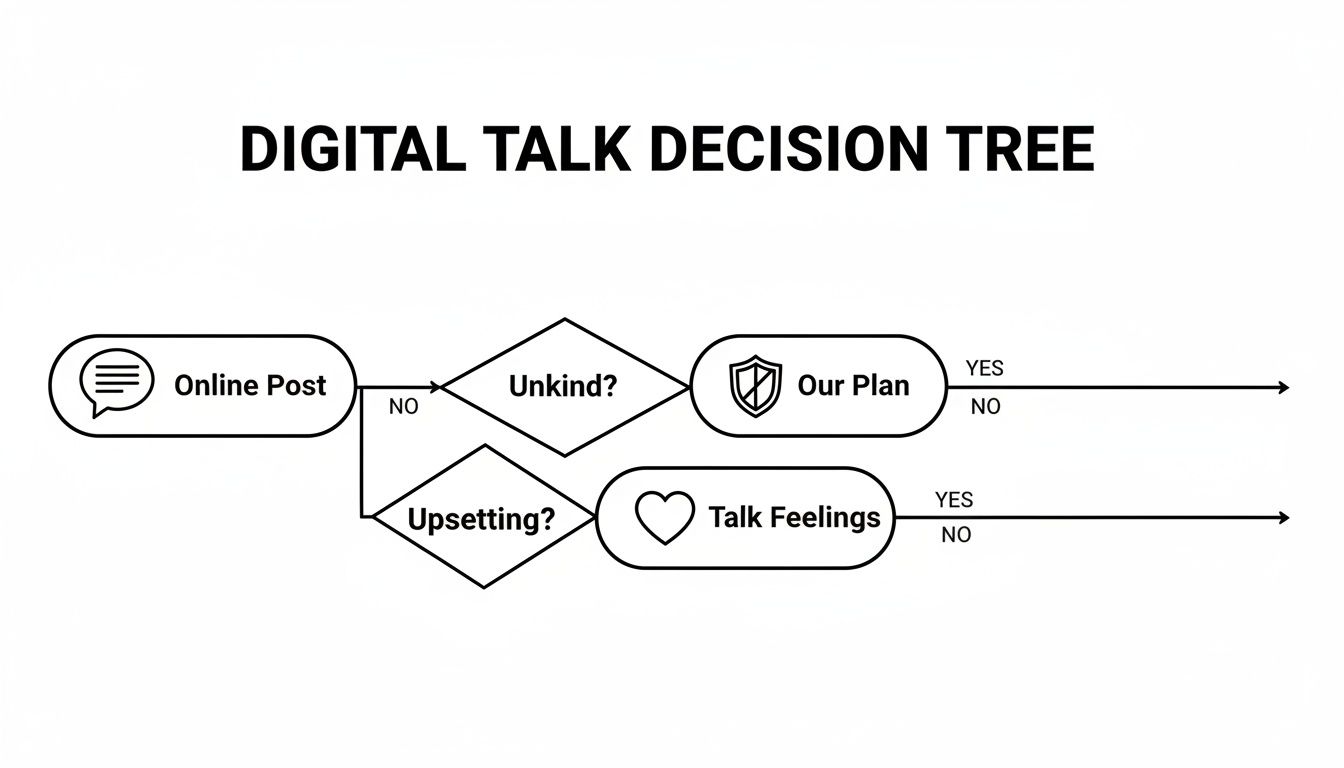
This visual guide can really help simplify those complex digital interactions, making it easier to respond in a consistent and emotionally aware way.
Taking the Next Steps in the UK
If you're feeling concerned, your GP is usually the best first port of call. They can listen to your worries and, if necessary, refer you to the Child and Adolescent Mental Health Services (CAMHS).
Don't forget to speak with your child's school, too. The SENCO (Special Educational Needs Coordinator) is an incredibly valuable resource and can talk you through the support options available in the school environment.
Charities like YoungMinds also offer fantastic, trusted advice for parents. And if a child's emotional development needs more specialised attention due to conditions like autism, there are resources that care for children with autism and can provide tailored support. Seeking help is a proactive step, not a last resort. It's all part of raising an emotionally intelligent child who feels supported on every level.
Got Questions About Emotional Intelligence? You're Not Alone.
Putting all this into practice in the real, messy world of family life is bound to bring up some questions. It’s one thing to read about these ideas, and another to handle a tricky situation in the moment. Here are some of the most common concerns I hear from parents, with some practical thoughts to help you feel more confident.
What If I Struggle with My Own Emotional Regulation?
This is such a common feeling, and a really honest one. Most of us simply weren't taught these skills when we were children, so it’s completely understandable to find it hard. The beautiful thing is, you don’t have to be perfect. In fact, seeing this as a chance for you and your child to learn together can be incredibly powerful.
When you feel those big emotions rising, try thinking out loud. It could be as simple as saying, "Wow, I'm feeling really frustrated right now. I'm going to take three big, slow breaths to help my body calm down." This does two amazing things: it models self-awareness and shows your child a healthy coping strategy in real-time. It's a huge relief for them to see that grown-ups have big feelings too, and that there are real ways to handle them.
My Teenager Shuts Down When I Try to Talk About Feelings
Ah, the teenager. Trying to have a direct conversation about emotions can feel like talking to a brick wall, can't it? The key here is to change tack. Move away from direct, probing questions and focus on creating small moments of connection instead.
Rather than asking "How are you feeling?", which can feel like an interrogation, try sharing a little piece of your own day or an observation. You could mention something from a film you watched together, like, "That character seemed really lonely when their friends left them out. I've felt a bit like that before." This creates an opening for them to share without being put on the spot. With the pressures of social media and friendships, building this bridge is more important than ever.
Remember, the goal isn't to force a deep and meaningful conversation every time. It's about consistently showing you're a safe harbour—that you're there to listen without judgement whenever they're ready to talk.
How Can I Support My Child’s Mental Health Further?
Beyond the day-to-day chats, bringing in some gentle, supportive tools can make a world of difference. Finding the right resources helps normalise talking about mental wellbeing and makes it a natural part of family life.
- Mental Health Apparel: Sometimes a simple visual reminder is all it takes. Wearing a t-shirt or hoodie from our collection with a positive, kind message can be a lovely way for the whole family to keep self-compassion front and centre.
- Mental Health Books: Reading stories together that explore a whole rainbow of emotions builds empathy. It gives you a shared language to talk about feelings that might otherwise be hard to name. Our book That's Okay to Feel is a great starting point for this.
- Relaxation Techniques: Teach them simple mindfulness exercises they can use anywhere. The '5-4-3-2-1' grounding technique is a great one: name five things you can see, four things you can touch, three things you can hear, two things you can smell, and one thing you can taste.
Please know, this advice is here to support you, but I am not a mental health professional. If you ever have real worries about your child's mental health, the most important step is to speak with your doctor or another qualified professional.
At Little Fish Books, we’re so passionate about creating tools that support you on this journey. From our engaging books that get conversations started to our apparel that spreads a little bit of kindness, everything we make is designed to help you build a strong foundation of emotional intelligence for your whole family.
You can explore our full collection at thatsokay.co.uk.