

Using a Story on Friendship to Nurture Your Child's Wellbeing
Using a good story on friendship is a wonderfully effective way to teach children about empathy, sharing, and how to get along with others. These stories create a safe, gentle space for them to explore big feelings and learn vital life lessons through characters and situations they can really relate to.
Why a Story on Friendship Is Such a Powerful Tool for Children
Friendships are the absolute bedrock of a child's social and emotional world. They're often the first proper relationships children form outside of the family, and they teach crucial skills like cooperation, communication, and how to sort out disagreements. Let's be honest, though – figuring out these early connections can be pretty tricky.
This is exactly where the magic of storytelling comes in. A thoughtfully chosen story on friendship acts as a gentle guide, giving children a mirror to their own experiences and a window into how others might be feeling. It's a fantastic way to introduce complex emotional ideas in a way that's easy to grasp and genuinely engaging.
Creating a Safe Space for Learning
When children see characters navigate the ups and downs of friendship in a book, they learn without the pressure of being in a real-life argument. A story about a character feeling left out or learning to share a special toy gives you a low-stakes way to talk about some very big emotions.
For example, a story might show two friends falling out and then finding a way to say sorry and make up. This models healthy conflict resolution, giving your child a kind of script they can use later on. It’s a simple but powerful method for building up their social and emotional toolkit, one page at a time. The benefits of reading for a child's development are huge, and you can explore more of them in our detailed article on the benefits of reading.
How Friendship Stories Boost Child Development
Here's a quick look at the core benefits of using storytelling to teach children essential social and emotional skills.
| Benefit | Impact on Child |
|---|---|
| Emotional Literacy | Helps children identify and name their own feelings by seeing characters experience emotions like sadness, jealousy, or joy. |
| Empathy Building | Encourages children to see situations from another's point of view, fostering compassion and understanding. |
| Conflict Resolution Skills | Models positive ways to solve disagreements, like talking things through, apologising, and forgiving. |
| Social Confidence | Provides examples of how to initiate friendships, share, and cooperate, building confidence for real-life interactions. |
| Safe Exploration | Offers a risk-free environment to think about tricky social scenarios without personal pressure or embarrassment. |
Ultimately, these stories are more than just entertainment; they're foundational tools for building emotionally intelligent and resilient children.
Addressing Mental Health Early
Teaching children how to make and keep healthy friendships from an early age is more important than ever. The mental health of our children is a growing concern, with one in five children aged 8 to 16 having a probable mental health problem. Addressing these issues early through conversation and storytelling can make a profound difference.
When we give children the skills to form meaningful bonds, we’re providing a protective shield against future isolation and anxiety. Openly discussing feelings and relationships helps to normalise mental health conversations, reducing stigma and encouraging children to seek help when they need it.
A simple story shared at bedtime can become the foundation for a lifetime of healthy, supportive relationships. It’s not just about reading; it’s about connecting and preparing them for the world.
To show you what I mean, here is a short story example that can spark these vital conversations.
A Short Story on Friendship: The Squirrel Who Couldn't Share
Pip was a little squirrel with a big, bushy tail and an even bigger collection of acorns. He had the best acorns in the whole forest and didn't want to share them with anyone. One sunny afternoon, his friend Squeaky came by. "Pip, can I have just one acorn? I'm so hungry."
Pip hugged his pile tightly. "No! These are all mine."
Squeaky's ears drooped, and he scampered away, sad and lonely. The next day, Pip slipped while climbing a tall oak tree and dropped his entire basket of acorns. They scattered everywhere! He tried to gather them, but it was too much for one little squirrel. Just then, Squeaky appeared. Seeing Pip in trouble, he immediately started helping. Together, they gathered every last acorn.
Pip looked at his friend. "You helped me, even when I was unkind. I'm sorry, Squeaky. Friends should share." From that day on, Pip always shared his acorns, and the two friends had more fun together than ever before.
Choosing the Right Story for Your Child's Age
Not every friendship story is a one-size-fits-all. The right message, the one that truly lands, depends entirely on your child’s developmental stage. Just as you wouldn’t hand a thick novel to a toddler, the stories we use to teach social skills need to meet them where they are.
Let's break down how to pick the perfect story that resonates with your child, no matter their age. It’s all about matching the narrative to their emotional world. A simple tale about sharing can feel like a revelation to a two-year-old, whereas a ten-year-old needs stories that mirror the complex social webs they're navigating at school.
Toddlers: Ages 1 to 3
For our youngest listeners, friendship is about simple, positive actions. Think sharing, being kind, and gentle hugs. Your best bet here are sturdy board books with bold, bright illustrations and text that's easy to repeat. The goal isn't a complex plot; it's about modelling those foundational behaviours.
Look for stories where animals play nicely together or characters take turns with a favourite toy. These straightforward narratives plant the very first seeds of empathy and cooperation. If you're looking for a few ideas, our guide to children's picture books has some wonderful suggestions for this age group.
For a toddler, a story about a bear sharing his honey is a profound lesson in generosity. It's their first, gentle introduction to the idea that being a friend means thinking about others.
Pre-schoolers: Ages 3 to 5
Once children hit their pre-school years, their understanding of social dynamics just blossoms. Now’s the time to bring in stories with a clear, simple problem and a satisfying solution. Look for books where characters have a small disagreement but find a way to work it out.
These stories create the perfect springboard for conversation. After you've finished reading, you could try asking a few gentle questions:
- "Why do you think the little fox felt sad when his friend took his toy?"
- "What did the rabbits do to become friends again?"
- "How did they say sorry to each other?"
This approach helps them connect the dots between actions and feelings, building a rich emotional vocabulary. A story about apologising or including someone in a game becomes a powerful, practical guide for their own playground adventures.
Primary-Aged Children: Ages 6 to 11
By the time children are in primary school, their social worlds are a lot more intricate. Friendships now involve navigating friendship groups, dealing with the sting of being left out, and managing bigger emotions like jealousy or loyalty. The right friendship story for this age should reflect these new realities.
Choose narratives that tackle these nuanced situations in a sensitive and relatable way. A story about a character who feels excluded by their friends can validate your child’s own feelings and open up a conversation about how they might handle it. Good mental health books for this age, like The Huge Bag of Worries by Virginia Ironside, can be invaluable for exploring these themes. These books provide a safe space to explore tricky scenarios and brainstorm solutions together, building their social resilience one story at a time.
Making the Story Stick with Questions and Activities
Reading a brilliant story on friendship is a fantastic start, but the real magic happens afterwards. This is where the conversations and activities come in, turning abstract lessons about kindness and empathy into real, tangible skills your child can use every day. By making storytime interactive, you help them truly connect the dots between a character's feelings and their own world.
Once you’ve finished reading, using effective discussion questions can shift storytime from a passive experience into an active one. It’s all about helping children explore why characters feel a certain way and what drives the story forward. Asking open-ended questions invites them to think for themselves and share their own perspectives—a powerful way to build emotional intelligence.
Starting the Conversation
Try to move beyond simple questions about what happened in the plot. The goal is to encourage reflection. This simple shift helps children process the story’s themes on a much deeper, more personal level.
Here are a few prompts I’ve found really get the conversation flowing:
- "What do you think makes someone a really good friend?"
- "Has anything like what happened in the story ever happened to you or someone you know at school?"
- "How do you think the character felt when that happened? What makes you say that?"
- "If you were that character, what might you have done differently?"
This guide gives a quick overview of how children at different ages tend to connect with friendship stories.
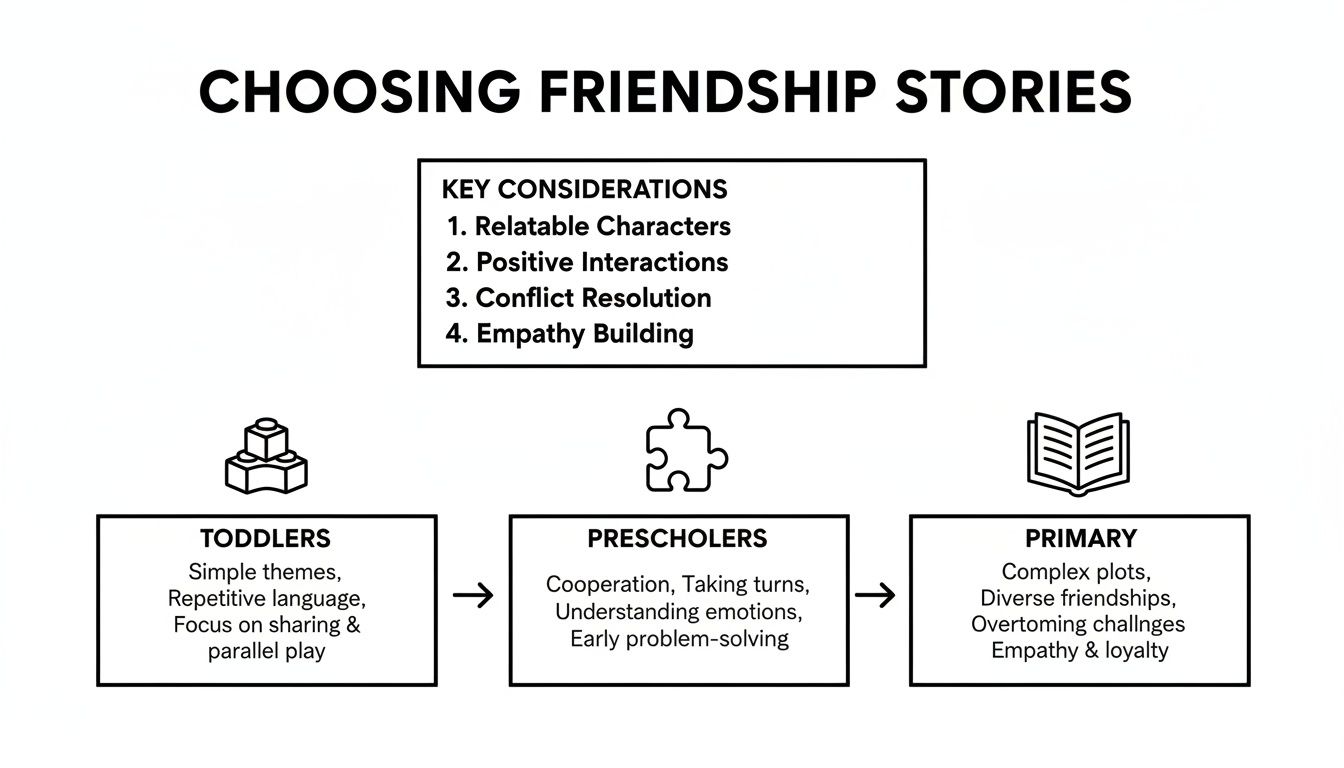
As you can see, while toddlers are focused on simple actions like sharing, older children are ready to explore the more complex, nuanced puzzle pieces of social interaction.
Hands-On Activities to Build Empathy
Activities are a brilliant way to cement a story's message long after the book is closed. A recent YouGov study revealed that 51% of Britons find it difficult to make new friends. This really highlights a need to actively teach and practise social skills from a young age, giving children the confidence they need for meaningful connections.
By turning fictional lessons into real-world practice, you give your child a safe space to rehearse crucial social skills like problem-solving and kindness, preparing them for the playground and beyond.
One lovely idea is to create a 'Kindness Jar' together. Whenever you or your child spot someone doing something kind—in real life, in a book, or on TV—write it on a slip of paper and pop it in the jar. When the jar is full, celebrate with a special treat. This simple, ongoing activity keeps the conversation about kindness and friendship alive.
Another great activity is to role-play a tricky scene from the book. For example, act out how a character could have invited a lonely friend to play, or practise saying sorry after an argument. This gives your child a chance to physically rehearse navigating a social situation without any real-world pressure.
Making Storytime an Unforgettable Experience

How you read a story is just as important as the one you choose. But don't worry, you don’t need to be a professional actor to make reading a story on friendship a truly captivating experience. It’s all about connection and creating a special moment together.
The goal isn’t a flawless performance, but to build a warm, engaging space where your child feels safe to listen, imagine, and connect with you. A few simple techniques can transform a basic read-aloud into something they'll remember for years, helping them absorb the story's emotional lessons on a much deeper level.
Using Voices and Pacing
Giving each character a slightly different voice is a brilliant way to help your child follow who is speaking. It doesn't have to be anything dramatic—a slightly higher pitch for a tiny mouse or a slower, deeper tone for a wise old owl is all it takes. This simple trick makes the story easier to follow and helps them understand different perspectives.
The pace of your reading also sets the emotional tone. When you get to a thoughtful or sad moment, slow right down to let the feeling sink in. For the exciting, action-packed parts? Speed things up a bit to build that brilliant sense of anticipation and keep them hooked on every word.
Your enthusiasm is contagious. When you're engaged with the story, your child will be too. It’s this shared enjoyment that makes storytime such a powerful bonding experience.
Bringing Emotions to Life
Your own expressions and gestures are powerful storytelling tools. When a character is sad, let your face show it. When they're excited, open your eyes wide and smile. These visual cues are a game-changer, especially for younger children who are still learning to connect words with feelings.
Pausing at key moments is another fantastic technique. Stop right before a big reveal and ask a curious question, like, "Oh no, what do you think is going to happen now?" This simple question instantly pulls your child into the story, turning them from a passive listener into an active participant.
For more great ideas on making reading a dynamic, shared experience, check out our article on interactive children's books.
By using these simple strategies, you make every story an unforgettable adventure. It’s about creating a moment of shared imagination and connection that reinforces those powerful lessons of friendship.
Taking Friendship Lessons into the Real World
This is where the real work begins—taking the beautiful lessons from a story on friendship and weaving them into the sometimes messy, complicated fabric of real life. Our goal is to connect the dots between the characters' experiences on the page and the challenges our kids face on the playground, in the classroom, and, increasingly, online. By gently reinforcing these ideas, we can help our children turn fictional tales into real-world emotional intelligence.
Before we dive in, I need to make something crystal clear: I am not a mental health professional. The advice that follows comes from my own experience as a parent and my personal research. It is not a substitute for professional guidance. If you have any worries about your child's mental health or wellbeing, please speak to your doctor or another qualified practitioner.
From Story to Self-Esteem
One of the biggest hurdles for our kids is actually internalising the lessons a story teaches. They might understand why a character felt brave or sad, but connecting that to their own feelings of self-worth can be a much bigger leap. That’s where simple, tangible reminders can make all the difference.
Think about something like mental health apparel. A t-shirt or hoodie from our collection, printed with a positive affirmation, can act as a wearable reminder of strength and self-worth. For a child feeling a bit wobbly after a friendship issue, a quiet message like "It's Okay to Feel" can be a comforting, private anchor throughout their school day. It’s a gentle nudge that their feelings are valid and that they have the resilience to get through it.
Navigating the Digital Playground
Friendships today aren't just happening face-to-face. For older kids especially, social media and online gaming have added a whole new layer of complexity. The pressure to fit in, the sting of being left out of a group chat, or the anxiety of misinterpreting a text message are very real struggles. This digital world has a huge impact on our children's mental health, which makes having open conversations more critical than ever.
It can feel a bit daunting to start that dialogue, but a good story can be the perfect icebreaker. After reading about a misunderstanding between two characters, you could try asking:
- "How do you think this would have played out differently if it happened over a text message?"
- "What makes it so hard sometimes to know how someone is really feeling online?"
These aren't conversations about banning technology. They're about arming our kids with the critical thinking skills they need to manage their digital friendships with kindness, confidence, and safety.
Poor mental health carries a heavy price, not just for individuals but for the wider economy. It's estimated to cost UK businesses up to £56 billion a year through absenteeism and reduced productivity. Nurturing emotional resilience from childhood is a powerful investment in a healthier future for everyone.
Fostering Quality Connections
Stories often show us that the strength of a friendship is far more important than the number of friends we have. It’s such a vital lesson in a world that can sometimes feel like a popularity contest. It's a sentiment that resonates deeply with adults, too.
Recent data shows that 88% of single Brits and 90% of those in relationships agree that when it comes to friends, quality always triumphs over quantity. You can discover more insights about friendship dynamics from the full study at YouGov.co.uk. By using a story on friendship, we can teach our children to look for and nurture those meaningful, supportive connections that will truly enrich their lives.
Got Questions About Nurturing Friendships? We've Got Answers
As parents and carers, we all have moments where we're not quite sure how to help our kids navigate the sometimes-tricky world of friendships. It's completely normal to have questions! Here are a few common ones I hear, along with some practical advice to help you on this incredibly important journey.
What Should I Do If My Child Struggles to Make Friends?
This is such a common worry. The first thing I always suggest is to gently observe your child in social situations. Try to pinpoint what the specific hurdle might be—is it shyness? Maybe they find it hard to share, or perhaps they're misreading social cues. You'll get so many clues just by watching.
Using a story on friendship at home is a brilliant, low-pressure way to role-play different scenarios. It gives them a safe space to practise without any real-world consequences. To build up those core abilities for lasting connections, you can also look into resources focused on building social skills in children.
Short, structured one-on-one playdates can also work wonders for building confidence. And always remember to praise their effort in trying, not just whether the playdate was a "success". If you're still concerned, having a quiet word with their teacher can offer invaluable insights from a different perspective.
How Can Stories Help My Child Resolve a Conflict with a Friend?
Books are like a secret weapon for conflict resolution. Find one where the characters are having a similar tiff to what your child is experiencing. Reading it together creates a bit of emotional distance from their own situation, which lets them think about the problem much more clearly.
Once you’ve finished the story, you can ask gentle, open-ended questions. Try something like, "How did the characters sort out their problem? Do you think any of their ideas might work for you and your friend?".
This approach helps your little one brainstorm solutions without feeling defensive or like they're being told off. The story becomes a shared language you can both use to talk about mending their real-life friendship, empowering them to take that positive next step.
When Is the Right Age to Start Talking About Friendship?
Honestly, it’s never too early. The conversations just look a bit different as your child gets older.
- For toddlers, you can use simple board books to introduce really basic concepts like taking turns and being gentle with our friends.
- As they hit preschool age, stories can help you start talking about understanding how other people feel.
- By primary school, the stories can get a bit more complex, touching on things like trust, loyalty, and how to navigate disagreements.
Starting these conversations early lays a really powerful and lasting foundation for healthy relationships all through their lives.
What Are Some Good Relaxation Tips for an Anxious Child?
When friendship worries creep in, simple relaxation techniques can be a game-changer. I love teaching children deep "bubble breaths"—inhaling slowly through the nose and then blowing out gently as if you're blowing a bubble. It's a simple trick that really calms the nervous system.
Another great tool is simply snuggling up to read a familiar, comforting book together. It provides a wonderful sense of security and a welcome distraction from whatever is on their mind. You could also try a simple guided meditation, where they imagine a safe, happy place. There are many child-friendly versions available online.
Remember, every child develops at their own pace. By offering gentle guidance, plenty of positive reinforcement, and the right tools, you can help them build the confidence and skills they need for a lifetime of happy, healthy friendships.
At Little Fish Books, we’re passionate about creating resources that support your child's emotional growth. From books that help tackle big feelings to apparel with positive affirmations, our entire collection is designed to spark important conversations and build resilience. Explore our shop to find the perfect tools to support your child's journey.