
What Is Emotion Coaching for Resilient Kids?
So, what exactly is emotion coaching? At its heart, it's a way of parenting that focuses on guiding children through their big feelings.
Instead of dismissing or punishing emotions, emotion coaching is all about seeing these moments as opportunities. Opportunities to connect, to teach, and to help your child build real emotional intelligence and resilience.
Understanding The Heart Of Emotion Coaching
In a world where children's mental health is a massive talking point, getting to grips with emotion coaching has never been more important. Recent figures are pretty sobering, showing that one in five children in the UK now has a probable mental health condition. With the constant pressures from social media and school, it's a complex emotional world for young people to try and figure out on their own.
This is where emotion coaching steps in as a compassionate, practical response.
Essentially, it’s about becoming your child's guide – or as some might say, their Personalized Emotional Support Human – helping them make sense of and manage their feelings. The whole approach is built on one simple but profound idea: all feelings are valid, even if all behaviours aren't. It shifts our focus from just trying to control a behaviour to understanding the emotion that's driving it.
When we do this, we create a deep sense of trust and security. A child who feels heard and understood can calm their brain's "fight or flight" response, which makes them much more open to learning and solving problems. It’s the difference between saying, "Stop crying!" and gently offering, "I can see you're really sad about that. Let's talk about it."
The Four Essential Steps
The process at the heart of emotion coaching is beautifully simple and can be broken down into four key steps. Think of it as a journey from listening with empathy to actively guiding your child toward finding their own solutions.
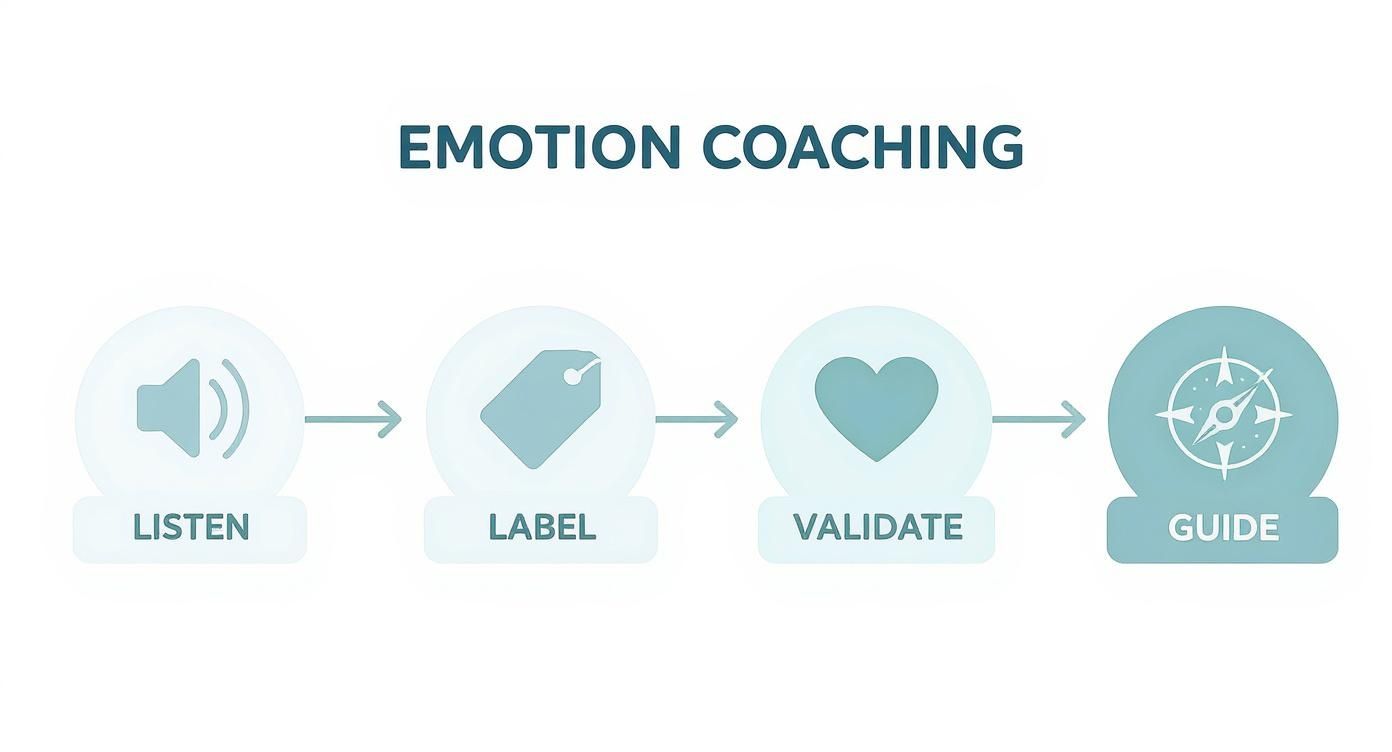
This table gives you a quick-reference guide to what each of these steps looks like in a real-life moment with your child.
The Four Core Steps of Emotion Coaching
| Principle | What It Means in Practice |
|---|---|
| 1. Listen | Really tune in to what your child is feeling, both in their words and their body language. Put down your phone, make eye contact, and give them your full attention. |
| 2. Label | Help them find the words for what they're experiencing. "It sounds like you're feeling really frustrated," or "I wonder if you're feeling a bit left out." |
| 3. Validate | Show them you understand and that their feeling is okay. This isn't about agreeing with their behaviour, but acknowledging the emotion behind it. "It makes sense that you'd feel angry about that." |
| 4. Guide | Once they feel heard, you can gently guide them towards problem-solving or setting limits. "It's okay to feel angry, but it's not okay to hit. What could we do instead?" |
Each step builds on the last, creating a secure space for your child to learn and grow.
By using these steps consistently, you're not just getting through a single tantrum; you're building your child's emotional literacy brick by brick. Giving children the words for their feelings is a foundational skill, crucial for developing healthy ways to cope when things get tough.
Emotion coaching isn't about raising children who never feel angry, sad, or anxious. It's about raising children who know what to do with those feelings when they arise.
Ultimately, this approach helps children develop self-regulation skills that will serve them for a lifetime. It equips them to handle life's challenges with confidence, which can lead to better relationships, improved focus at school, and stronger mental wellbeing all around.
Please remember, I am not a mental health professional. If you have serious concerns about your child's mental health, it's always best to seek help from your doctor or another qualified practitioner.
The Proven Science Behind Emotion Coaching in the UK
Emotion coaching isn't just a gentle parenting idea; it’s a powerful approach with some serious evidence behind it. While it first started to take shape in the USA, it's been successfully brought over, adapted, and tested right here in the UK, both in homes and professional settings. It gives us a solid framework for nurturing a child's mental wellbeing, moving past fads to offer something reliable for building emotional resilience.

Take, for example, a groundbreaking pilot study in England with 127 participants. This research looked at training practitioners – staff from schools, early years settings, and youth centres – and the results were clear. They saw a statistically significant jump in emotion coaching skills, showing a real, measurable change in how adults handled emotionally charged moments with children. You can read more about these impressive UK-based findings and how the approach was tailored for British children.
Translating Research Into Real-World Benefits
This kind of evidence is so important because it gives parents and educators confidence. When you use emotion coaching, you’re not just guessing; you’re using a method proven to improve children’s emotional understanding and behaviour.
Studies in UK early years settings have shown how practitioners trained in these techniques create environments where children feel safer to express themselves. The knock-on effect? Fewer disruptive incidents and a calmer, happier atmosphere for everyone.
The impact goes way beyond the classroom, too. The skills learned through emotion coaching directly tackle the rising tide of mental health challenges young people face. With constant pressures from social media and school, giving children the tools to understand and manage their feelings is a vital protective shield.
At its core, the science confirms what many parents and carers feel in their gut: connection and understanding are far more effective than dismissal or punishment for building long-term emotional health.
The Lasting Impact on Mental Wellbeing
Adopting emotion coaching is a true investment in your child’s future. The benefits ripple out far beyond just managing a single tantrum. This approach helps to build stronger neural pathways in a child's developing brain, boosting their ability to self-regulate and feel empathy for others.
It’s also a huge support for your own wellbeing. Understanding the ‘why’ behind a child's behaviour can dial down parental stress and replace that feeling of helplessness with a clear, compassionate plan.
Please note, I am not a mental health professional. The information in this guide is for educational purposes. If you have serious concerns about your child's mental health, it is essential to seek advice from your GP or a qualified practitioner.
Putting Emotion Coaching into Practice at Home
Knowing the theory is one thing, but the real test of emotion coaching comes when you’re staring down a full-blown meltdown. How do you actually use these ideas when your toddler is launching toys across the room, or your teenager has just slammed their door with almighty force?
It all comes down to shifting your go-to phrases from reactive to responsive.
The trouble is, in those high-stress moments, our instincts often take over. We default to dismissing the feeling ("you're fine!"), disapproving of it ("stop that crying!"), or just ignoring it altogether in the hope the behaviour will stop. But these reactions, however well-intentioned, can accidentally send the message that a child's feelings are wrong, invalid, or just too much to handle. Over time, that can really chip away at their mental health.
Swapping Common Reactions for Coaching Responses
Let's get practical. The goal is to have some phrases in your back pocket that help you label feelings, set gentle limits, and problem-solve with your child. This simple shift turns a moment of conflict into a powerful opportunity to connect.
Here’s a look at how that switch can sound:
| Instead of This (Dismissing/Disapproving) | Try This (Emotion Coaching) |
|---|---|
| "Stop crying, you're fine." | "I can see you're really upset. It's okay to be sad." |
| "There's nothing to be scared of." | "It sounds like you're feeling scared. Tell me what's worrying you." |
| "That's enough! Go to your room!" | "You're clearly very angry right now. It's not okay to shout, but let's talk about what made you so mad." |
| "Just get over it." | "It's hard when you feel so disappointed. Let's sit together for a minute." |
See the difference? This simple switch in language validates the emotion first. This does something incredible—it helps to calm a child’s fired-up nervous system and opens the door for a proper conversation. It’s a foundational piece of building healthy emotional regulation, a skill they’ll carry with them for the rest of their lives.
Navigating Specific Scenarios
Of course, what you say will change depending on the situation. But the core principles of validating, labelling, and guiding stay exactly the same.
Scenario 1: Sibling Squabbles
- Instead of: "Who started it? I don't care, just stop fighting!"
- Try This: "Wow, it looks like there are some big, frustrated feelings here. Tom, you look furious. Anna, you look hurt. Let's all take a breath and figure out what happened."
Scenario 2: School-Related Anxiety
- Instead of: "Don't be silly, you love school! You'll have fun once you get there."
- Try This: "I can see your tummy feels all wobbly about school today. It sounds like you're feeling really anxious. Shall we try drawing what the worry looks like?"
Scenario 3: Friendship Troubles
- Instead of: "Well, if they were mean, then they aren't your friend. Just play with someone else."
- Try This: "That sounds so hurtful. It’s horrible to feel left out by a friend. I'm so sorry that happened. Do you want to tell me more about it?"
Remember, the aim isn't to swoop in and solve the problem for them. It's to sit with them in that big, messy feeling, give it a name, and show them they have a trusted ally to help them figure out what to do next.
This supportive approach is so important for children's mental health, especially as they start to navigate the complicated social world of growing up.
The Lifelong Benefits for Your Child and Family
When you start using emotion coaching, you're not just dealing with a single tantrum or a bad mood. You're planting seeds for the future. The positive ripples spread far beyond that one conversation, bringing real, long-term rewards for your child and, honestly, for the whole family.
Think of it as a powerful protective layer for their mental health, building a foundation of emotional wellbeing that can genuinely last a lifetime. This is more crucial than ever, especially with the constant pressures young people face today.
When children feel their emotions are seen and heard, it's amazing what happens. They can concentrate better at school, they learn to manage their own reactions, and their bond with you becomes stronger. It also has a knock-on effect for parents, lowering the overall stress in the house and creating a calmer, more connected home where everyone feels valued.
Building Resilience and Academic Success
One of the biggest wins I see with emotion coaching is the direct impact it has on a child's resilience. When kids understand and learn how to navigate their feelings, they get so much better at bouncing back from life's little bumps – whether that's a falling out with a friend or a disappointing mark at school. We have a whole guide dedicated to this, which you can read here: building resilience in youth strategies for long-term emotional well-being.
This emotional stability is also clearly linked to how they get on at school. A child who isn't drowning in anxiety or frustration can actually focus in the classroom. They can engage with their lessons and start seeing challenges as puzzles to be solved rather than mountains they can't climb.
The goal isn’t to prevent problems from ever happening. It's about giving children the inner toolkit they need to navigate them successfully. This is a true cornerstone of lifelong mental and emotional health.
Proven Impact in UK Schools
These aren't just nice ideas; the benefits are being proven right here in UK schools. Big initiatives like The Attachment Aware Schools Project and The Alex Timpson Schools Programme have consistently shown just how effective emotion coaching can be when rolled out for all pupils.
The results are pretty clear. These studies have found noticeable increases in children's wellbeing, huge drops in sanctions and exclusions, and better attendance and engagement across the board. The staff involved also said they felt more confident and capable of supporting children who were struggling.
A Calmer, More Connected Family
The positive effects don't stop with the kids. As a parent, learning to become an emotion coach helps you get to grips with your own emotional responses. This self-awareness is incredible for reducing your own stress and improving how you connect with your partner and others.
Ultimately, this whole approach can shift your family's dynamic. It starts to replace conflict and crossed wires with empathy and teamwork, creating a home that truly feels like a safe harbour from the world's pressures.
Please remember, I am not a mental health professional. This information is for educational purposes. If you have serious concerns about your child's mental health, please seek help from your doctor or a qualified practitioner.
Common Mistakes and How to Avoid Them
Learning emotion coaching is a skill, and like any new skill, it takes practice. It’s completely normal to stumble along the way, so don't worry if you don't get it 'right' every time. Understanding a few common pitfalls can help you navigate those tricky moments with more confidence, making sure your efforts genuinely support your child’s emotional wellbeing.
Perhaps the biggest hurdle is mistaking this approach for permissive parenting. It’s a common worry, but there’s a crucial difference.
The key is to remember that all feelings are welcome, but not all behaviours are acceptable. You can absolutely validate your child’s intense anger about a broken toy without accepting them throwing it across the room. It’s all about setting kind but firm boundaries on actions, not on the emotions themselves.

Gentle Course Corrections
Sometimes, in our rush to help our kids feel better, we accidentally do the opposite. Jumping in to fix the problem too soon or using phrases like "at least..." can unintentionally shut a child down. These kinds of reactions can make them feel like their big emotions are an inconvenience we just want to go away.
Here are a few common traps and how to sidestep them:
- The Problem-Solving Rush: It’s so tempting to offer solutions straight away. But before you do, just sit with the feeling first. Acknowledge their sadness or frustration before gently asking, "What do you think we could do about this?"
- The 'At Least' Trap: Saying "at least you have other toys" might seem helpful, but it minimises their very real, in-the-moment pain. A simple, connecting phrase like, "I can see you're so disappointed about that," is far more powerful.
- Saving it for Meltdowns: Emotion coaching isn't just a fire extinguisher for big explosions. The real magic happens when you practise labelling and validating the smaller feelings throughout the day—like the flicker of annoyance with homework or the burst of excitement for a playdate.
Acknowledging a child's feelings doesn't mean you agree with their perspective or condone their behaviour. It simply means you are validating their emotional experience as real and important. This builds trust, which is the foundation of effective guidance.
By being mindful of these small adjustments, you can avoid a lot of common frustrations and build a stronger, more emotionally honest connection with your child.
Please remember, I am not a mental health professional. This guide is for informational purposes. If you are worried about your child's mental health, please speak to your GP or a qualified professional.
Helpful Resources for Your Family's Wellbeing
Embarking on this emotion coaching journey is about so much more than just having the right conversations. It’s about weaving emotional awareness into the very fabric of your family life, making it as natural as brushing your teeth.
This toolkit is here to give you practical resources that help you and your children explore feelings together, calmly and constructively. The real goal is to create a home where everyone feels seen, heard, and emotionally safe.

We can't overstate how vital it is to address children’s mental health. Poor mental health in childhood can cast a long shadow, leading to challenges well into adulthood. With the growing pressures of social media, providing that support early on has never been more crucial.
It's a big deal. Consider this: the cost of poor mental health to UK businesses is estimated at over £50 billion per year. It’s a stark reminder of how the emotional skills we learn (or don't learn) as children directly impact our adult lives.
Simple Relaxation Tips
When those big emotions start to bubble up, having a few simple, go-to relaxation techniques can be a game-changer. These are tools you can practise together, turning them into familiar, comforting habits for when things get tough.
- Box Breathing: This one is brilliantly simple and so powerful. Breathe in for a count of four, hold for four, breathe out for four, and then hold again for four. It's a fantastic way to calm the nervous system right down.
- A 'Feelings Check-in': Why not make this part of your bedtime routine? Ask something like, "What was your happiest feeling today? And what about your toughest feeling?" This makes talking about the full spectrum of emotions a normal, everyday thing.
Further Reading and Support
Books are just wonderful tools for starting conversations about feelings. For children, look for stories that name and explore different emotions. Good examples include The Colour Monster by Anna Llenas or the books in the Big Bright Feelings series by Tom Percival. They give children a relatable way to understand their own complex inner worlds.
For parents, books like The Whole-Brain Child by Dr. Daniel J. Siegel and Dr. Tina Payne Bryson can offer deeper insights into emotional intelligence and parenting.
At Little Fish Books, our own range of mental health apparel is designed to help you wear these conversations proudly, making mental wellbeing a normal and visible part of family life.
By bringing these resources into your home, you're not just managing moments of difficulty; you're actively building a solid foundation of emotional health that will support your children for life.
Disclaimer: I am not a mental health professional. The information in this guide is for educational purposes only. If you have serious concerns about your child's mental health, it is essential to seek advice from your GP or a qualified practitioner.
Got Questions About Emotion Coaching?
It’s completely normal for questions to pop up when you’re trying something new, especially when it comes to parenting. I’ve put together this quick-fire FAQ to tackle some of the most common things people ask when they start exploring emotion coaching.
Does Emotion Coaching Work for Teenagers Too?
It absolutely does. Of course, you’ll talk to a teenager differently than you would a toddler, but the heart of emotion coaching—validating their feelings and working on solutions together—is incredibly powerful during these years.
For a teen trying to figure out a world of complex social pressures and intense feelings, having a parent who truly listens without passing judgement can be a massive anchor for their mental health.
How Long Does It Take to See a Difference?
You might notice little shifts in how you connect and communicate almost right away. A bit more openness here, a calmer conversation there. But building real, lasting emotional skills is a marathon, not a sprint.
The key thing to remember is that consistency is always more important than perfection. The long-term rewards for your child’s wellbeing are so worth the effort you put in now.
Isn't This Just Being a Good Listener?
That’s a great question, and while good listening is a huge part of it, emotion coaching takes things a few steps further. After you listen, you do three more crucial things: you help your child put a name to the feeling, you validate that feeling (let them know it's okay to feel that way), and then you help them problem-solve or set limits on their behaviour.
It’s a more intentional process that actively teaches emotional intelligence—a skill that’s more vital than ever in a world so heavily influenced by the pressures of social media.
Ready to build your family's emotional toolkit? Explore the resources at Little Fish Books, where you'll find engaging mental health books, activities, and apparel designed to support young minds. Start your journey today at https://thatsokay.co.uk.