

10 Youth Group Icebreaker Games to Foster Connection in 2025
In an era where youth mental health is a growing concern, creating a safe and welcoming space is more vital than ever. Statistics from leading UK charities reveal a startling rise in anxiety and depression among young people, often amplified by the pressures of social media. The Health and Safety Executive (HSE) estimates that stress, depression, or anxiety accounted for 17.1 million working days lost in the UK in 2022/23, underscoring the long-term economic and societal cost of poor mental health and the importance of fostering resilience from a young age.
Effective youth group icebreaker games are far more than just a way to fill time; they are a foundational tool for building trust, encouraging communication, and nurturing emotional literacy. A well-chosen game can dismantle social barriers, helping young people feel seen and valued, which is a critical first step in addressing mental wellbeing. Integrating these activities is one of many community engagement best practices that can transform a group's dynamic.
This article offers 10 practical and engaging games designed to break the ice while subtly promoting a supportive environment. Each one provides a structured way for young people to connect, share, and have fun together, laying the groundwork for deeper conversations and a stronger community.
Disclaimer: I am not a mental health professional. If you have serious concerns about a child's mental health, it is essential to seek guidance from a doctor or a qualified professional.
1. Two Truths and a Lie: The Storyteller's Start
This classic icebreaker is one of the most effective youth group icebreaker games for encouraging both creative thinking and active listening. The premise is simple: each person shares three "facts" about themselves. Two of these statements must be true, and one must be a carefully crafted lie. The rest of the group then discusses and votes on which statement they believe is the false one.
The game shines in its adaptability, making it perfect for diverse groups. It reveals surprising and humorous details about participants, fostering connection through shared laughter and discovery. A participant might share, "I've met the King, I can speak three languages, and I once won a hot-dog-eating contest." The ensuing debate creates a natural, low-pressure social interaction.
Why It Works for Youth Groups
This game is a gentle exercise in self-representation. It allows young people to control their own narrative and decide their level of vulnerability. A shy teen can stick to light-hearted, fun facts, while someone more comfortable might share a deeper truth. This autonomy is crucial for building trust and a sense of psychological safety within the group.
Emotional Literacy Tie-In: This activity allows individuals to practise self-awareness and self-expression. Choosing what to share, and how to present it, helps young people explore their own identity and how they wish to be perceived by their peers.
How to Implement It Effectively
- Set the Tone: Start with a leader or facilitator sharing their three statements. Make one of the truths particularly surprising or funny to encourage creativity.
- Time Management: Give each person 1-2 minutes to share their statements and allow a minute for group discussion and voting. This keeps the energy high and ensures everyone gets a turn.
- Encourage Preparation: For quieter or more anxious participants, suggest they think about their statements beforehand. This removes the on-the-spot pressure.
- Focus on Fun: Emphasise that the goal is connection, not deception. The most memorable moments often come from the surprising truths, not just the well-told lies.
2. Human Bingo: The Connection Catalyst
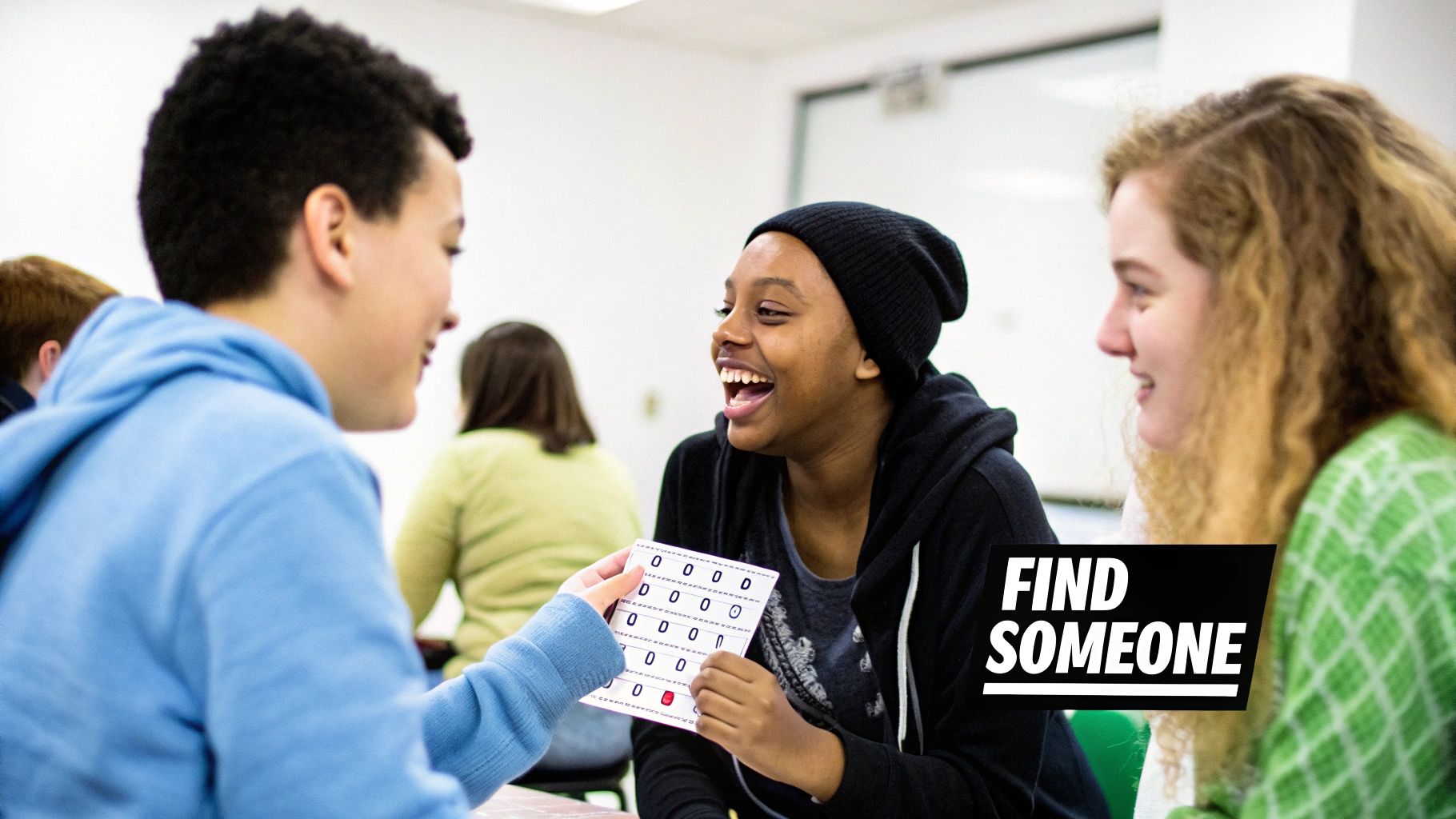
This high-energy game is one of the most effective youth group icebreaker games for getting everyone moving and interacting from the get-go. The concept is simple: participants receive bingo cards filled with unique characteristics or experiences (e.g., 'has travelled to another country', 'plays a musical instrument', 'is the oldest sibling'). Their goal is to mingle and find people who match each square, getting a signature to prove it.
The objective is to fill a line, a pattern, or the entire card, encouraging wide-ranging interaction rather than cliquey conversations. It excels at breaking down social barriers in a structured way, making it ideal for youth group kickoff events or any situation where a new group is forming. This organised mingling helps even shy members start conversations with a clear purpose.
Why It Works for Youth Groups
Human Bingo transforms the potentially awkward task of meeting new people into a fun, low-pressure quest. It gives young people a reason to approach others and a script to start a conversation, which is invaluable for those who feel anxious in social settings. The game celebrates the diverse experiences within the group, revealing surprising commonalities and unique individual stories.
Emotional Literacy Tie-In: This game actively builds social awareness and relationship skills. By seeking out others based on specific prompts, young people practise initiating conversations, asking questions, and actively listening to their peers' responses, which are foundational components of developing strong interpersonal connections.
How to Implement It Effectively
- Customise the Cards: Tailor the squares to your group. Include a mix of simple traits ('has a pet') and more unique ones ('has seen a shooting star'). This personalisation makes the game more relevant and engaging.
- Set a Time Limit: Keep the energy high by setting a 10-15 minute time limit. This encourages quick, focused interactions and adds a sense of friendly competition.
- Offer Small Prizes: Reward the first few people to shout "Bingo!" with small treats or privileges. This adds a light-hearted incentive to participate fully.
- Debrief Afterwards: Spend a few minutes sharing surprising discoveries. Ask, "What was the most interesting thing you learned about someone?" This reinforces the connections made during the game. For more ideas on structured interaction, you can explore other social skills activities for young people.
3. Never Have I Ever: The Experience Revealer
A classic that has evolved from a party game into one of the most revealing youth group icebreaker games, “Never Have I Ever” is excellent for uncovering shared experiences and unique life stories. In its youth-friendly version, participants start with all ten fingers held up. One person makes a statement beginning with "Never have I ever...", such as "Never have I ever been to another country." Anyone who has done that action puts one finger down. The goal is simply to share, not to be the last one standing.
This game gently uncovers the diverse backgrounds and adventures within the group. It moves quickly and keeps energy levels high, making it ideal for the start of a youth retreat or a summer camp bonding session. The statements can range from the silly, like "Never have I ever eaten a whole pizza by myself," to the more significant, like "Never have I ever performed on a stage," sparking natural follow-up conversations.
Why It Works for Youth Groups
The game provides a structured format for sharing personal history without the pressure of direct questioning. It equalises the room by focusing on experiences rather than opinions, allowing young people to connect over commonalities they might never have discovered otherwise. This process helps build empathy as participants realise the vast range of experiences held by their peers, fostering a more inclusive and understanding group dynamic.
Emotional Literacy Tie-In: This activity encourages perspective-taking and social awareness. Hearing about others' experiences helps young people understand that everyone has a unique journey. It also builds self-awareness as they reflect on their own life experiences and what has shaped them.
How to Implement It Effectively
- Set the Tone: Have a leader start with a few pre-planned, light-hearted statements to establish a positive and safe atmosphere. This prevents the game from veering into uncomfortable territory.
- Establish Boundaries: Clearly state that statements should be kept appropriate for the group. Avoid sensitive topics like family issues, trauma, or risky behaviours. The focus is on fun, shared experiences.
- Frame it Positively: Emphasise that this isn't a competition. The aim is to learn about each other. Celebrate the diversity of experiences rather than focusing on who has fingers left.
- Allow for Follow-Up: After a particularly interesting statement, pause and allow for brief, voluntary storytelling. Asking, "Who wants to share a quick story about that?" can lead to fantastic moments of connection.
4. Four Corners: A Game of Movement and Opinion
This energetic activity is one of the best youth group icebreaker games for getting participants moving and sharing opinions without the pressure of a spotlight. The facilitator designates four corners of the room with different options for a given category. For instance, the corners might represent seasons: Spring, Summer, Autumn, and Winter.
After a question is asked, "Which is your favourite season?", everyone moves to the corner that matches their choice. This simple act of movement and non-verbal alignment instantly creates small, like-minded groups. It’s a fantastic way to reveal common ground and spark low-stakes conversations among participants.
Why It Works for Youth Groups
Four Corners removes the fear of having a "wrong" answer and instead celebrates personal preference. The physical movement breaks up sedentary patterns, increasing energy and engagement. It allows young people to express themselves kinesthetically, which is particularly beneficial for those who are less comfortable with purely verbal activities. It is a brilliant way to build a sense of belonging through shared interests.
Emotional Literacy Tie-In: This game encourages self-reflection and decision-making. As questions progress from simple preferences to values, participants must consider their own beliefs and choices, fostering a stronger sense of self-awareness and the confidence to stand by their convictions.
How to Implement It Effectively
- Start Light: Begin with fun, easy questions like "Favourite pizza topping?" or "Ideal superpower?" to create a playful atmosphere before moving to more thoughtful topics.
- Encourage Discussion: Once in their corners, give groups a minute to briefly discuss why they made that choice before a few share with the wider group.
- Manage Time: Keep the game brisk. Aim for four or five questions over 10-15 minutes to maintain momentum and hold everyone’s attention.
- Ensure Accessibility: For participants with mobility challenges, offer alternative ways to participate, such as raising a coloured card or using hand signals for each corner.
5. Speed Meeting (Speed Dating Format)
For larger gatherings where getting to know everyone seems impossible, this high-energy icebreaker is a game-changer. Modelled after speed dating, participants form two lines facing each other, creating pairs. Each pair gets 2-3 minutes to discuss a specific, light-hearted prompt (e.g., “What’s a hidden talent you have?”) before a signal is given and one line shifts, forming new pairs.
This dynamic format is one of the most efficient youth group icebreaker games for large events, such as conferences or regional youth gatherings. It rapidly breaks down social barriers by ensuring every participant has several brief, focused, one-on-one conversations. The structure removes the pressure of initiating small talk, making it easier for everyone to engage.
Why It Works for Youth Groups
In an age where digital interaction often dominates, Speed Meeting encourages direct, face-to-face communication. It builds social confidence by providing a safe, structured framework for conversation. The quick rotations keep the energy high and prevent conversations from fizzling out, which is ideal for holding the attention of young people.
Emotional Literacy Tie-In: This activity directly develops active listening and interpersonal communication skills. By responding to varied prompts, young people practise articulating their thoughts concisely and listening attentively to others, fostering empathy and mutual understanding.
How to Implement It Effectively
- Clear Signals: Use a loud timer, a bell, or a whistle to clearly signal the end of each round. This keeps the game moving smoothly and avoids confusion.
- Prepare Prompts: Have 5-6 engaging prompts ready. Write them on cards or a whiteboard. Start with simple topics and gradually move to slightly more thought-provoking ones.
- Set the Vibe: Play some upbeat, energetic background music at a low volume. This fills any potential silences and adds to the lively atmosphere of the game.
- Manage Numbers: If you have an odd number of participants, have one person (or a leader) sit out each round to act as the timekeeper. This ensures everyone has a partner.
For more ideas on building group cohesion, check out these team-building activities for youth.
6. Would You Rather: The Conversation Catalyst
This deceptively simple game is a powerful tool for sparking discussion and revealing personality traits in a fun, non-confrontational way. A facilitator poses a series of dilemma questions, each beginning with "Would you rather...?" Participants then choose between two distinct, often quirky or thought-provoking, scenarios.
For example, asking "Would you rather have the ability to fly or be invisible?" instantly gets people thinking. The real magic happens in the follow-up, where participants share the reasoning behind their choice. It's a fantastic, low-stakes way to get everyone talking, making it one of the most versatile youth group icebreaker games for any setting, from a bus trip to an online meeting.
Why It Works for Youth Groups
This game excels at accommodating various comfort levels. There are no right or wrong answers, which removes the fear of judgement. It allows young people to share their thought processes and values without needing to talk directly about themselves. Discussing a hypothetical choice is often easier than sharing a personal story, creating a gentle pathway to deeper connection and understanding.
Emotional Literacy Tie-In: This activity fosters critical thinking and empathy. By hearing others' justifications, young people learn to appreciate different perspectives and understand that people's values drive their decisions. Exploring these choices can be a great way to introduce concepts from emotional intelligence games for kids.
How to Implement It Effectively
- Balance the Questions: Mix light-hearted, silly questions ("...eat only pizza or only ice cream for a year?") with more thought-provoking ones ("...be able to see the future or change the past?").
- Encourage Justification: The most important part is the "why". Prompt participants to explain their reasoning to fuel the conversation.
- Use It as a Transition: This game is perfect for filling short gaps or shifting the energy between more structured activities.
- Keep a Good Pace: Give participants about 30-45 seconds to decide and a minute or so to share, ensuring the momentum doesn't lag.
7. M&M Game (or Skittles/Candy Variation): The Sweet Share
This tactile activity is one of the most colourful youth group icebreaker games for encouraging participation through a sweet treat. The concept is wonderfully simple: a bowl of multi-coloured sweets (like M&Ms or Skittles) is passed around, and each young person takes a few. Each colour corresponds to a specific sharing prompt, turning a simple snack into a structured conversation starter.
For example, red might mean 'share your favourite hobby', yellow could be 'name a place you want to visit', and green might ask 'what is one thing you are grateful for today?'. The element of chance removes the pressure of deciding what to share, making the process feel more like a game and less like an interrogation. It’s a brilliant way to get discussions flowing in a low-stakes, enjoyable manner.
Why It Works for Youth Groups
The game uses a familiar, positive item-sweets-to lower social barriers. For many young people, especially those who are more introverted or anxious, having a physical object to focus on can be calming. The randomised prompts also ensure a level playing field; no one has to invent a fascinating story on the spot. This creates a gentle pathway for everyone to contribute, fostering a sense of inclusion and shared experience from the very beginning.
Emotional Literacy Tie-In: This game encourages self-reflection in a playful context. Answering prompts like 'what makes you happy?' or 'what's a challenge you overcame?' helps young people identify and articulate their feelings and experiences, building a foundational vocabulary for emotional expression.
How to Implement It Effectively
- Create Clear Prompts: Prepare a chart or slide with 5-6 clear prompts, one for each sweet colour. Start with lighter questions before considering deeper ones.
- Be Mindful of Allergies: Always check for allergies and dietary restrictions. Offer allergy-safe alternatives like Skittles or have a non-food option ready, such as coloured beads or pieces of paper.
- Manage the Share: Ask each person to share the answer for just one of their chosen sweets to keep the game moving. If time allows, you can do a second round.
- Leader Goes First: As with other icebreakers, have a youth leader model the activity. This demonstrates the expected tone and length of the answer, setting everyone at ease.
8. Ball Toss Questions: Active Connection
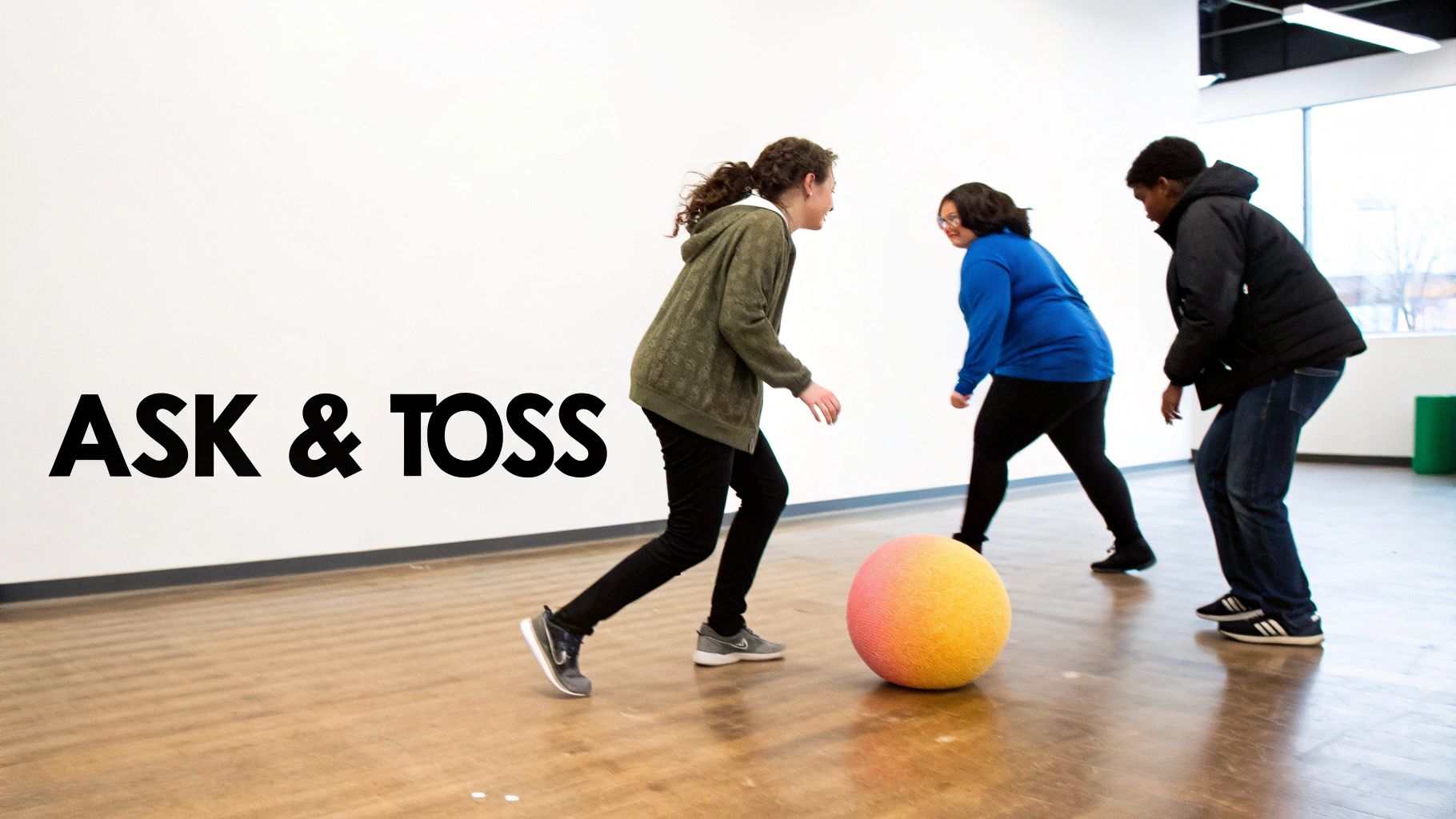
This game injects energy into the classic Q&A format, making it one of the most engaging youth group icebreaker games for kinaesthetic learners. Participants stand in a circle and toss a soft ball to one another. The person throwing the ball asks a question, and the person who catches it must answer before tossing it to someone new with a different question.
The game’s strength is its blend of physical activity and personal sharing. The simple act of throwing and catching a ball breaks down physical barriers and keeps the energy levels high, while the questions encourage participants to share facts and feelings. For example, a question like, "What is one thing you're proud of?" can lead to meaningful revelations in a fun, fast-paced environment.
Why It Works for Youth Groups
Ball Toss Questions is brilliant for groups that have trouble sitting still. The physical component helps to channel excess energy constructively, making it easier for young people to focus and engage. It removes the stiff formality of a sit-down discussion, creating a more relaxed and spontaneous atmosphere where everyone feels included in the action. The random nature of the toss ensures that different people interact, preventing cliques from dominating the conversation.
Emotional Literacy Tie-In: This activity promotes social awareness and active listening. Participants must pay attention to both the person speaking and the movement of the ball. It also practises spontaneous self-expression, helping young people become more comfortable thinking on their feet and sharing their thoughts openly.
How to Implement It Effectively
- Choose the Right Ball: Use a soft, easy-to-catch item like a foam ball, a beach ball, or even a beanbag to ensure safety and reduce performance anxiety.
- Prepare Initial Questions: Have a list of light-hearted questions ready to start the game, such as "What's your favourite pizza topping?" or "If you could have any superpower, what would it be?"
- Establish Clear Rules: Before starting, explain that there are no "wrong" answers and that the goal is to get to know one another. Set a guideline for respectful listening.
- Modify for Inclusivity: Ensure the activity is accessible for all participants. If someone has mobility challenges, they can be a designated "question master" or the circle can be adapted to accommodate them.
9. Scavenger Hunt (People Version): The Active Connector
This energetic game flips the traditional scavenger hunt on its head. Instead of searching for objects, participants search for people who match specific criteria, collecting signatures to prove their discoveries. This is one of the most dynamic youth group icebreaker games for large groups, transforming mingling from a daunting task into a fun, goal-oriented mission.
Participants are given a list with prompts like, ‘Find someone who has visited another continent,’ or ‘Find someone who can play three different musical instruments.’ The quest to find qualifying individuals encourages members to move around and initiate dozens of brief, positive conversations. For groups planning outdoor adventures, this type of active game can set a collaborative tone, similar to the teamwork needed when preparing your family camping essentials for a big trip.
Why It Works for Youth Groups
This activity excels at breaking down social barriers and cliques by creating a shared, low-stakes objective. It organically reveals the diverse experiences and hidden talents within the group, celebrating individuality in a structured way. The movement and interaction make it especially effective for kinesthetic learners and for raising the energy level in the room.
Emotional Literacy Tie-In: This game promotes social awareness and relationship skills. It requires young people to approach others, ask questions, and listen actively. This helps them practise initiating conversations and showing genuine curiosity about their peers, which are foundational skills for building healthy relationships.
How to Implement It Effectively
- Create a Balanced List: Design a list of 15-20 descriptors with a mix of common and unique traits. Include fun, achievable items like ‘has a pet dog’ alongside more challenging ones like ‘was born in December’.
- Set Clear Rules: Establish a time limit, typically 20-30 minutes, and clarify rules such as ‘one signature per person per sheet’ to encourage wider interaction.
- Offer Small Incentives: A small prize for the first person to complete their sheet or the person with the most signatures can add a layer of friendly competition.
- Debrief Afterwards: Gather the group to share the most surprising or interesting facts they learned. This reinforces the connections made during the game.
10. Desert Island/Survival Scenario
This collaborative challenge is one of the most revealing youth group icebreaker games for observing teamwork, values, and problem-solving skills in action. The concept involves presenting small groups with a hypothetical crisis, such as being stranded on a desert island, and asking them to agree on a limited number of essential items for survival.
The real magic happens during the discussion. Groups must debate, justify their choices, and ultimately reach a consensus, offering a fantastic window into individual personalities and group dynamics. For instance, one group might prioritise practical tools like a knife and a water filter, while another might choose a book or a musical instrument, sparking a conversation about what truly matters for survival, both physically and mentally.
Why It Works for Youth Groups
This game moves beyond simple introductions and requires genuine collaboration. It helps young people practise negotiation, communication, and compromise within a low-stakes, imaginative setting. Seeing how others think and prioritise can build mutual respect and understanding, creating a solid foundation for deeper group cohesion. It is an excellent way to see who emerges as a natural leader and who excels at building consensus.
Emotional Literacy Tie-In: The activity strengthens social awareness and relationship skills. By navigating disagreements and working towards a common goal, participants learn to appreciate diverse perspectives and manage interpersonal dynamics. This models healthy conflict resolution, a vital life skill.
How to Implement It Effectively
- Create Small Groups: Divide participants into groups of 4-6 to ensure everyone has a chance to contribute to the discussion.
- Provide Clear Scenarios: Give each group a written scenario with clear instructions and a firm time limit (e.g., 10 minutes) to keep the energy focused.
- Facilitate Presentations: Ask each group to present its final list of items and, more importantly, the reasoning behind their collective decisions.
- Debrief the Process: After the presentations, lead a short discussion about the decision-making process itself. Ask questions like, "What was the most difficult item to agree on?" or "Did anyone change their mind during the discussion?"
Top 10 Youth Group Icebreakers — Quick Comparison
| Activity | Implementation Complexity 🔄 | Setup & Resources ⚡ | Expected Outcomes 📊 | Ideal Use Cases 💡 | Key Advantages ⭐ |
|---|---|---|---|---|---|
| Two Truths and a Lie | 🔄 (very low) | ⚡⚡⚡ (no materials) | ⭐⭐⭐ — Personal sharing, laughter | Small–mid groups (5–30), 15–45 min | Minimal prep; inclusive; creative |
| Human Bingo | 🔄🔄 (low–moderate) | ⚡⚡ (printable cards) | ⭐⭐ — Networking & commonalities | Large mixers (15–100+), 20–30 min | Encourages mingling; scalable; competitive fun |
| Never Have I Ever | 🔄 (very low) | ⚡⚡⚡ (no materials) | ⭐⭐ — Reveals experiences, discussion prompts | Mid groups (10–50), 15–30 min | Easy to run; surprising discoveries; flexible |
| Four Corners | 🔄🔄 (low–moderate) | ⚡⚡ (open space) | ⭐⭐ — Preference clusters & small-group talk | Any size with space (10–100+), 15–20 min | Gets people moving; creates instant small groups |
| Speed Meeting (Speed Dating) | 🔄🔄🔄 (moderate) | ⚡⚡ (timing device, prompts) | ⭐⭐⭐ — Fast one-on-one connections | Large events (20–100+), 15–25 min | Meets many people quickly; prevents cliques |
| Would You Rather | 🔄 (very low) | ⚡⚡⚡ (no materials) | ⭐⭐ — Creative conversation, personality reveal | Any size, flexible duration | Simple; adaptable; sparks thought |
| M&M Game (Candy Variation) | 🔄🔄 (low–moderate) | ⚡⚡ (candies or colored tokens) | ⭐⭐ — Guided sharing via chance | Small groups (8–50), 15–20 min | Tactile; lowers sharing pressure; fun reward |
| Ball Toss Questions | 🔄🔄 (low–moderate) | ⚡⚡ (one soft ball) | ⭐⭐⭐ — High energy, broad participation | Indoor/outdoor groups (10–50), 15–25 min | Kinesthetic; playful; engages many quickly |
| Scavenger Hunt (People) | 🔄🔄🔄 (moderate–high) | ⚡⚡ (checklists, space) | ⭐⭐⭐ — Active mingling & discovery | Mid–large groups (15–100+), 30–45 min | Energetic; reveals diversity; memorable |
| Desert Island / Survival Scenario | 🔄🔄 (moderate) | ⚡⚡ (scenario sheets, small groups) | ⭐⭐⭐ — Deep discussion & teamwork | Small groups/breakouts (12–60), 30–45 min | Builds problem‑solving, consensus & insight |
Building on the Momentum: Next Steps for a Mentally Healthy Group
The ten youth group icebreaker games detailed in this article, from Human Bingo to the Desert Island Scenario, are more than just ways to fill time. They are powerful, practical tools for dismantling social barriers and building the foundational trust necessary for a thriving, supportive community. Each game serves as a carefully chosen key, unlocking conversations and connections that might otherwise remain dormant. By encouraging shared laughter, friendly competition, and moments of genuine self-revelation, you lay the groundwork for a space where young people feel seen, heard, and valued. This initial burst of energy and connection is the perfect launchpad for fostering a culture of long-term emotional wellbeing.
The real magic happens when the momentum from these activities is channelled into consistent, intentional practices. Creating a mentally healthy environment isn’t about a single grand gesture; it’s about the accumulation of small, thoughtful actions that normalise conversations around feelings and mental health. The ultimate goal is to transform your group from a simple gathering into a genuine safe haven where young people can be their authentic selves.
From Icebreakers to Intentional Support
So, where do you go from here? How do you build upon the positive atmosphere these games create? The key is to weave wellbeing practices into the very fabric of your group’s routine.
- Integrate Mindful Moments: Begin or end sessions with simple relaxation techniques. A 'box breathing' exercise (inhale for four, hold for four, exhale for four, hold for four) or a mindful listening activity can centre the group, reduce anxiety, and signal that it's okay to slow down.
- Create a Resource Corner: Set up a small, accessible library with mental health books aimed at young adults, such as The Subtle Art of Not Giving a F*ck by Mark Manson or Reasons to Stay Alive by Matt Haig. Having tangible resources on hand demonstrates a commitment to their wellbeing.
- Normalise Help-Seeking: Regularly and openly mention that it's brave and responsible to seek professional help. Ensure you have contact information for local youth mental health services, and remind everyone that speaking to a GP is a crucial first step for any serious concerns. As a youth leader, remember your role is to guide and support, not to diagnose. You can also normalise the conversation through mental health apparel, which can act as a walking billboard for acceptance.
A Note on Professional Guidance: While these activities foster connection, they are not a substitute for professional mental health care. Always be prepared to direct a young person to qualified professionals like their doctor or a counsellor if they express significant distress or concerns about their mental health.
By consistently applying these strategies, you signal that mental health is a priority. This proactive approach helps to dismantle the stigma that so often prevents young people from speaking up, especially in an era where social media pressures can significantly impact their sense of self-worth. One recent study found that 57% of teenagers feel pressure from the way people look on social media. You are not just playing games; you are actively building a resilient, empathetic, and mentally aware community, one interaction at a time. The connections forged during a simple game of Two Truths and a Lie can become the very relationships that help a young person navigate life’s biggest challenges.
Ready to expand your toolkit for emotional literacy? Explore the curated collection of books and resources at Little Fish Books. Our materials are specifically designed to help you continue the important conversations started by these youth group icebreaker games, providing engaging stories and activities that make discussing big feelings easier for everyone.