

Using a Blank Faces Template to Nurture Emotions
A blank faces template is a beautifully simple tool: a printable outline of a face with no features. It's used to help children explore and express their emotions in a really hands-on way.
More Than Just a Drawing Activity
It might look like just another arts-and-crafts sheet, but a simple blank face template is one of the most powerful resources I've come across for nurturing emotional literacy. It gives children a safe, tangible way to investigate complex feelings, transforming a drawing session into a moment of genuine emotional development.
Children's mental health is, quite rightly, a huge topic of conversation right now. With pressures from school, friendships, and the online world, it's clear that many young people are struggling. In fact, recent data shows that one in five children in England aged 8 to 16 has a probable mental health condition. Giving them the tools to understand and talk about their feelings early on is one of the best ways we can build their resilience for life.
A gentle reminder: While I’ll be sharing educational strategies and my own insights in this guide, I am not a mental health professional. If you have any worries about your child's mental wellbeing, please do chat with a qualified specialist or your GP.
The Power of a Blank Canvas
For a child who can't yet find the words for 'frustrated' or 'anxious', a blank faces template can act as a non-verbal bridge. It's often much easier to draw scrunched-up eyebrows or a wobbly, downturned mouth than it is to explain the feeling out loud.
This simple act of drawing externalises the emotion. It turns an overwhelming internal feeling into something they can see, point to, and talk about without feeling put on the spot.
This is an approach you'll see in classrooms up and down the country. Blank faces are a staple in Early Years (EYFS) and Key Stage 1 (KS1) settings, used in creative play and as part of the PSHE curriculum. They’re brilliant for helping children learn to recognise different facial expressions and connect them to feelings.
Here’s a quick look at the key developmental areas these templates support in children.
Core Benefits of Using a Blank Faces Template
| Developmental Area | How Templates Help | Practical Example |
|---|---|---|
| Emotional Literacy | Provides a visual way to identify and name feelings. | "Show me what 'surprised' looks like on this face." |
| Communication Skills | Opens up conversations about why someone might feel a certain way. | After drawing a sad face, ask, "I wonder what made them feel sad?" |
| Empathy & Social Skills | Helps children understand that others have feelings too. | Read a story and have children draw the character's feelings at different points. |
| Self-Expression | Offers a safe outlet for children who struggle with verbal expression. | Leave templates in a calm-down corner for children to use when they feel overwhelmed. |
These activities are just the beginning, but they show how a simple sheet of paper can become a powerful tool for connection and understanding.
Building an Emotional Vocabulary
Helping our children build a rich emotional vocabulary is one of the greatest gifts we can give them. It doesn’t just help them understand themselves; it lays the foundation for empathy. Using a tool like a blank faces template is a fantastic, practical way to kickstart these vital conversations.
Activities like this help normalise talking about mental health from day one. You can also bring colour into the conversation by exploring the benefits of colouring emotions with your child. By fostering an open dialogue now, we're helping to raise a generation that's more in tune with their emotional needs and better equipped to handle whatever life throws their way.
Setting Up Your Emotional Toolkit
Before you dive into an activity with a blank faces template, getting your materials together first can make all the difference. This isn't just about printing a sheet of paper; it’s about creating an inviting and well-prepared space for creative expression. A little prep work really does transform a simple drawing exercise into a meaningful moment of connection.
First, you’ll need the templates. A quick online search will bring up hundreds of free printable blank faces template options, from simple ovals to more detailed head-and-shoulder outlines. It’s a good idea to choose a few different styles to see what resonates.
If you plan on using things like playdough, paint, or reusable markers, I highly recommend laminating the templates. This makes them far more durable and means you can use them for endless creative sessions.
Assembling Your Feelings Toolkit
Think beyond just a pack of coloured pencils. Creating a dedicated 'feelings toolkit' makes the whole experience much more engaging and sensory-rich. It sends a clear message that you value this time, and it encourages a child to explore different textures and materials as they express themselves.
Here are a few ideas to get your toolkit started:
- Classic Art Supplies: Pencils, crayons, felt-tip pens, and paints are perfect for drawing facial expressions.
- Textural Materials: Scraps of wool or yarn for hair, small fabric offcuts for clothes, or even buttons for eyes can add a wonderful three-dimensional element.
- Natural Items: Why not go on a nature walk first? You could collect leaves, small twigs, petals, and seeds to create beautifully expressive and organic faces.
Having these items organised in a special box or tray makes the activity feel contained and important. It becomes an open invitation to create, without the pressure of a perfect outcome. It also opens up another avenue for discussion; for instance, a spiky twig might represent an 'angry' feeling, while soft petals could signify 'calm'.
This kind of tactile exploration is very similar to other somatic exercises. In fact, you can learn more about how physical sensations connect to our emotions by reading our guide on using a body mapping template.
Setting the Scene for Openness
How you introduce the activity is just as important as the materials you provide. The goal here is to gently open up a dialogue about emotions, not to put a child on the spot. I’ve found that direct questions like, "How are you feeling today?" can sometimes feel too intense and cause a child to withdraw.
Instead of asking a direct question, try a softer, more observational prompt. This approach removes pressure and invites curiosity, making it easier for a child to share their thoughts.
For example, you could say something like, "I wonder what kind of day this person is having?" or "Let's see if we can show what a really excited face looks like." This frames the activity as a shared exploration. You're simply wondering together, which makes it a low-stakes, collaborative, and ultimately more connecting experience for everyone involved.
Exploring Feelings with Your Child
Okay, you’ve got your templates printed and your art supplies are ready. Now for the fun part: turning a simple outline of a face into a real conversation about feelings. How you approach this really depends on who you’re doing it with.
With toddlers and younger children, it’s best to stick to the big, core emotions. Think chunky crayons, finger paints, and simple words like ‘happy’, ‘sad’, or ‘angry’. You’re just trying to connect the drawing to things they already understand in their own little worlds.
For older children, you can get into the more complex stuff. This is a great chance to introduce words like ‘frustrated’, ‘proud’, ‘anxious’, or even ‘disappointed’. They might even want to write a little story about the character they've created, explaining why they feel a certain way.
I find it helps to think of it as a simple three-step flow: get your stuff, get the templates ready, and then get the conversation started.
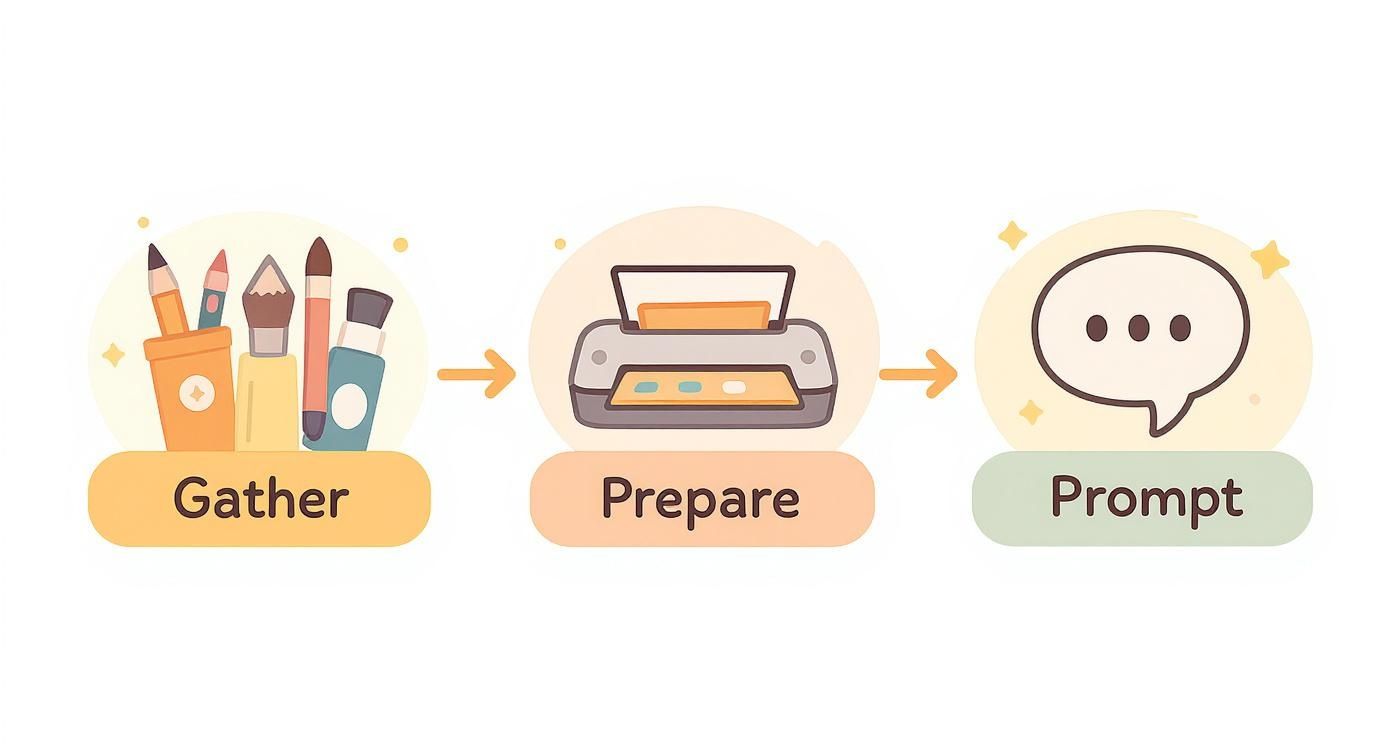
This little visual is a good reminder that the prep work and the way you prompt the chat are just as vital as the drawing itself.
Fostering a Supportive Dialogue
The magic really happens when you use gentle, open-ended prompts. Instead of just asking, "What feeling is that?", try describing what you see and connecting it to a real-life moment. It's a simple way to model empathy and makes it so much easier for a child to share what they’re thinking.
You could try saying things like:
- "This face looks a little bit sad. It reminds me of when my friend couldn't come over to play."
- "Wow, look at that big smile! I wonder if they just got some brilliant news."
- "Those eyebrows are scrunched up. Sometimes my face looks like that when I'm trying to figure out a tricky puzzle."
See the difference? It shifts the dynamic from a quiz to a shared moment. It sends a powerful message that all feelings are okay and it's safe to talk about them.
Remember, the aim isn't to get the 'right' answer or create a perfect piece of art. The goal is to open a channel for communication and make talking about emotions a normal, everyday part of your family's life.
Adapting for Different Needs
One of the best things about a blank faces template is how adaptable it is, especially for children with Special Educational Needs (SEN). Making it a sensory-rich experience can be a game-changer for engagement.
Think about using different textures to create the facial features – things like sand, glitter, or even playdough. You could pair the templates with simplified emotion cards that have clear images, providing a helpful visual reference. For a child who is non-verbal, this can be an incredibly powerful way for them to express themselves without words.
We know from experience in UK early years settings that these kinds of tools genuinely work. They lead to measurable improvements in engagement and hand-eye coordination. It’s all about supporting a multisensory approach to learning, which is so important for early cognitive development.
And this doesn't have to be the only way you explore emotions through art. Things like using a coloring book to explore feelings can be another fantastic outlet. At the end of the day, it's about turning a creative activity into a meaningful conversation that builds a strong foundation for lifelong emotional wellbeing.
Using Digital Tools for Creative Expression
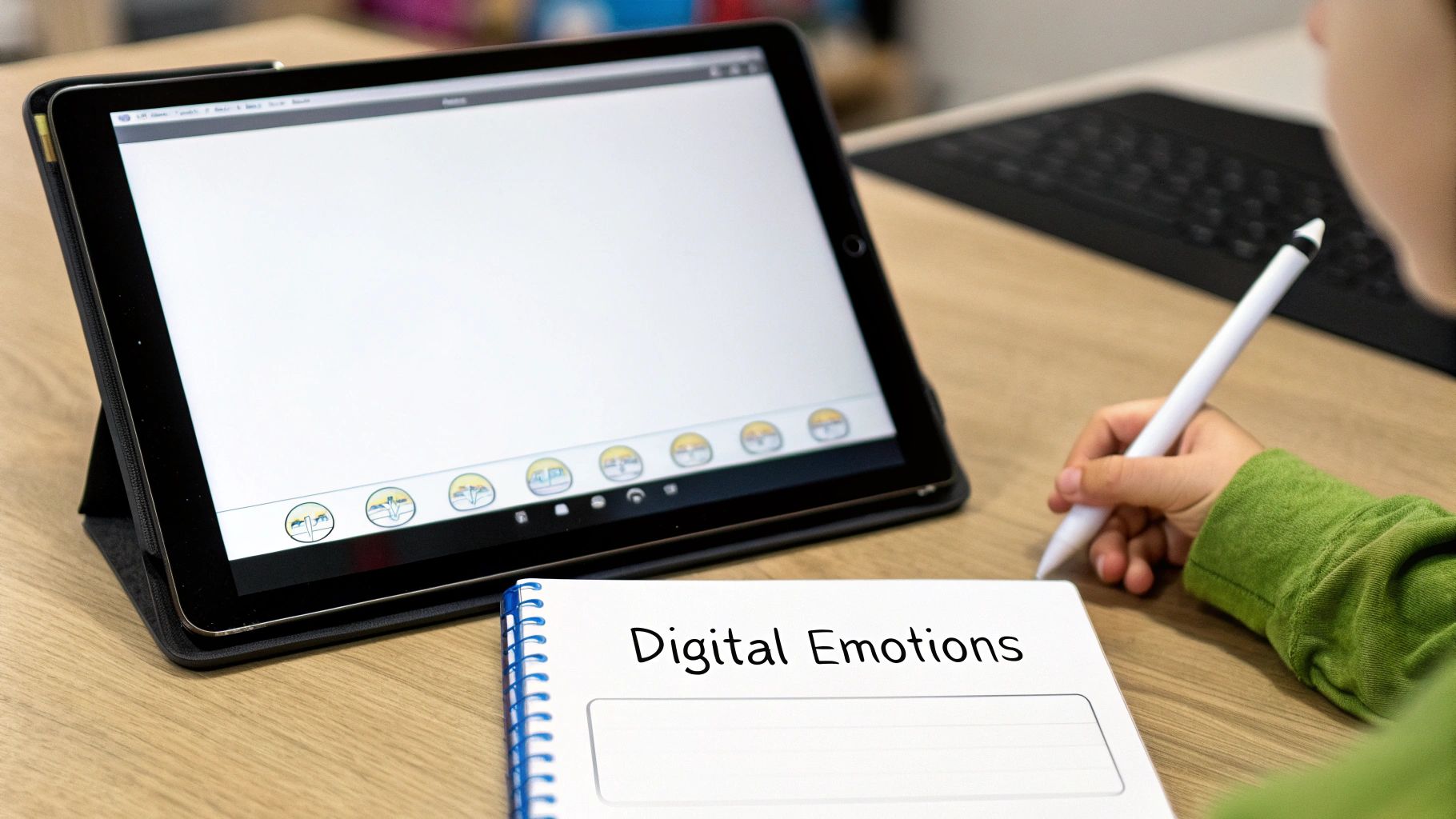
Moving beyond paper and pencils can open up a whole new world of creativity. A digital blank faces template on a tablet or computer gives children a chance to experiment freely with colours, lines, and textures in a way that feels modern and engaging.
One of the biggest wins of working digitally is the famous 'undo' button. For a child who might feel hesitant to commit to a drawing with permanent markers, this simple feature can be incredibly liberating. It encourages them to take creative risks without that nagging fear of making a mistake.
From Static Image to Dynamic Story
Digital tools allow you to take the creative process so much further. A drawing of a face doesn't have to be the final product; it can be the starting point for a much bigger narrative.
Simple, user-friendly animation apps can turn a series of drawings into a short storyboard. This allows a child to build a story around their character's emotional journey. They can explore not just how a character feels in one moment, but how those feelings might change over time in response to different events. This storytelling adds a real layer of depth, connecting emotions to cause and effect.
For those looking to merge art with video, you can even explore various techniques for digital drawing and highlighting on videos, turning a simple template into an interactive part of a larger project.
Reflecting on Identity Through Self-Portraits
Using a blank faces template as a basis for a digital self-portrait encourages thoughtful reflection on identity. Children can experiment with different ways of representing themselves, choosing colours and styles that reflect their personality, mood, or just how they see themselves in that moment.
This activity can be a really gentle way to explore self-perception and identity. Technology can even enhance this experience; for instance, you can explore our guide on using an augmented reality experience for mental health and emotions to see how digital tools are being used in innovative ways to support wellbeing.
A digital self-portrait isn't just about drawing what you look like. It's an opportunity for a child to express who they feel they are on the inside, providing a valuable snapshot of their inner world.
Connecting Templates to Real-World Technology
It’s fascinating to show children how a simple learning tool connects to complex, real-world technology. The concept of a facial template extends far beyond the classroom and into fields like biometrics and security.
In the UK, this technology is a cornerstone of facial recognition technology (FRT). By 2019, UK airports were widely using eGate systems that rely on facial templates for 1:1 verification to speed up passport control. This shows how the basic idea of mapping a face is used not just for art, but to verify identity and safeguard borders, sparking important conversations about technology and privacy.
Keeping the Conversation Going
The real magic happens when the lessons from our little craft session extend beyond the activity itself. This is all about using that positive momentum to create a home where talking about feelings is just… normal. It’s what you do. Long after the pens and paper have been tidied away.
This is more important than ever. The pressure to succeed, maintain friendships, and navigate an increasingly online world can take a significant toll. Addressing mental health early doesn't just help children manage their feelings now; it equips them with essential life skills, preventing more serious issues from developing later on.
Navigating Modern Pressures
One of the toughest challenges for our children is the constant pressure from social media. It's a world of curated perfection that can profoundly impact their self-esteem and mental health. Gentle, open conversations about this are your best tool.
You don't have to be heavy-handed. Try asking something like, "It's funny how everyone looks so happy in their online pictures, isn't it? I wonder if they ever have sad or worried days too." This opens a door to chat about the gap between online life and real feelings, without making it a big lecture.
Just a quick note: I am not a mental health professional. The advice I share here comes from personal experience and is for educational purposes. If you have genuine concerns about your child’s mental wellbeing, your first port of call should always be your GP or a qualified specialist.
The ripple effect of poor mental health is huge, and not just on a personal level. In the UK, mental ill-health is estimated to cost employers between £53-56 billion every single year due to absenteeism and reduced productivity. This just goes to show how vital it is that we build these resilient foundations from a young age.
Weaving Wellbeing into Daily Life
Creating a supportive atmosphere at home doesn’t need grand gestures. It's the small, consistent things you do every day that make the biggest difference.
- Create a 'Calm-Down Corner': Find a cosy spot in your home and fill it with soft cushions, a favourite blanket, and maybe a few calming books or sensory toys. It's a safe space where anyone in the family can go to take a quiet moment when things feel a bit much.
- Practise Mindful Breathing: You can introduce simple breathing exercises in a really playful way. A personal favourite is 'teddy bear breathing'—get them to lie down, pop a small stuffed toy on their belly, and watch it gently rise and fall with each slow breath in and out.
Continuing the Journey with Great Resources
To keep the dialogue alive, surround your family with things that normalise these chats. It could be as simple as wearing mental health apparel, like a t-shirt with a positive message on it. It’s a small but powerful way to keep the conversation front and centre.
Another brilliant way to keep talking is through books. There are some truly wonderful stories out there that help children make sense of their emotions, giving you a shared language to talk about tricky subjects.
Recommended Mental Health Books for Children
To get you started, I've put together a list of some of my favourite books that can help you continue the conversation about emotions with different age groups.
| Book Title | Author | Target Age Group | Key Theme |
|---|---|---|---|
| The Colour Monster | Anna Llenas | 2-5 years | Identifying and separating feelings. |
| Ruby's Worry | Tom Percival | 4-7 years | Understanding and sharing anxieties. |
| The Huge Bag of Worries | Virginia Ironside | 5-8 years | Managing worries by talking about them. |
| What to Do When You Worry Too Much | Dawn Huebner | 6-12 years | Cognitive-behavioural techniques for anxiety. |
These stories are fantastic for snuggling up and reading together, creating a safe and gentle way to explore big feelings.
Got Questions About Using Face Templates?
Even with the best intentions, diving into activities around emotional wellbeing can bring up a few wobbles. It's completely normal to wonder if you're doing it 'right' or how to handle certain situations that might pop up. Let's walk through some of the common queries I hear when people start using a blank faces template.
A question I get asked a lot is, "What if my child just doesn't want to do it?" My best advice is never to force it. Instead, try leaving the template and some inviting art supplies out where they can easily see and reach them. More often than not, a child’s natural curiosity will lead them to it when they feel ready, and that makes their engagement so much more genuine.
Another common concern is what to do if a child draws a really sad, angry, or worrying face. Your role here isn’t to fix it, but simply to hold space for that feeling. A calm, gentle response like, "It looks like this person is feeling really sad today. Thank you for sharing that with me," creates a safe, judgement-free zone for them to express themselves.
Looking After Their Mental Health Responsibly
The growing awareness around children's mental health is a huge step forward, but it also brings a great deal of responsibility for us as parents and educators. Activities with face templates are a brilliant way to get conversations started, but they're just one small piece of a much bigger puzzle. They are not a diagnostic tool, nor are they a substitute for professional support.
Please remember, I am not a mental health professional. The ideas and strategies I'm sharing here are for educational purposes. If you are ever worried about your child’s mental wellbeing, it’s so important to seek advice from a qualified specialist or your GP.
Building emotional resilience is a gentle, ongoing process. It's the simple, consistent things you do every day that make the biggest difference.
- Breathing Buddies: Have your child lie down and pop a small stuffed toy on their tummy. Guide them to take slow, deep breaths and watch their little ‘breathing buddy’ gently rise and fall.
- Worry Time: Set aside a specific, short period (maybe 10 minutes) each day where it's okay to talk about or write down any worries. This helps to contain anxious thoughts rather than letting them take over the entire day.
- Five Senses Grounding: When a child feels overwhelmed, gently guide them to name five things they can see, four things they can touch, three things they can hear, two things they can smell, and one thing they can taste.
These small, consistent actions weave emotional support right into the fabric of your daily life, reinforcing the lessons you begin with tools like a blank faces template.
At Little Fish Books, we're passionate about creating resources that support these vital conversations. From our beautifully illustrated books to engaging activities, our goal is to help you nurture your child's emotional growth, every step of the way.
You can explore our full range of emotional wellbeing resources at https://thatsokay.co.uk.