

Books About Finding Yourself That Nurture Your Child's Growth
Books about finding yourself are so much more than just a good story. They’re a mirror, showing children their own feelings reflected back at them. And they’re a window, giving them a peek into how other people feel and live. These stories are incredible tools for building emotional literacy, resilience, and self-compassion from a very young age, acting as little guides on the path to self-discovery.
How Stories Shape Your Child's Inner World
Picture this: your child comes home from school, quiet and withdrawn after a falling out with a friend. They might not have the words to explain the tangled-up mess of frustration, sadness, and confusion they feel inside. This is where the magic of a story can begin. It offers a safe space to explore those big, complicated emotions without the pressure of a direct, face-to-face chat.

The Growing Need for Emotional Tools
Now more than ever, we need to be talking about mental health in childhood. The reality is that one in six children aged 5 to 16 in the UK were identified as having a probable mental health condition in 2021. This makes finding supportive resources absolutely vital. It doesn't help that the constant stream of social media often presents a polished, unrealistic version of life, making it even harder for young minds to explore who they really are. The impact is significant, with studies showing a link between higher social media use and increased symptoms of anxiety and depression among young people.
It's essential to create an environment where children feel safe to be themselves. Books provide a gentle, offline way to start conversations about what it means to be human—flaws and all.
Stories can be a powerful counter-narrative to that pressure. They teach children that it’s okay to feel big emotions and that making mistakes is just part of growing up. For a practical example, think about a character who learns to overcome their fear of failure after not being picked for the school play. That simple story can inspire a child to finally try that new sport or hobby they’ve been too nervous to start, reframing failure as a chance to learn rather than a final judgment.
Reading as a Relaxation Practice
Beyond the lessons tucked inside the pages, the simple act of reading itself can be a fantastic way to unwind. Just setting aside some quiet time for a story can help soothe an anxious mind and bring a sense of calm.
Here are a few simple relaxation tips to pair with reading:
- Deep Belly Breaths: Before you even open the book, take three slow, deep breaths together. Breathe in through the nose for four counts, hold for four, and out through the mouth for six.
- Cosy Reading Nook: Create a comfortable, safe space with blankets and pillows. Make it their special spot, free from distractions.
- Mindful Listening: Encourage your child to close their eyes and just listen to the story, focusing only on the sound of your voice and the images the words create in their mind.
While books are wonderful resources, it’s important to remember their role. Please note, I am not a mental health professional. If you have serious concerns about your child's wellbeing, it is always best to seek guidance from your GP or a qualified professional.
Unpacking the Core Lessons in Self-Discovery Books
When you really get down to it, books about finding yourself are like emotional toolkits disguised as captivating stories. They create a safe, quiet space for children to explore complicated feelings and social situations without any pressure. This is more important than ever, especially when you think about the constant exposure to social media that urges children to present a perfect, polished version of themselves, leaving very little room for messy, authentic self-discovery.
Stories act as a gentle counterpoint to all that noise. They show characters who aren't perfect, who make mistakes, and who learn and grow from them. That's where the real magic happens.
Fostering Resilience and Emotional Awareness
One of the most vital skills these books nurture is resilience. Picture resilience as a tree that learns to bend in the wind without breaking. A story might feature a character who fails an important test but, instead of seeing it as a complete disaster, learns to view it as a chance to try studying differently next time. This teaches children that setbacks are just a part of life, not a final verdict on their worth.
Another massive theme is learning to identify those big, overwhelming feelings. A child might not have the words for jealousy, but they’ll absolutely recognise it in a story about a character whose best friend starts playing with someone new. Seeing this emotion laid out on the page helps them put a name to it in their own life, which is always the first step toward managing it.
Addressing mental health in childhood is a proactive step towards a healthier society. The cost of poor mental health to UK businesses is estimated at up to £56 billion a year, highlighting the long-term economic and social benefits of investing in emotional wellbeing from an early age.
Building Self-Compassion and Understanding Others
Self-compassion is another cornerstone. So many stories feature characters who are incredibly hard on themselves after making a mistake. Through the journey of the narrative, they learn to treat themselves with the same kindness they'd offer a friend. This is such a powerful lesson for any child struggling with perfectionism or that nagging, negative inner voice.
These books also build empathy by pulling back the curtain on social dynamics. A story might explore why a classmate is acting like a bully, perhaps revealing their own hidden struggles at home. This encourages young readers to look beyond surface-level behaviours and consider what might be going on for others, which is the very foundation of kindness and stronger relationships. For anyone looking to continue this journey, delving into the best personal development books can offer a wealth of strategies and insights for profound self-discovery.
Let's break down some of the key emotional skills that these kinds of stories help to develop.
Key Emotional Skills Developed Through Reading
This table outlines the core emotional skills that books about finding yourself help to nurture in young readers and their real-world benefits.
| Emotional Skill | What It Means for Your Child | Why It Matters in Everyday Life |
|---|---|---|
| Resilience | Learning to bounce back from mistakes and challenges without giving up. | Helps them cope with school pressures, friendship hiccups, and trying new, difficult things. |
| Empathy | The ability to understand and share the feelings of another person. | Leads to kinder friendships, less conflict, and a greater sense of community and connection. |
| Self-Awareness | Recognising their own emotions, strengths, and weaknesses. | Empowers them to understand what they need and how to ask for help when they feel overwhelmed. |
| Self-Compassion | Treating themselves with kindness, especially when they make a mistake. | Reduces anxiety and perfectionism, and builds a healthier relationship with themselves. |
Ultimately, reading these stories helps children build a rich internal world, equipping them with the language and understanding they need to navigate not just the story on the page, but the bigger story of their own lives.
Choosing the Right Book for Your Child's Age
Trying to find the perfect book to help a child make sense of their inner world can feel a bit like searching for a needle in a haystack. The secret is matching the story's depth and complexity to where they are in their own development. What clicks for a toddler is worlds away from what resonates with a teenager, but the goal is always the same: to hand them stories that act as a mirror to their own lives and feelings.
This has never been more important. With one in six children in the UK now experiencing a probable mental health condition, the need for supportive, gentle resources has shot up. You can see this reflected right there on the shelves in bookshops.
The diagram below shows how these self-discovery stories branch out, helping kids build core skills like understanding their feelings, developing resilience, and figuring out their social world.
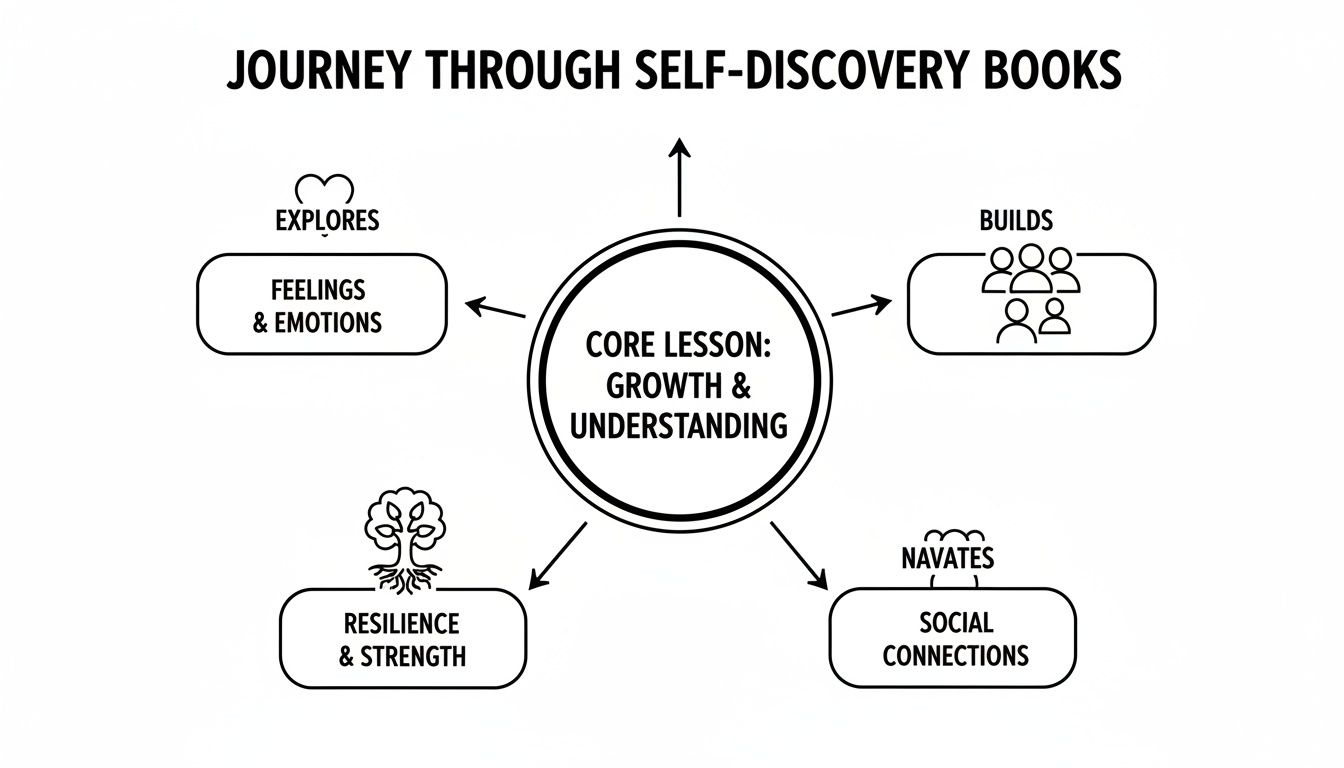
It’s a great illustration of how one single story can teach a whole raft of emotional skills, laying a really rich foundation for a child’s personal growth.
Early Years (Ages 2-5)
For our littlest readers, simplicity is everything. At this age, children are just starting to put names to their big, overwhelming feelings.
- What to look for: Picture books with bright, clear illustrations of facial expressions are perfect. You want stories with simple plots and perhaps some repetition, focusing on one core emotion at a time—like being sad, angry, or happy.
- A simple example: Think of a book about a little rabbit who feels sad because he’s lost his favourite toy. This helps a toddler connect the word "sad" to that feeling of loss. The story is straightforward, making the emotion easy to grasp and talk about.
Primary School (Ages 6-10)
Once children start primary school, their social worlds explode, bringing all sorts of new and trickier challenges. Books for this age group can start to gently explore more complex social situations and the first steps of building resilience.
When picking out a book, look for titles that get right to the heart of self-discovery, like the lovely Free To Be The Book. Stories like this give children the vocabulary they need to talk about who they are and how they feel.
Look for early chapter books with relatable characters who are navigating everyday problems—falling out with friends, feeling left out at playtime, or coping with not being the best at something. These stories show them it’s completely normal to have setbacks and offer gentle examples of how to bounce back.
Young Teens (Ages 11-14)
This is such a pivotal time for figuring out who you are, and it’s often made more complicated by the pressures of social media and friendship groups. Books about finding yourself for this age group can tackle more mature themes like self-doubt, finding where you belong, and learning to be your authentic self.
Stories that feature characters grappling with who they are—separate from their family or what their friends think—can be incredibly reassuring. These narratives create a safe space for young teens to reflect on their own journey. If you’re looking for more ideas, our guide to the best mental health books for young readers might be just what you need.
Turning Reading into a Conversation
The real magic of books about finding yourself happens after the last page is turned. These stories aren't just meant to be passively enjoyed; they're conversation starters, designed to open up a dialogue and turn reading time into a real moment of connection. A book’s journey truly begins when you start talking about it.
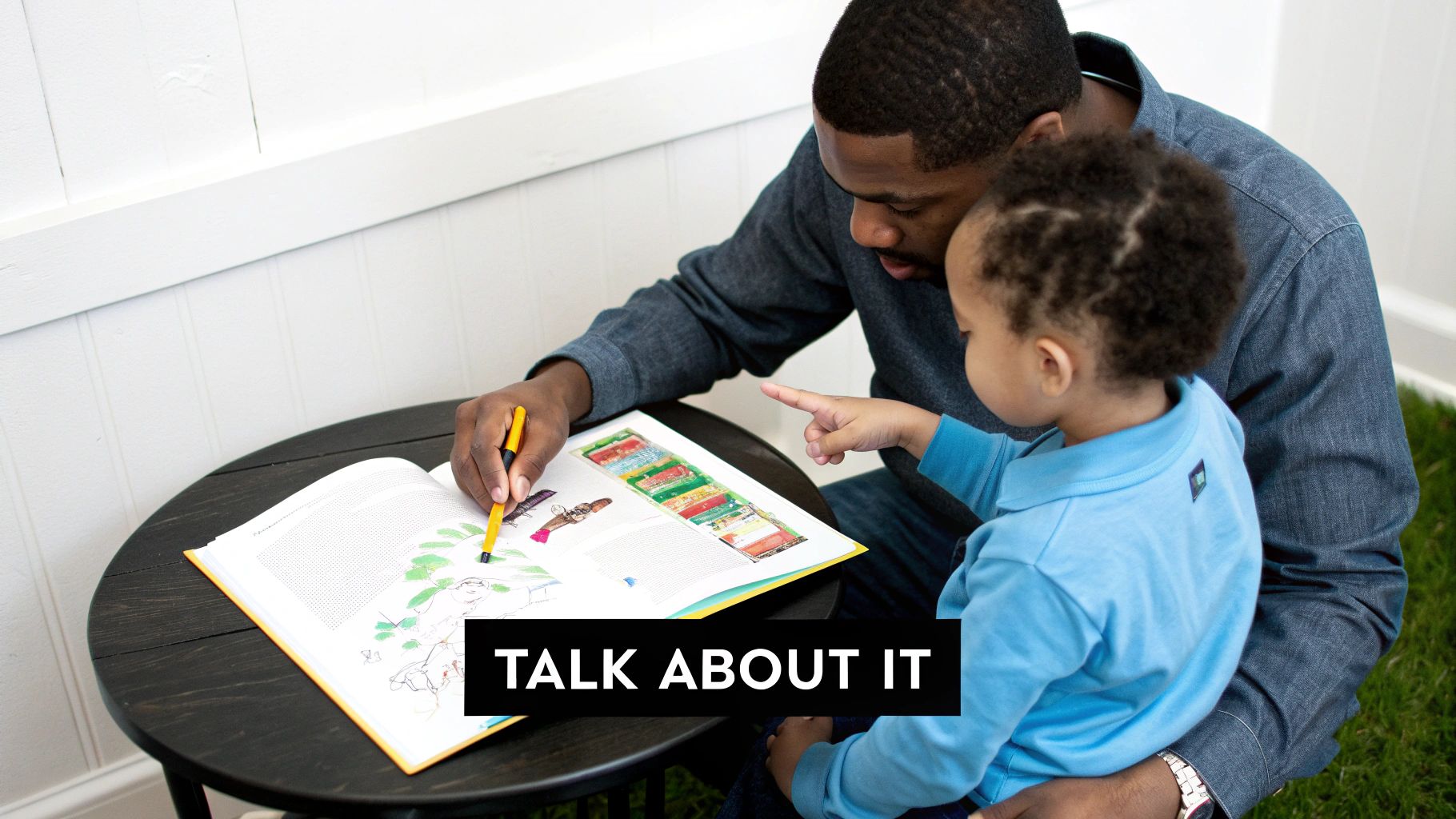
This doesn't need to feel like a test or an interrogation. It’s all about creating a safe, comfortable space where a child feels they can share what’s on their mind without any pressure. The aim is simply to listen and let them know their perspective is valid and important.
Sparking Meaningful Discussions
Open-ended questions are your best friend here. They invite much more than a simple "yes" or "no," encouraging children to dig a little deeper into the characters' experiences and see how they might relate to their own lives.
Here are a few gentle prompts to get things flowing:
- "How do you think the main character felt when that happened?"
- "Have you ever felt a bit like that? What was it like for you?"
- "What do you think was the bravest thing that character did?"
- "If you could give the character some advice, what would you say?"
These kinds of questions softly build a bridge between the world in the book and your child's own feelings. Exploring themes like this can be incredibly powerful, and you can learn more about this approach in our helpful story on friendship.
Bringing Stories to Life with Activities
Sometimes, words aren't the easiest way for a child to process big feelings. This is where creative activities come in, offering another way to explore a story’s themes in a playful, hands-on way. It’s a brilliant method for making the book’s message stick long after story time has ended.
For example, you could try:
- Drawing Emotions: Ask your child to draw how a character was feeling during a key moment in the book. It’s a simple way to help them connect feelings with expressions.
- Role-Playing Scenarios: Act out a scene from the story together. This lets them step into a character's shoes and safely explore different ways of handling a tricky situation.
- Mindful Journalling: For older children, a simple prompt like, "Write about a time you felt brave," can be a fantastic way to encourage quiet, personal reflection.
By turning reading into an interactive experience, you are not just teaching a child to love stories. You are giving them a language to understand themselves and the world around them, building a foundation of emotional resilience that will support them for years to come.
Remember, the goal is always connection, not perfection. Whether it’s through a heartfelt chat or a fun drawing session, you’re showing your child that their inner world is important and absolutely worth exploring.
Building Emotional Support Programmes with Books
When you weave books about finding yourself into structured wellbeing programmes, something powerful happens. Whether it's in a classroom or a therapy setting, stories create a shared experience, a common ground where children can start to talk about big, complicated feelings. They act as the perfect ice-breaker, gently chipping away at the stigma that can sometimes make mental health conversations feel daunting. Suddenly, abstract ideas like ‘resilience’ aren’t just words; they're the journey of a character everyone has met.
This approach gives emotional learning a solid, tangible framework. Imagine a teacher taking a book’s core theme and making it the focus of a whole week. It could spark circle time discussions, inspire creative writing, and even lead to fantastic art projects. This kind of consistency is brilliant for helping a story’s emotional lessons really sink in and stick.
From Story Time to Strategic Support
In a therapeutic setting, a book can be an absolute gift for building trust and rapport. A therapist might read a story with a child to softly open the door to a tough topic, like anxiety or loss. It allows the child to see their feelings mirrored in a fictional character, exploring them from a safe distance before they need to talk about their own experiences directly.
This kind of proactive investment in emotional education is more than just a nice idea; it's crucial. The cost of poor mental health to UK businesses is estimated at a staggering £56 billion every year, with so many of these issues having roots in childhood. By building emotional literacy early on, we're taking a preventative step that doesn't just benefit the individual child, but our future workforce and society as a whole. You can dive deeper into effective strategies for providing youth emotional support to learn more.
By integrating stories into support systems, we are not just teaching children to read; we are equipping them with the emotional vocabulary and resilience they need to navigate their own life story with greater confidence and self-awareness.
The Power of Narrative in a Thriving Market
The demand for these kinds of resources is undeniable. Recent data shows that UK book sales have hit £1.82 billion, and it's fiction that's leading the charge, making up 33.26% of the total revenue. You can get more details about the UK books market on Mordor Intelligence.
This huge appetite for stories about personal growth and self-discovery is fantastic news. It proves that people are hungry for narratives that resonate on a deeper level. For anyone using books to support children, this is a massive advantage—the very nature of a good story makes its emotional impact stronger and its lessons far more memorable.
Building a World of Wellbeing, Not Just a Bookshelf
The magic that happens when a child opens a book about finding themselves shouldn't just stop when the back cover closes. For the lessons of resilience, self-worth, and emotional honesty to really take root, they need to be part of a child's everyday world. It’s about creating a whole culture of support around them.
Think of it less as a one-off lesson and more as building an ecosystem. This approach blends reading with small, consistent reinforcements. Take daily affirmations, for example. Simple phrases like "I am brave enough to try" or "It's okay to feel sad sometimes" act as gentle echoes of the messages they absorb from their favourite stories.
Weaving Wellbeing into the Fabric of Daily Life
Tangible reminders can be surprisingly powerful, too. Something as simple as mental health apparel—a T-shirt or a hoodie with a positive, reassuring message—isn’t just a piece of clothing. It's a wearable hug, a quiet anchor of strength they can carry with them through the school day. It’s a physical link back to the feeling of safety and understanding they get from a book.
When you put these pieces together, you create a really strong foundation for emotional health:
- Mental health books are the starting point, introducing the big ideas around emotional literacy.
- Conversations are where understanding deepens and connections are built.
- Affirmations help to internalise positive self-talk and build resilience.
- Apparel offers a comforting, physical reminder of their inner strength.
This isn't about grand gestures, but about weaving these threads into the fabric of everyday life. It creates a continuous loop of support where every element makes the others stronger.
A truly supportive environment is built from many small, consistent actions. It's about showing children—through stories, words, and tangible symbols—that their emotional wellbeing is a priority and that they are never alone on their journey.
Building this kind of supportive culture is becoming more accessible as the market for these resources expands. In the UK, ebook revenue jumped by 17% last year alone. With self-publishing opening doors for new voices, more diverse and relatable books about finding yourself are hitting the shelves all the time. You can read more about how self-publishing is changing the book landscape on philparker-fantasywriter.com.
Your Questions Answered
When you start exploring the world of emotional wellbeing with children, it’s natural for questions to pop up. I get a lot of queries from parents, teachers, and carers who want to use these kinds of stories to support the kids in their lives, so I've gathered a few common ones here.
When Should I Start Introducing Books About Emotions?
Honestly, you can start right from the very beginning. Simple board books that show different facial expressions are brilliant for helping babies make those first connections. As they grow into toddlers and young children, you can gradually introduce stories with more complex feelings and situations.
The trick is simply to match the book to their developmental stage. Keep it gentle, keep it simple, and build from there.
What if My Child Doesn't Want to Talk About the Book?
That is absolutely fine. The last thing you want to do is force a conversation they’re not ready for. Let the story do its work; it’s planting important seeds all on its own.
A gentle invitation is all that’s needed. Something as simple as, “I’m always here if you fancy a chat about the story,” can open the door without any pressure. You might find they’re more willing to engage through play, like drawing their favourite character or acting out a scene.
How Can I Find a Book for a Specific Challenge, Like Anxiety?
Your local library or bookshop is a fantastic place to start. Children’s librarians, in particular, are treasure troves of knowledge and can often point you to the perfect book.
Online, you can look for curated reading lists on parenting blogs or websites that sort books by emotional themes. And don't forget to ask the professionals—school counsellors or therapists often have a go-to list of recommendations that are spot-on for a child's specific needs.
Just a quick note: while these books are wonderful tools, they are one part of a bigger support system. I am not a mental health professional, so if you have real concerns about your child’s wellbeing, it’s always best to chat with your GP or a qualified expert.
At Little Fish Books, we've put together a thoughtful collection of books, activities, and even mental health apparel designed to create a warm, supportive space for emotional growth. You can explore all our resources to help your child on their journey of self-discovery right here: https://thatsokay.co.uk.