

10 icebreakers for youth groups that spark connections
Running a youth group means creating a space where young people feel seen, heard, and valued. This is more crucial now than ever. In the UK, recent statistics highlight a growing mental health crisis among children and adolescents; for instance, NHS figures show that one in five children and young people in England aged 8 to 25 had a probable mental health condition in 2023. The pressure of social media, academic stress, and societal uncertainty can leave them feeling isolated.
Effective icebreakers for youth groups do more than just fill time; they are powerful tools for dismantling social barriers and nurturing emotional literacy. They can transform a quiet room into a vibrant community, laying the groundwork for trust and open communication. Addressing mental wellbeing is not just a compassionate choice; it is a strategic one. Poor mental health has significant societal costs, with estimates from Deloitte suggesting that it costs UK employers up to £56 billion a year. By proactively building supportive environments, we equip young people with the resilience they need to thrive.
This guide provides 10 thoughtfully selected icebreakers, designed not just for fun, but to intentionally build the empathy and connection vital for mental wellbeing. Each activity includes clear instructions, adaptations for different groups, and trauma-informed tips to ensure a safe and inclusive atmosphere. While many of these activities focus on individual connection, the principles of creating strong group dynamics can be seen in other areas, such as with fresh team building activities often used in corporate settings. We'll show you how to adapt these foundational concepts to foster genuine peer support and create a space where everyone belongs.
1. Two Truths and a Lie: The Classic Connector
A fantastic starting point for any group, 'Two Truths and a Lie' is one of the most versatile and effective icebreakers for youth groups. It invites participants to share three statements about themselves: two genuine and one fabricated. The rest of the group then guesses which one is the lie. This simple game is brilliant for encouraging creative thinking and revealing surprising facts about one another, sparking immediate, light-hearted conversation.
This activity is a staple in settings from summer camps to university orientation weeks because it empowers individuals to control their own level of disclosure. For example, a young person could share, "I have a pet dog," "My favourite food is pizza," and "I've climbed Mount Everest." They can participate fully without feeling pressured to reveal anything deeply personal.
How to Implement It
- Purpose: To build rapport, encourage active listening, and share unique personal facts in a low-pressure format.
- Time: 10–20 minutes, depending on group size.
- Materials: None required, but a whiteboard or flip chart can be useful for larger groups to jot down statements.
Instructions:
- Explain the concept: each person will share three “facts” about themselves, but one is a lie.
- Model the activity yourself. For example: "I have met the Queen," "I can speak three languages," and "I once won a hot dog eating contest." This shows vulnerability and sets a playful tone.
- Give participants 1-2 minutes to think of their three statements.
- Go around the circle, having each person share their two truths and a lie.
- After each person shares, the group can briefly discuss and then vote on which statement they believe is the lie.
- The person reveals the lie, often sharing a brief story behind one of the truths.
Trauma-Informed Tips & Adaptations
For some young people, being put on the spot can cause anxiety. To create a safer space, allow them to write their statements down first. You can also permit a "pass" or suggest they go later, giving them time to observe and feel more comfortable. For a quieter group, consider having them work in pairs first to build confidence before sharing with everyone. By focusing on connection over competition, you can foster key social skills. For more ideas on building these skills, explore these social skills activities for kids.
2. Human Bingo: The Interactive Mixer
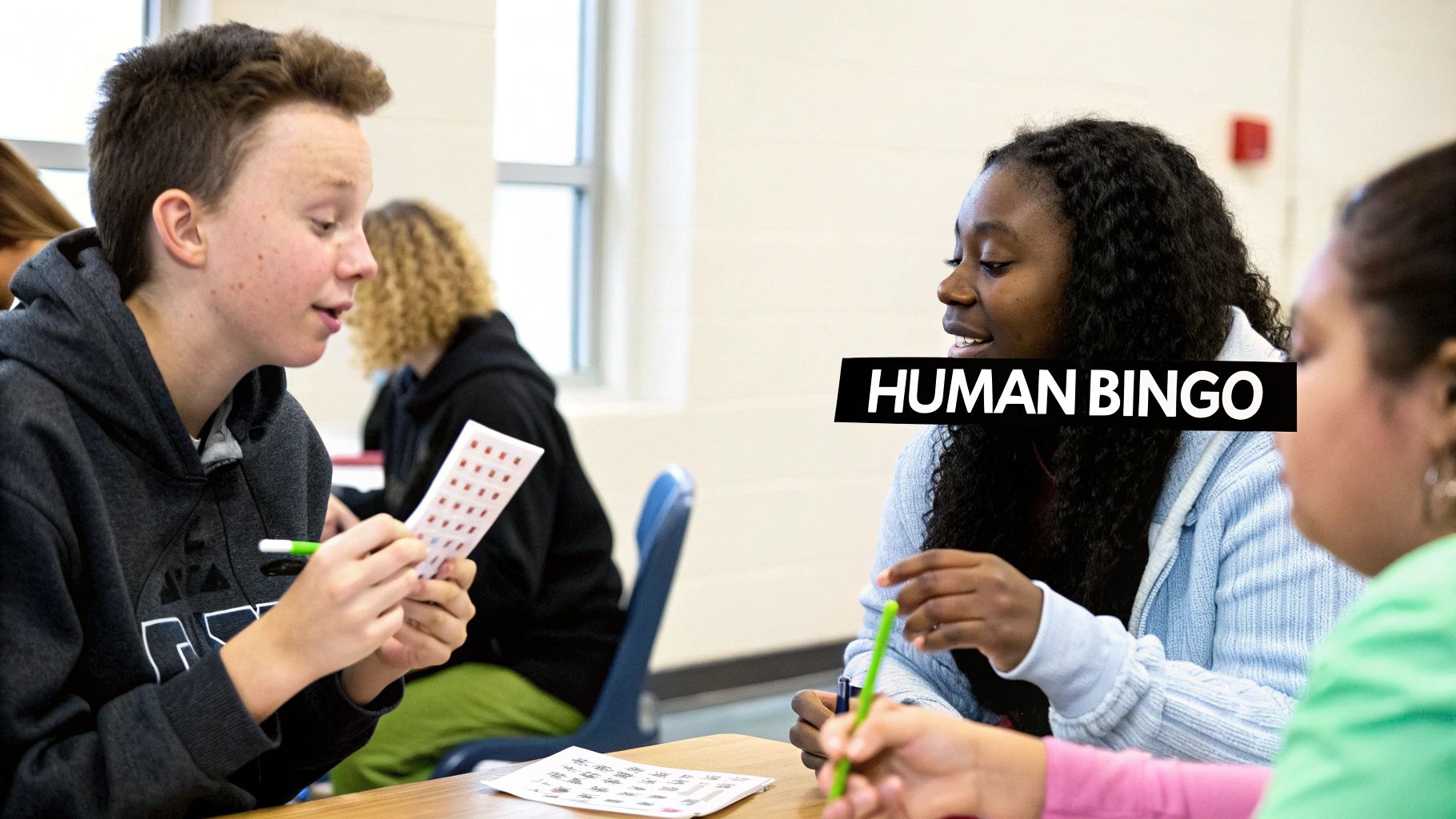
Human Bingo is a dynamic and engaging activity that gets everyone moving and interacting from the get-go. It’s one of the best icebreakers for youth groups because it transforms simple introductions into a fun, mission-based game. Participants are given bingo cards filled with various traits or experiences (e.g., 'has a pet other than a cat or dog,' 'is left-handed,' 'can play a musical instrument'), and their goal is to find others in the group who match these descriptions.
This game excels at breaking down social barriers and encouraging young people to move beyond their usual friendship circles. It provides a structured, low-pressure reason to start conversations, making it ideal for larger groups or gatherings where participants may not know each other well. The movement and energy involved can also help ease anxiety and make the environment feel more relaxed and playful.
How to Implement It
- Purpose: To encourage mingling, energise the group, and help participants discover commonalities in a fun, structured way.
- Time: 15–25 minutes.
- Materials: Pre-made bingo cards (one per person) and pens.
Instructions:
- Distribute a Human Bingo card and a pen to each participant.
- Explain the objective: find different people who match the descriptions in the squares and get them to sign that square.
- Set a rule that each person can only sign another person's card once or twice. This ensures everyone mingles widely.
- Announce "Go!" and allow participants to circulate around the room, asking questions and collecting signatures.
- The first person to get a complete line (horizontal, vertical, or diagonal) shouts "Bingo!"
- You can continue playing until a few people have won or until someone gets a "full house" (all squares filled).
Trauma-Informed Tips & Adaptations
The high-energy nature of this game can be overwhelming for some. Create a designated "quiet zone" where participants can take a brief break if needed. Ensure the traits on the bingo cards are inclusive and avoid potentially sensitive topics. For instance, instead of "has been on a plane," use "would like to travel to..." which is more inclusive of different socioeconomic backgrounds. For even more ideas on facilitating inclusive group activities, explore these youth group icebreaker games. By customising the cards and setting clear, gentle ground rules, you create a safe and welcoming space for everyone to connect.
3. Speed Networking (Speed Dating Format)
For groups where you need to kickstart lots of connections quickly, 'Speed Networking' is one of the most dynamic icebreakers for youth groups. Organised like a speed-dating event, it involves youth pairing up across two lines facing each other. They have just a few minutes to answer a prompt question before one line rotates, creating new pairs and conversations. This rapid-fire format ensures everyone meets multiple people efficiently, breaking down initial barriers with structured, engaging chats.
This activity is brilliant for larger events like youth leadership conferences or mentorship programme kickoffs where broad interaction is key. It democratises conversation, preventing cliques from forming early on and giving quieter individuals a structured way to engage one-on-one, which can be less intimidating than speaking to a large group. The fast pace keeps energy high and discussions focused.
How to Implement It
- Purpose: To facilitate a high number of one-on-one interactions, energise the group, and explore various topics quickly.
- Time: 15–25 minutes, depending on the number of rotations.
- Materials: A list of pre-prepared prompt questions, a timer, and a bell or whistle to signal rotations.
Instructions:
- Arrange two rows of chairs or have two lines of people facing each other.
- Explain that one line will remain stationary while the other line will move one spot to the right after each round.
- Announce the first question (e.g., "What is a skill you'd love to learn?").
- Set a timer for 2-3 minutes for each pairing to discuss the question.
- When the timer goes off, ring the bell and instruct the designated line to move one person down.
- Introduce a new question for the new pairings and repeat the process for 5-8 rounds.
Trauma-Informed Tips & Adaptations
The fast pace can be overwhelming for some. Start with lighter questions ("If you could have any superpower, what would it be?") before moving to anything more personal. Clearly state that anyone can "pass" on a question. For neurodivergent youth who may find constant transitions or noise challenging, offer a quieter zone where pairs can move for their chat. You can also provide the questions in writing beforehand, allowing participants time to process and prepare their thoughts, fostering a sense of safety and inclusion.
4. Would You Rather: The Energising Choice Game
A brilliant way to get a group moving and thinking, 'Would You Rather' is a dynamic activity that poses a series of dilemma-based questions. Participants physically move to different sides of the room to signal their choice, creating an active and visual representation of the group's preferences. This makes it one of the most engaging icebreakers for youth groups, particularly for those with lots of energy to burn.
This game excels at revealing personality traits and values in a fun, non-confrontational way. By starting with silly questions (like 'Would you rather have telekinesis or telepathy?') and gently progressing to more thoughtful ones, you can build a sense of camaraderie and shared understanding. It's a fantastic tool for youth group meetings, camp gatherings, or even as a warm-up in a school gym class.
How to Implement It
- Purpose: To encourage quick decision-making, reveal personality traits, and get participants moving and talking.
- Time: 10–15 minutes.
- Materials: None required, just an open space where people can move from one side to the other.
Instructions:
- Designate two sides of the room for 'Option A' and 'Option B'.
- Explain the game: You will call out a "Would You Rather..." question, and participants must move to the side of the room that represents their choice.
- Start with a simple, fun question to get everyone comfortable. For example, "Would you rather have pepperoni or pineapple on your pizza?"
- Once everyone has chosen a side, invite one or two volunteers from each group to briefly explain their reasoning.
- Continue with a series of 5-10 questions, varying them from light-hearted to slightly more thought-provoking.
- Keep the pace brisk to maintain energy, but allow enough time for brief sharing after each question.
Trauma-Informed Tips & Adaptations
Physical movement can be challenging or uncomfortable for some. Ensure there is a clear, accessible path and offer a non-physical option, such as raising a hand or using a coloured card to indicate a choice. For virtual groups, use Zoom's poll feature or have participants type their answers in the chat. Avoid questions that touch on sensitive topics like family, wealth, or difficult past experiences. By validating both choices equally and focusing on the 'why' behind a decision, you create an environment where every young person’s perspective is valued and respected.
5. Name Tag Mixer
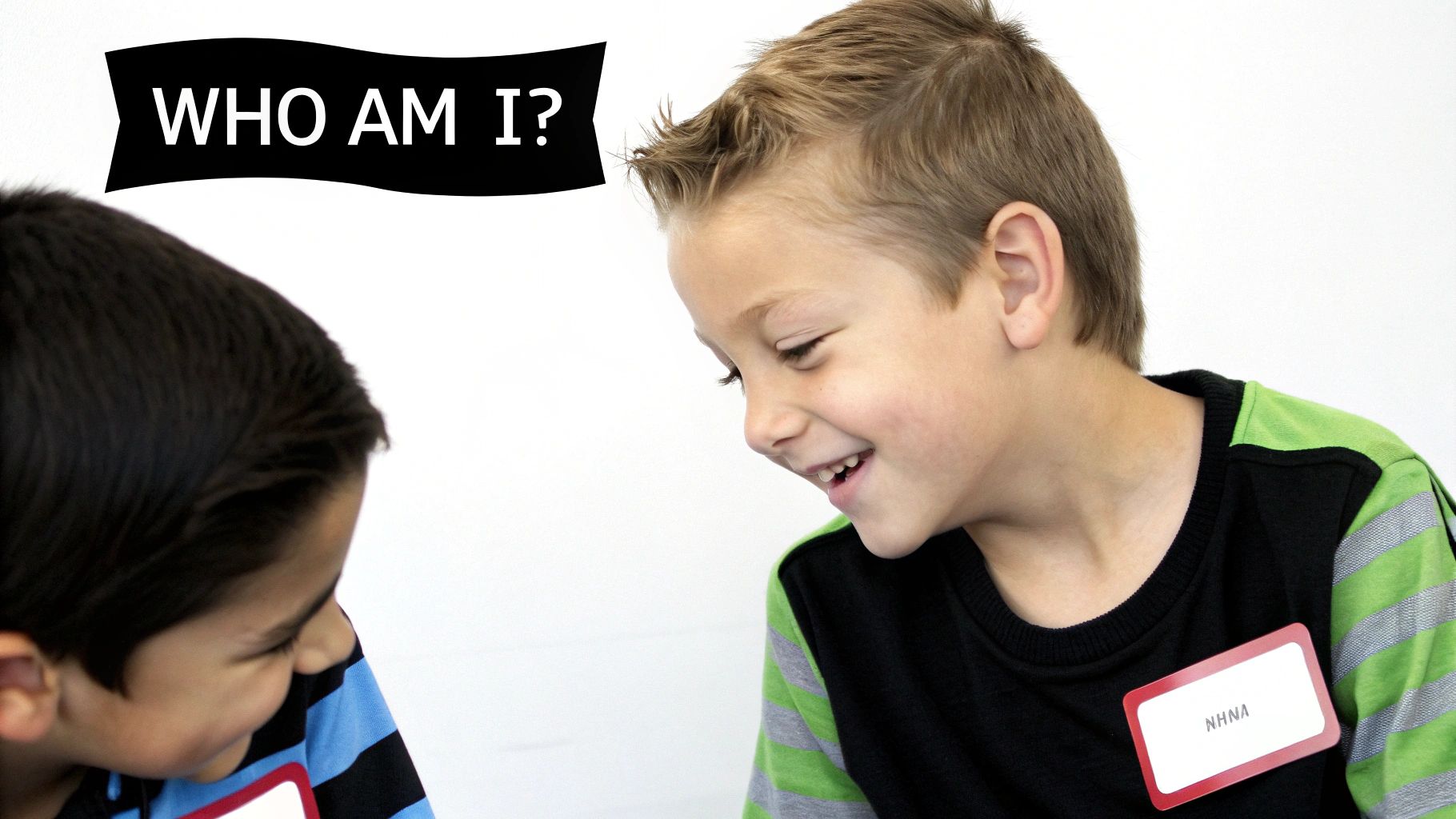
The ‘Name Tag Mixer’ is a dynamic and interactive game that gets everyone moving and talking from the very start. It’s one of the most effective icebreakers for youth groups because it eliminates the initial awkwardness of approaching new people. Each participant gets a name tag placed on their back with the name of a famous person, character, or object, which they cannot see. Their task is to figure out their assigned identity by asking only yes/no questions to others in the group.
This activity is brilliant for larger gatherings, like youth ministry events or school assemblies, as it encourages mingling and breaks down social barriers. The shared goal of discovery creates instant, light-hearted connections and a room filled with laughter as participants try to unravel their mystery identity. It’s a simple concept that generates a huge amount of positive energy and social interaction.
How to Implement It
- Purpose: To encourage mingling, develop communication skills, and foster a fun, energetic atmosphere.
- Time: 10–15 minutes.
- Materials: Name tags or sticky notes, and pens.
Instructions:
- Beforehand, write the names of well-known people, characters (e.g., Harry Potter, Spider-Man), or objects (e.g., a banana, the Eiffel Tower) on name tags.
- As each young person arrives, stick a name tag on their back without letting them see it.
- Explain the goal: they must discover their identity by asking other participants questions that can only be answered with "yes" or "no."
- Encourage everyone to circulate and interact. A good rule is to ask one person a maximum of three questions before moving on to someone else.
- Model some good yes/no questions to get them started, such as "Am I a real person?" or "Am I from a film?"
- Once someone guesses their identity, they can move their name tag to their front and help others guess theirs.
Trauma-Informed Tips & Adaptations
The fast-paced nature of this game might feel overwhelming for some. To support a more inclusive environment, create a designated "quiet corner" where participants can take a break if needed. For those who feel anxious about not knowing an answer, reassure them that "I don't know" is a perfectly acceptable response. You can also adapt the game by having participants work in pairs, where they help each other discover their identities, reducing individual pressure and focusing on collaborative problem-solving. This fosters teamwork and ensures everyone feels supported.
6. Common Ground Circle: Visualising Unity
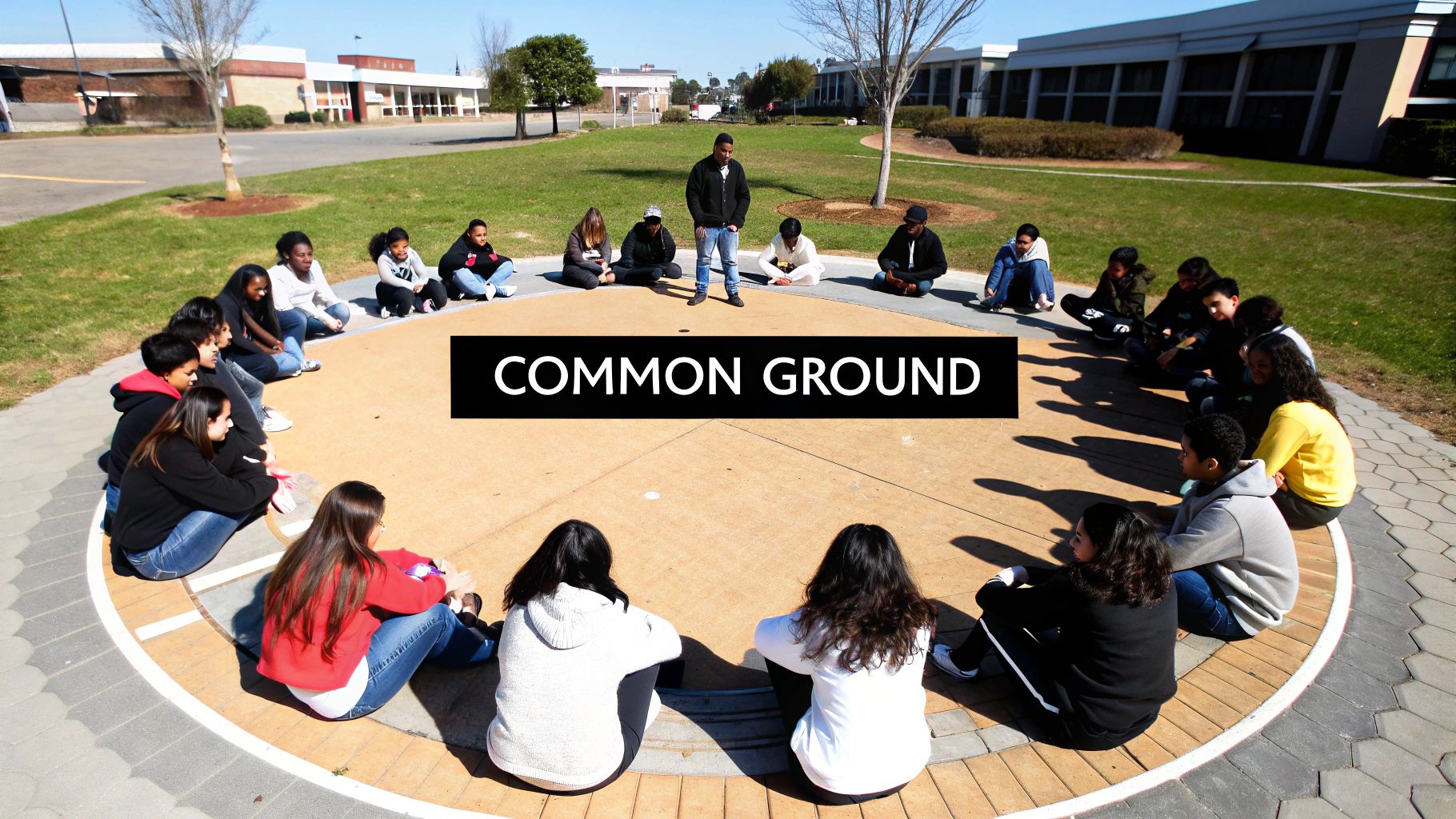
'Common Ground Circle' is a powerful, movement-based activity that visually demonstrates connection and shared experience. It stands out among icebreakers for youth groups for its ability to break down cliques and perceived differences in real-time. The facilitator calls out a series of statements, and anyone who identifies with the statement steps into the centre of the circle, creating a tangible representation of their commonalities.
This exercise is especially effective in diverse settings like inclusion initiatives or faith-based youth groups because it fosters empathy and understanding without requiring deep verbal disclosure. It helps young people see that despite outward differences, they often share similar tastes, experiences, and even vulnerabilities, creating a foundation of unity.
How to Implement It
- Purpose: To visually highlight shared experiences, build empathy, and foster a sense of group unity.
- Time: 10–15 minutes.
- Materials: A large open space for the circle and a prepared list of statements.
Instructions:
- Ask everyone to stand in a large circle, facing inwards.
- Explain the activity: You will read a statement beginning with "Step into the centre if..." and anyone who relates to it should take a few steps forward.
- Encourage participants to look around and notice who is in the centre with them before stepping back to the circle's edge.
- Begin with lighthearted, universal statements. For example: "Step into the centre if you love pizza," or "Step into the centre if you have a pet."
- Gradually progress to more meaningful statements, such as: "Step into the centre if you speak more than one language," or "Step into the centre if you've ever felt lonely."
- Conclude the activity by acknowledging the many connections discovered within the group.
Trauma-Informed Tips & Adaptations
The power of this activity lies in its optional nature. Explicitly state that no one ever has to step forward if they are uncomfortable. This empowers participants and respects their boundaries, which is crucial for building trust. Avoid statements that could isolate or stigmatise, such as those related to family structure or negative life events.
For groups that may be hesitant, keep the statements fun and non-vulnerable. You can also follow up with small-group discussions, asking, "Was there a time you were surprised by who stepped into the circle with you?" This shifts the focus from individual disclosure to shared observation. By creating a space of choice and respect, you reinforce emotional safety for all participants.
7. Four Corners: Get Moving and Find Common Ground
An excellent way to get energy flowing, ‘Four Corners’ is a dynamic activity that combines movement with self-expression. It’s one of the most engaging icebreakers for youth groups because it physically illustrates shared interests and perspectives. The facilitator poses a question with four possible answers, each assigned to a corner of the room. Participants then move to the corner that best represents their choice, creating an instant visual of the group's preferences.
This activity is brilliant for larger groups or for those who have been sitting for a while. It breaks up a session, encourages non-verbal participation, and facilitates smaller, more manageable discussions within each corner. By starting with light-hearted questions and building towards more meaningful topics, you can gently guide the group towards deeper connection and understanding.
How to Implement It
- Purpose: To encourage physical movement, identify shared interests, and stimulate small-group discussion.
- Time: 10–15 minutes.
- Materials: Four large pieces of paper or signs and a marker to label the corners of the room.
Instructions:
- Clearly label each of the four corners of your space with a distinct choice. For example: A) Sports, B) Arts, C) Academics, D) Social Causes.
- Explain the game: You will ask a question, and everyone will move to the corner that best fits their answer.
- Pose the first question. For example: "Which of these activities are you most interested in?"
- Once everyone has chosen a corner, give them 2-3 minutes to discuss with the others there why they made that choice.
- Invite one person from each corner to briefly share a key point from their small-group discussion with everyone.
- Repeat with a few more questions, moving from fun topics (e.g., "Favourite season: Spring, Summer, Autumn, or Winter?") to more reflective ones.
Trauma-Informed Tips & Adaptations
Movement can be liberating for some but intimidating for others, particularly those who are self-conscious or have experienced trauma related to their physical presence. Ensure the room is accessible and there's a clear path to each corner. Validate all choices and emphasise there are no "right" or "wrong" answers to foster psychological safety. For young people who may find decision-making stressful, allow them to stand in the middle for a moment or join the corner with a friend. This "no-pressure" approach helps create a supportive environment where everyone feels comfortable participating at their own pace.
8. Storytelling Circle: Building Deeper Bonds
The Storytelling Circle is a powerful and intimate activity that moves beyond surface-level introductions. It stands out among icebreakers for youth groups by creating a space for sharing meaningful personal experiences. Participants sit in a circle and take turns sharing short, two to three-minute stories based on a shared theme, such as 'a challenge I overcame' or 'someone who inspired me'. This vulnerable yet structured format fosters empathy and helps young people discover profound connections with their peers.
This icebreaker is particularly effective in settings like youth mentorship programmes, faith-based retreats, and peer support groups. By focusing on shared human experiences, it builds a foundation of trust and mutual respect. It encourages participants to listen actively and honour each other's stories, creating a genuine sense of community and belonging that can be difficult to achieve with more superficial games.
How to Implement It
- Purpose: To build deep connections, foster empathy, and develop active listening and public speaking skills in a safe, structured environment.
- Time: 20–30 minutes, depending on the group size and time allocated per story.
- Materials: A talking piece (like a small ball or stone) to signify whose turn it is to speak, and a timer to keep stories concise.
Instructions:
- Arrange the group in a circle and explain the activity's purpose: to get to know each other on a deeper level through stories.
- Introduce the theme. Examples include: "a time you felt brave," "your greatest adventure," or "a moment that changed you." Give everyone the theme and guiding questions in advance if possible.
- Model the activity by sharing your own story first. This demonstrates the expected level of vulnerability and sets a safe, open tone for the group.
- Establish clear ground rules: one person speaks at a time, no interruptions, and everything shared in the circle stays in the circle.
- Pass the talking piece around the circle. The person holding it shares their story for 2-3 minutes. Use a timer to gently enforce the time limit.
- After each story, thank the person for their courage in sharing. You can allow for one or two respectful, clarifying questions before moving on.
Trauma-Informed Tips & Adaptations
Creating psychological safety is paramount for this activity. Before you begin, emphasise that participation is completely optional and no one will be pressured to share. For young people who find storytelling daunting, you could adapt the activity by having them share a story about a fictional character or a favourite memory from a book or film that resonates with them. It is crucial to manage the group's response, ensuring all stories are met with respect and appreciation rather than judgment. This mindful approach helps build a supportive atmosphere where every young person feels seen and heard.
9. Collaborative Art/Mural Project
For groups that may be less verbal or more creatively inclined, a collaborative art project is one of the most powerful and inclusive icebreakers for youth groups. This activity involves participants contributing to a single, shared piece of art, such as a mural on a large sheet of paper, a collage from magazine cut-outs, or even a sculpture from recycled materials. The focus shifts from individual performance to collective creation, allowing for expression without words.
This approach is particularly effective because it creates a tangible symbol of group unity and individual contribution. It suits a wide range of settings, from youth arts programmes to community service kick-offs, providing a low-pressure way for young people to engage, mingle, and express their unique perspectives in a shared, safe space. The finished piece serves as a lasting reminder of their first steps in forming a cohesive group.
How to Implement It
- Purpose: To foster non-verbal communication, encourage teamwork, and create a physical representation of group identity.
- Time: 20–30 minutes, depending on the complexity of the project.
- Materials: Large paper or canvas, markers, paints, magazines for collage, glue, scissors, and any other varied art supplies.
Instructions:
- Set up a central station with all the art materials laid out attractively. Play some background music to help set a relaxed, creative mood.
- Explain the goal: to create a single piece of art together that represents the group. Emphasise that artistic skill is completely irrelevant; participation is what matters.
- Provide a simple, open-ended prompt. For example: "Draw or add something that represents your hopes for this group," or "Contribute a colour or image that shows how you're feeling today."
- Allow participants to approach the project at their own pace. Encourage them to add to, or build upon, what others have created.
- Let the activity unfold organically, with the facilitator available to offer encouragement.
- Once everyone seems finished, gather the group to briefly discuss the final piece, asking what they notice or what parts stand out to them.
Trauma-Informed Tips & Adaptations
Creative expression can be a powerful tool for processing emotions, but it's vital to create a non-judgemental environment. Avoid any comments that praise one person's artistic "talent" over another's. Instead, focus on the act of contribution itself. For young people who are hesitant, provide various mediums; someone who dislikes drawing might prefer cutting and pasting images for a collage. Ensure there are no right or wrong answers to the prompt. The goal is expression, not a perfect outcome, which helps build psychological safety and validates every individual's contribution.
10. Role-Based Problem Solving (Group Challenge)
This activity moves beyond simple conversation into active collaboration, making it one of the most dynamic icebreakers for youth groups. Small teams are given a challenge to solve, such as building a tower with limited materials or cracking an escape room-style puzzle under a time constraint. The focus on a shared goal encourages immediate teamwork, reveals different communication styles, and builds a sense of collective achievement.
This approach is fantastic for youth leadership programmes or team-building retreats because it highlights natural strengths and encourages strategic thinking. By working together to overcome a hurdle, participants create a shared positive memory and learn to appreciate the diverse skills within their group, fostering respect and connection that lasts beyond the activity itself.
How to Implement It
- Purpose: To build teamwork, improve communication, and observe problem-solving skills in a practical, hands-on scenario.
- Time: 15–30 minutes, depending on the complexity of the challenge.
- Materials: Varies by activity. Examples include spaghetti and marshmallows for a tower, or pre-made puzzle kits.
Instructions:
- Divide the young people into small, diverse groups of 3-5.
- Clearly explain the challenge, the rules, and the time limit. For example: "Your team has 15 minutes to build the tallest free-standing tower using only these 20 sticks of spaghetti, one metre of tape, and one marshmallow."
- Assign or let teams choose roles (e.g., strategist, builder, communicator) to encourage structured collaboration.
- Start the timer and observe the groups. Offer hints only if a team is completely stuck to maintain momentum.
- When time is up, celebrate the efforts of all teams, regardless of the outcome.
- Lead a debrief session, asking questions like, "What worked well in your team?" and "What would you do differently next time?" to reflect on the process. For more extensive activities that promote group cohesion, explore ideas for fun team building activities.
Trauma-Informed Tips & Adaptations
Competition can be a significant trigger for anxiety. Emphasise collaboration over winning and celebrate the process of working together. For young people who may struggle with pressure, assigning specific, manageable roles can provide a clear focus and reduce feelings of being overwhelmed. Allow teams to rotate roles in subsequent challenges so everyone has a chance to try different skills. Discover more ways to encourage positive group dynamics with these team-building activities for youth.
Comparison of 10 Youth Group Icebreakers
| Activity | 🔄 Implementation complexity | ⚡ Time / Efficiency | Resources required | 📊 Expected outcomes (⭐) | 💡 Ideal use cases & tips |
|---|---|---|---|---|---|
| Two Truths and a Lie | Low — minimal prep, easy to run | ⚡ 15–30 min — moderate pace | None (optional pen/paper) | Builds rapport and laughter; surface-level personal info (⭐⭐⭐) | Great for mixed-size groups; set 30s limit, model examples, encourage creative lies |
| Human Bingo | Medium — card creation and setup | ⚡ 15–25 min — energizing movement | Printed/custom bingo cards, pens, prizes (optional) | Encourages mingling and discovery of commonalities (⭐⭐⭐⭐) | Use specific traits, limit signatures per person, brief rules, offer small prizes |
| Speed Networking | Medium — requires rotation structure | ⚡ 15–20 min — very efficient for many connections | Timer, prepared prompts, clear space | Rapid introductions; many brief connections, limited depth (⭐⭐⭐) | Start light, use clear signals for rotation, prepare 5–8 questions |
| Would You Rather | Low — simple to run live or virtually | ⚡ 10–20 min — quick whole-group activity | Prepared questions, space or poll tool | High engagement and visible opinion split; reveals values quickly (⭐⭐⭐⭐) | Begin silly, avoid polarizing topics early, invite brief explanations |
| Name Tag Mixer | Low–Medium — prep name tags | ⚡ 15–25 min — steady mingling | Name tags with hidden identities, list of names | Natural conversation starters; playful identity guessing (⭐⭐⭐) | Choose recognisable names, model yes/no questioning, set time limits |
| Common Ground Circle | Low — facilitator-led, minimal setup | ⚡ 10–20 min — quick visual activity | Prepared category list, open space | Visualises shared experiences; builds inclusion and empathy (⭐⭐⭐⭐) | Start with universal prompts, make stepping optional, avoid shaming categories |
| Four Corners | Low–Medium — needs clear space and signs | ⚡ 15–25 min (multiple rounds) — flexible pacing | Corner signs/tape, space for groups | Forms small discussion groups; reveals interest distribution (⭐⭐⭐) | Label corners clearly, use follow-up sharing, ensure even physical spacing |
| Storytelling Circle | Medium–High — needs strong facilitation | ⚡ 30–60 min — time-intensive but deep | Safe space, prompts, skilled facilitator | Deep trust-building and empathy; substantive connections (⭐⭐⭐⭐⭐) | Establish psychological safety, model a story first, enforce time limits, keep participation optional |
| Collaborative Art / Mural | Medium — material prep and setup | ⚡ 20–45 min — flexible pacing | Art supplies, large surface, display area | Tangible group artifact; inclusive for creative/quiet youth (⭐⭐⭐⭐) | Emphasise process over skill, provide varied materials, display finished work |
| Role-Based Problem Solving | Medium–High — requires materials and scenario design | ⚡ 25–45 min (incl. debrief) — engaging workflow | Challenge materials, instructions, timers, facilitator | Strengthens teamwork, leadership, and problem-solving (⭐⭐⭐⭐) | Calibrate difficulty, assign/rotate roles, debrief to surface learning and celebrate effort |
From Icebreakers to Lasting Bonds: Your Next Steps
You've just explored a comprehensive toolkit of icebreakers for youth groups, from the simple fun of 'Two Truths and a Lie' to the collaborative energy of a 'Mural Project'. Yet, the true power of these activities lies not in the games themselves, but in the foundation they help to build. Choosing the right icebreaker is the first, crucial step in intentionally crafting an environment of psychological safety, trust, and genuine connection. These games are not just time-fillers; they are catalysts for community.
The activities detailed in this article are stepping stones. The real magic happens when the moments of shared laughter and discovery are built upon over time, creating a consistent culture where young people feel seen, heard, and safe to be their authentic selves. The goal is to move beyond the initial "getting to know you" phase and into a space of sustained support and mutual respect.
From Fun Activities to a Supportive Culture
To make this transition, it is vital to be intentional about what comes next. A successful icebreaker opens the door to communication; your ongoing strategy keeps that door open. Think of each activity as a data-gathering exercise. What did you learn about your group's dynamics? Who is naturally outgoing, and who needs more gentle encouragement to participate?
Use these insights to plan future sessions that cater to diverse personalities and needs. The ultimate aim is to create a space that feels less like a structured meeting and more like a supportive community.
Actionable Next Steps for Deepening Connection
Building on the momentum from these icebreakers requires a multi-faceted approach. Here are some practical, actionable steps to continue fostering a positive and emotionally intelligent environment:
- Integrate Emotional Literacy Tools: Don't let the conversation stop when the game ends. Incorporate resources that help young people identify and articulate their feelings. Mental health books are a fantastic and accessible tool for this. Exploring stories that deal with complex emotions like anxiety, friendship challenges, or self-doubt can open up vital conversations in a gentle, non-confrontational way. For example, a book about a character dealing with friendship worries can be a great way to start a discussion about navigating social pressures.
- Embrace Creative Expression: For many young people, expressing feelings verbally can be daunting. Offer alternative outlets. You can integrate creative expression through resources like free downloadable emotions colouring sheets, which provide a relaxing and meditative way for individuals to process their feelings without pressure.
- Introduce Simple Mindfulness Practices: The impact of social media and academic pressures on youth mental health is significant. Introducing simple relaxation tips, like a two-minute guided breathing exercise or a five-minute mindfulness practice focusing on the senses, can be incredibly powerful additions to your group's routine. A practical example is the '5-4-3-2-1' technique: ask them to silently name five things they can see, four things they can feel, three things they can hear, two things they can smell, and one thing they can taste. These skills help build resilience and provide young people with tangible tools to manage stress.
- Foster a Visual Identity of Support: Consider how your physical space and even what you wear can reinforce your group's values. Mental health apparel, such as t-shirts or wristbands with positive affirmations (e.g., "It's Okay to Not Be Okay"), can serve as a great conversation starter and a visible symbol of solidarity and shared commitment to wellbeing.
Creating this supportive space is an ongoing process, not a one-time achievement. By consistently prioritising connection and emotional wellbeing through engaging icebreakers for youth groups and follow-up activities, you give young people an invaluable gift: a safe harbour where they can grow, learn, and thrive.
A Gentle Reminder: It is important to recognise that while these activities are beneficial, they are not a substitute for professional mental health care. I am not a mental health professional. The information provided here is for informational purposes only. If you have serious concerns about a young person's mental health, please encourage them or their caregivers to speak with a GP or a qualified mental health provider for a proper diagnosis and treatment plan.
Ready to take the next step in fostering emotional literacy and connection? The resources at Little Fish Books are specifically designed to help open up conversations about feelings in an engaging and accessible way. Explore our collection of beautifully illustrated books that provide the perfect follow-up to your icebreaker activities, turning a moment of fun into a meaningful dialogue.