
A Parent's Guide to Safety Planning Templates
A safety planning template is really just a personalised, practical roadmap. It’s designed to help a child or young person figure out what to do in moments of intense emotional distress or when things feel completely overwhelming. Think of it as a collaborative tool, not a clinical document, that outlines specific steps, coping strategies, and support contacts to turn to. It’s about moving beyond just managing a crisis and towards building long-term resilience.
Understanding the Need for a Safety Plan
Let's be honest, navigating a child's big feelings can be overwhelming for everyone involved. In a world where mental health challenges among young people are becoming more and more common, having a proactive approach is no longer just a nice-to-have—it’s essential. A safety planning template isn’t some rigid form to fill out; it’s a compassionate conversation starter and a practical guide you create with your child.
The importance of addressing mental health early on really can't be overstated. The statistics are quite stark: half of all mental health problems are established by the age of 14. If left unaddressed, these challenges can have a huge impact not just on the individual and their family, but on wider society too.
For instance, the cost of poor mental health to UK businesses is estimated to be up to £56 billion a year. That figure really underscores the long-term consequences when we don't nurture foundational emotional skills in childhood. A safety plan is a proactive step that goes beyond crisis management, equipping families with strategies for improving mental wellness.
Normalising the Conversation
One of the biggest benefits of creating a safety plan is that it makes talking about difficult emotions normal. It sends a powerful message to a child: "your feelings are valid, you are not alone, and we can figure this out together." This simple process helps to dismantle the stigma that so often prevents young people from asking for help. It shifts the entire focus from fear and reaction to empowerment and preparedness.
This approach is so effective that it's been integrated into national health strategies. In England, suicide prevention strategies now include safety planning templates as a core tool. Since the 2012 Suicide Prevention Strategy was introduced, all regions now have local suicide prevention plans that feature safety planning.
Despite this, there's still a critical need for this kind of personalised support. Nearly half (48%) of people who died by suicide had been in contact with mental health services within seven days of their death, which really highlights how crucial comprehensive, individualised safety planning is. You can explore the full government strategy to understand its scope.
Important Disclaimer: I am not a mental health professional. This guide provides information and practical support, but it is not a substitute for professional medical advice. If you have any concerns about your child's mental health, please consult your GP or a qualified professional.
Ultimately, a safety plan is much more than just a piece of paper. It becomes a symbol of hope—a tangible reminder for your child that they have the strength and support to get through the tough times. By creating one together, you are building a foundation of resilience that will serve them for the rest of their lives.
Creating the Safety Plan Together
The most effective safety plan isn't a form you fill out about your child; it's a living document you create with them. This needs to be a supportive conversation, not an interrogation. The whole point is to build a practical toolkit that feels genuinely theirs, giving them a real sense of ownership and control over their emotional world.
Forget about a rigid, clinical process. Just find a calm, comfortable time to talk, maybe on a quiet weekend afternoon. The idea is to have a natural chat where you can explore their unique warning signs—those personal signals that let them know distress is building.
These signs are rarely textbook definitions. A child might say they feel "fizzy inside," "like a volcano is about to erupt," or just express a sudden, overwhelming need to be alone. Really listening to their language and validating it is the first step in helping them build that crucial self-awareness.
This visual shows how a solid plan builds from a basic roadmap into a toolkit that fosters true resilience.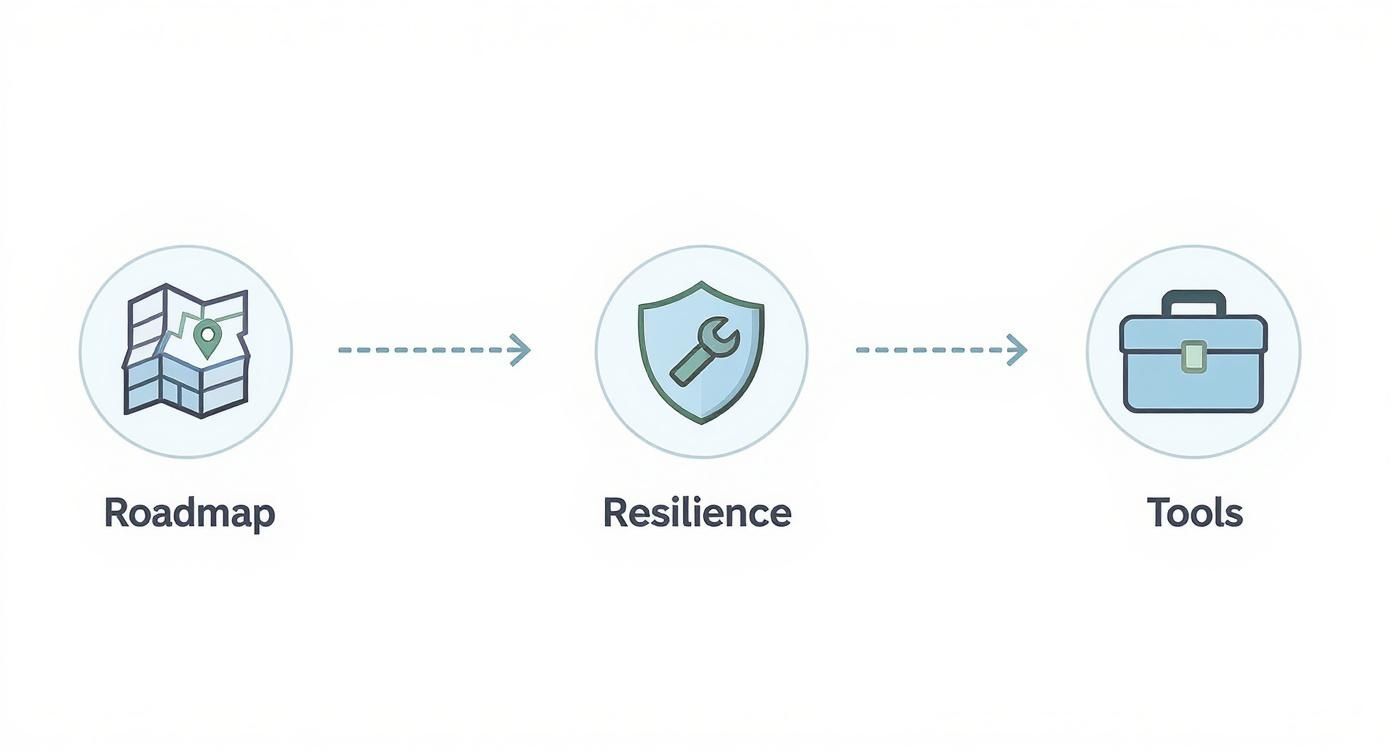
Following this kind of structure helps turn abstract ideas about 'coping' into real, practical steps your child can actually follow when they need them most.
Key Components of a Child's Safety Plan
To make this feel less overwhelming, it helps to break the plan down into manageable chunks. Each part builds on the last, creating a comprehensive and personalised toolkit. The table below outlines the essential elements and gives you a few ideas for different age groups to get the conversation started.
| Component | What It Is | Example for a Child (7-11) | Example for a Teenager (12-17) |
|---|---|---|---|
| Warning Signs | The unique feelings, thoughts, or physical sensations that signal distress is starting. | "My tummy feels wobbly," "I want to hide under my duvet." | "My thoughts start racing," "I get a tight feeling in my chest," "I just want to snap at everyone." |
| Internal Coping Strategies | Simple actions they can do on their own, anywhere, without needing anything or anyone. | "Do my square breathing," "Squeeze my fists tight and then let go." | "Listen to my 'chill' playlist on my phone," "Repeat my mantra: 'This feeling isn't forever'." |
| Distractions & Soothing Activities | Physical items or activities that help shift focus away from distressing thoughts. | "Get my calm-down box," "Colour in my special book," "Go bounce on the trampoline." | "Scribble in my journal," "Do a few minutes on a mindfulness app," "Go for a walk or run." |
| Safe People & Places | A list of trusted people to contact and safe spaces to go to when they need help. | "Talk to Mum or Dad," "Go to the school library," "Call Grandma." | "Text my best friend," "Go to my room and shut the door," "Talk to the school counsellor." |
Remember, these are just starting points. The most powerful ideas will come directly from your child, in their own words.
Identifying Internal Coping Strategies
Once you've talked about the warning signs, the next step is to explore what they can do for themselves in that moment. These are their internal coping strategies—actions they can take anywhere, without any props.
A few practical things to try together:
- Box Breathing: A beautifully simple technique. Breathe in for a count of four, hold for four, breathe out for four, and hold again for four. You can make it more tangible by tracing a square in the air or on a leg.
- Grounding Techniques: The 5-4-3-2-1 method is fantastic. Name five things you can see, four things you can feel, three things you can hear, two things you can smell, and one thing you can taste.
- Calming Playlists: Help them create a go-to playlist on a phone or device. Fill it with songs that make them feel peaceful, powerful, or happy.
- Positive Self-Talk: Work on a few phrases they can repeat to themselves. Simple things like, "This feeling will pass," or "I am safe and I can get through this."
The key is to keep these strategies simple and memorable. Under stress, our brains can't handle complex instructions. A few well-practised techniques are far more effective than a long list of ideas they can't recall.
Building a Toolkit of Tangible Distractions
Beyond what they can do in their own head, it's incredibly powerful to have a set of tangible distractions. These are physical items and activities that help pull their focus away from overwhelming thoughts. One of the best tools for this is a 'calm-down box'.
This isn't a toy box. It's a special, curated collection of soothing objects that you can decorate and fill together.
Ideas for what to put inside:
- A soft blanket or a favourite cuddly toy.
- Sensory items like putty, a stress ball, or a fidget spinner.
- A colouring book and some nice pencils or pens.
- A soothing scent, like a small, safely-used bottle of lavender oil.
- A notepad just for writing, drawing, or scribbling down feelings.
Another brilliant technique for understanding where a child feels their emotions physically is body mapping. Learning how to use a body mapping template can give you both incredible insight into their physical warning signs, making their internal experience much clearer.
Finding Their Safe People and Places
The final piece of this puzzle is helping your child identify their support network. This part of the plan is all about knowing who to call and where to go when things feel too big to handle alone.
Ask them directly: "Who are the people that make you feel safe and heard?" Their list might include you, a grandparent, a trusted teacher, a school counsellor, or a close friend. It’s so important to respect their choices here.
Next, talk about safe places. This could be their bedroom, a cosy corner of the living room, the school library, or even a grandparent's house. Just knowing they have a physical space to retreat to can bring a huge sense of security.
For each person and place, get specific. For example: "If you feel overwhelmed at school, you can ask Mrs. Davis if you can spend ten minutes in the library." or "If you need to talk to Grandma, her number is saved in your phone, and you can call her anytime."
By working through these elements together—warning signs, internal strategies, external distractions, and a support network—you are doing so much more than just creating a document. You're building a shared language of support, strengthening your connection, and equipping your child with the life-long skills of emotional resilience.
Using the Safety Plan at Home and School
Creating a safety plan is a brilliant first step. But its real power comes when it stops being just a piece of paper and becomes a living, breathing tool your child can rely on anywhere. A plan that only exists in a kitchen drawer is only half a plan. The goal is to build a reliable support system your child can access wherever they are, especially at school, which is often where the biggest challenges pop up.
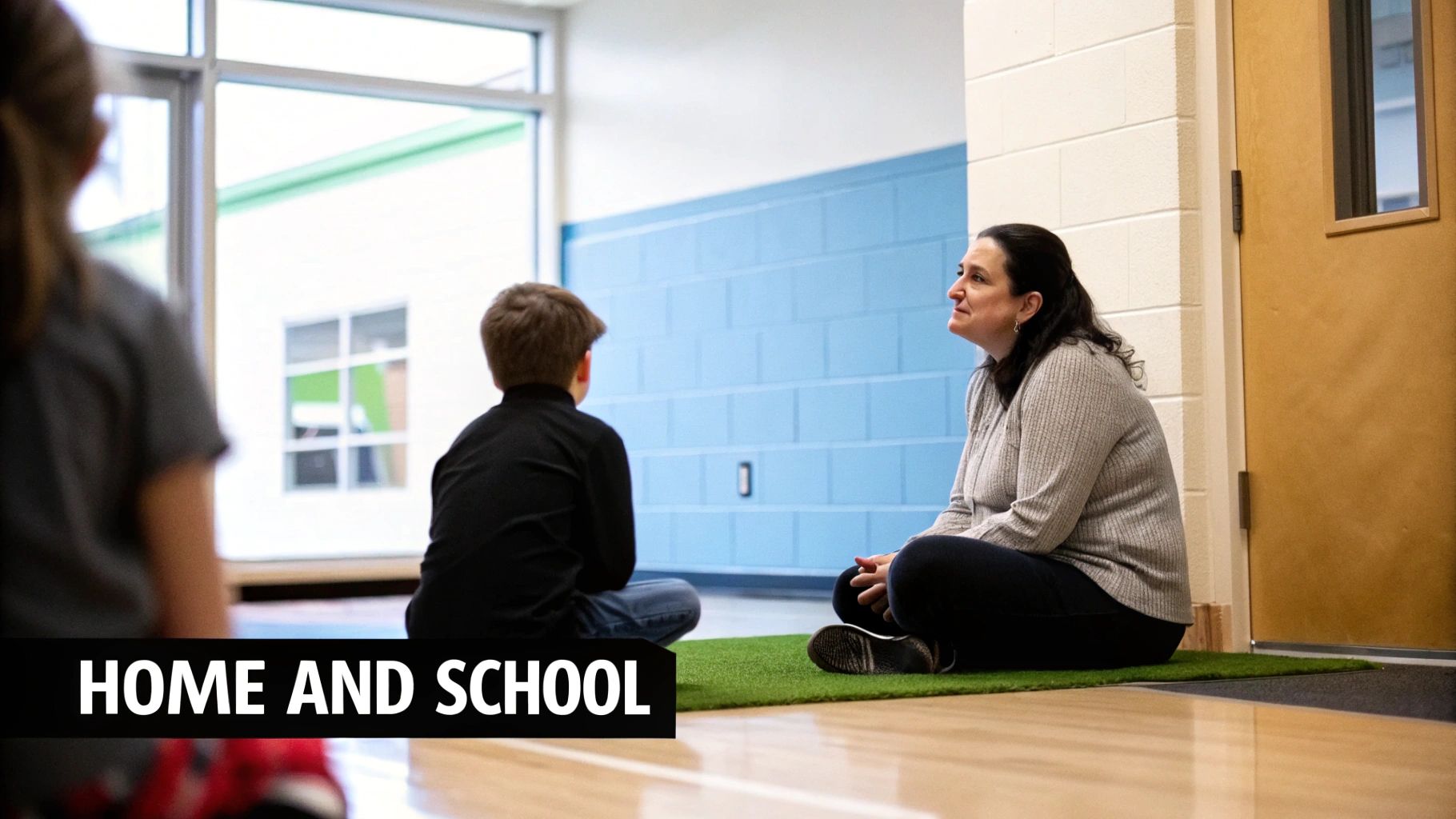
This means shifting from a personal plan to a team approach. At home, that involves the whole family. Siblings, grandparents, and other important people in your child's life need to understand their role. This isn't about oversharing private details; it's about making sure everyone knows how to respond in a supportive way, creating a consistent and predictable safe space for your child.
Adapting the Plan for School
School can be an incredibly stimulating place, but for a child wrestling with big emotions, it can also be completely overwhelming. The noise, the social dynamics, the pressure to perform—it can all be a minefield of triggers. That’s why collaborating with school staff isn’t just a nice idea; it’s absolutely essential.
The best place to start is by setting up a meeting with your child's teacher, and perhaps the school counsellor or a designated mental health lead.
- Share a simplified version: A busy teacher doesn’t need to see the entire detailed document. A one-page summary is far more effective. Just focus on the key warning signs, their most helpful calming strategies, and who to contact if things escalate.
- Agree on a signal: Work with your child and their teacher to come up with a discreet, non-verbal signal they can use when they feel overwhelmed. This could be something as simple as placing a specific coloured pencil on their desk or a subtle hand gesture.
- Identify a safe space: Ask if there's a quiet spot in the classroom or another room—like the library or counsellor’s office—where your child can go for a few minutes. This allows them to use their coping strategies without feeling like they’re being put on the spot.
This kind of proactive teamwork helps teachers truly understand what your child needs. It gives them the tools to offer the right support at the right moment, which can stop small wobbles from turning into big crises. It transforms the safety planning template from a document at home into a shared resource that really works.
Real-World Scenarios and Practical Examples
So, what does this look like day-to-day? Let’s imagine your son starts to feel that familiar 'fizzy' sensation in his stomach during a noisy maths lesson. Using the signal he and his teacher agreed on, he lets her know he needs a moment. She gives him a quiet nod, and he heads to the reading corner. He can do his box breathing for five minutes, feel the calm return, and then rejoin the lesson.
At home, a common flashpoint might be a squabble with a sibling. Instead of jumping straight to consequences, the safety plan offers a different route. You could gently say, "It sounds like you're feeling really angry right now. Should we take a look at your plan and see what might help?" This simple question validates their feelings while guiding them towards a healthier way to cope.
The most effective safety plans are flexible and built on genuine collaboration. They must be tailored to the child's real world and, most importantly, be built on what they say they need to feel safe.
This collaborative spirit is backed up by mental health professionals. Research shows that practitioners who directly ask people what they need to stay safe see much better outcomes, a practice that became even more critical during the recent pandemic. You can read more about these evolving approaches to safety planning and see just how vital direct input really is.
Keeping the Plan Alive and Evolving
A safety plan isn't something you create once and then file away. It needs to grow and change right along with your child. Their challenges will shift, their coping skills will develop, and new people will come into their lives. It's so important to review the plan together regularly—maybe once a month, or after a particularly tough week.
Keep the conversation going with simple questions:
- "Did using your calm-down box help when you felt upset last week?"
- "Is there a new song we should add to your feeling-better playlist?"
- "You've been spending a lot of time with your new friend, Sam. Would you like to add him to your list of safe people to talk to?"
This ongoing dialogue keeps the plan relevant and useful. More than that, it constantly reinforces the message that you are on this journey together, as a team. To help with these chats, resources like our emotion regulation worksheets can give your child the words to identify and communicate their feelings more clearly, making every review of the safety plan even more powerful.
Knowing When to Seek Professional Help
A safety plan is a powerful tool, but it’s so important to recognise its limits. I like to think of it as a first-aid kit for emotional distress; it's brilliant for managing immediate wobbles, but it’s not a substitute for professional medical care when a deeper issue is brewing. This is where you, as a parent or carer, become your child's most important advocate.
Knowing when that moment arrives is crucial. The best advice I can give is to trust your gut. If you’re worried about your child's mental health, the very first and most important step is to seek professional advice.
Spotting the Red Flags
While every child is unique, certain behaviours can signal that it's time to bring in extra support. A safety planning template can actually be a massive help here, as it encourages you to track behaviours and notice when patterns are changing.
Keep an eye out for these significant red flags:
- Any talk of self-harm or suicide. Never, ever dismiss comments about wanting to die or hurt themselves. This needs immediate professional attention.
- Sudden, drastic changes in behaviour. Noticeable shifts in their mood, sleep, or appetite that stick around for more than a couple of weeks are a key sign something is wrong.
- Pulling away from their world. If your child suddenly withdraws from friends, family, and activities they used to love, it’s a definite cause for concern.
- A persistent sense of hopelessness. A continuous feeling of sadness, worthlessness, or a belief that things will never get better needs to be addressed by a professional.
Your GP is the best place to start. They can assess the situation and refer you to specialised services like CAMHS (Child and Adolescent Mental Health Services). Being prepared for immediate crises is also a vital part of any safety net. To build your confidence, it's worth learning some essential paediatric first aid skills.
Disclaimer: I am not a mental health professional. This information is for guidance only. Please consult a doctor if you have any worries about your child's wellbeing.
Your Role as Their Healthcare Advocate
When you do reach out for help, the safety plan you’ve already created becomes an incredibly useful document. It gives clinicians an immediate, personalised insight into your child’s world—showing them specific triggers, coping strategies, and who is in their support network. It shows you're proactive and can help fast-track a more effective treatment plan.
Sadly, many families feel their safety concerns aren’t fully heard by healthcare services. NHS England has reported that patients in mental health inpatient settings often feel their needs are overlooked, highlighting a gap between policy and what happens in practice. In response, new national guidance on Safety Assessment and Safety Planning is expected by April 2025 to improve how these plans are used. Having your own well-thought-out plan ensures your child's voice stays central to the conversation.
Weaving Professional Contacts into Your Plan
Make professional support an official part of your safety planning template. The last thing you want is to be scrambling for phone numbers during a crisis.
Your plan should have a clear, easy-to-find list with:
- Your GP's surgery number.
- Local CAMHS contact details.
- The NHS 111 number.
- Crisis support lines like Samaritans (116 123) or YoungMinds (text YM to 85258).
By integrating these contacts, you normalise the idea of seeking professional help. It sends a powerful message: doctors and therapists are part of the team, just like family and friends. It reframes reaching out not as a last resort, but as a planned, positive step towards feeling better. This is how we empower our children to see that asking for help is a true sign of strength.
Building a Wider Support System for Your Child
A safety plan is a brilliant, essential tool, but it really finds its power when it's part of a wider, supportive world for your child. A document on its own can't create a culture of care; that comes from the conversations, the resources, and the connections you build around them. This is about moving beyond the template to create a lasting foundation of mental wellbeing for your whole family.
An open, supportive environment is what makes any safety plan truly work. It’s about building a network of care that extends far beyond moments of crisis, creating a world where your child feels seen, heard, and consistently supported.
Cultivating a Culture of Openness
I can't stress enough how important it is to address mental health openly, especially with the pressures kids face today. The numbers are staggering: in 2023, one in five children and young people in England aged 8 to 25 had a probable mental health condition. These aren't just statistics; they represent real families navigating real, everyday challenges.
This is exactly why creating a home where feelings are discussed as normally as what you had for lunch is so vital. It removes the stigma and teaches children that it's okay not to be okay.
A wonderful way to get these conversations started is through storytelling. Curated mental health books for children can be a gentle gateway to exploring big emotions like anxiety, sadness, and anger in a way that feels safe and relatable.
For us as parents, reading up on these topics builds our own confidence too. It gives us the language and understanding to support our children in a way that truly helps.
Navigating the Impact of Social Media
Social media is a huge part of modern childhood, but its impact on mental health can be, well, complicated. While it offers connection, it can also dial up the pressure and expose young minds to things they just aren't ready for.
Building a healthier online space for your child is more about open dialogue than rigid rules.
- Talk about the 'highlight reel'. Help them see that what they're looking at online is often a carefully curated, unrealistic version of other people's lives.
- Set digital boundaries together. Decide on screen-free times, like during meals or before bed, to give their brains a rest and encourage real-world connection.
- Model healthy behaviour. Our relationship with our own phones sets a powerful example, whether we realise it or not.
For more in-depth advice, exploring online resources for youth emotional support can give you practical strategies for managing digital wellbeing and finding positive online communities.
The Wider Community and Workplace Support
Support for children’s mental health stretches far beyond the family home. The community, and especially the workplace, plays a crucial part. When parents are stressed and unsupported, it has a direct knock-on effect on the family environment.
The cost of poor mental health to UK businesses is estimated at a massive £56 billion a year, thanks to absenteeism and lower productivity. Supportive parental leave policies and flexible working aren't just 'nice-to-have' perks; they are essential investments in the wellbeing of the next generation.
An environment where parents feel supported at work is one where they have the emotional capacity to be fully present for their children at home. This creates a positive cycle that benefits families, businesses, and society as a whole.
This wider support network also includes practical, everyday things that reinforce a positive mental health message. Think about items like mental health apparel—t-shirts or hoodies with affirming messages—which act as small, daily reminders of self-worth and resilience. They're conversation starters that help chip away at stigma.
Simple relaxation tips can also be woven into the fabric of family life, becoming part of your collective toolkit.
- Mindful Minutes: Just take one minute to sit quietly together and focus on breathing in and out.
- Gratitude Jar: Each day, write down one thing you're grateful for and pop it in a jar.
- Nature Walks: Getting outdoors is a proven mood booster for all ages. It just works.
Ultimately, building this supportive ecosystem is the most important work we can do. The safety planning template is your map, but the real journey is about creating a culture of compassion, understanding, and unwavering support that will last a lifetime.
Disclaimer: I am not a mental health professional. This guide is for informational purposes only. Please seek help from your doctor if you are worried about your child's wellbeing.
Your Questions Answered
When you're trying to figure out the best way to support your child emotionally, it's natural for questions to pop up. Let's walk through some of the most common things parents ask when they're putting together a safety planning template for the first time.
At What Age Is a Safety Plan Appropriate?
There’s no magic number here. It’s less about their birthday and more about their developmental stage.
You can introduce a really simple, visual plan as soon as a child can start to talk about their feelings, which might be around six or seven years old. For younger kids, it's all about pictures and simple ideas. As they grow into teenagers, the plan can become much more detailed, touching on more complex emotions and coping skills.
The key is to match the plan to their understanding. For a little one, it might be as simple as pointing to a picture of a "safe person" to talk to or having a designated "calm-down corner" in the house. For a teen, it will likely involve more self-led strategies and knowing who to contact for professional support.
What Should I Do If My Teenager Refuses to Participate?
This is a really tough one, and believe me, it’s a common hurdle. Teenagers are hardwired to push back against things that feel forced, especially when it involves talking about feeling vulnerable. If they’re digging their heels in, the worst thing you can do is try to force it.
Instead, try a gentler approach:
- Leave the door open. Just let them know you’re there for them whenever they feel ready to talk, no strings attached.
- Show, don't just tell. You could even sketch out your own simple plan for dealing with a stressful day and leave it somewhere they might see it. This reframes it as a normal tool for anyone, not a punishment or a sign they're in trouble.
- Start small. Forget the whole plan for a minute. Just ask a simple, low-pressure question like, "What's one song that always makes you feel a bit better when you're having a bad day?" It's a tiny, non-threatening step that can build a foundation for a bigger conversation later.
If you have genuine concerns about their immediate safety, it's vital to get professional advice, even if they won't engage with you. Your GP is always the best first port of call.
How Often Should We Review the Plan?
Think of a safety plan as a living document, not something you create once and file away. It needs to grow and change right alongside your child.
Checking in on it together every few months is a good rhythm to get into.
It’s also really smart to revisit it after a tough time or a significant event. This gives you a natural opportunity to talk about what worked, what didn’t, and what you could do differently next time. The aim is to keep the safety planning template useful and relevant to what they’re going through right now.
At Little Fish Books, we believe that giving children the tools to understand their emotions is one of the most important things we can do. Our collection of books, activities, and resources is designed to help you start these crucial conversations and build a foundation of emotional wellbeing for your family. You can explore all our supportive materials at https://thatsokay.co.uk.