
What Is Developmental Psychology and How Does It Shape a Child's Life
Have you ever wondered why your toddler has a meltdown over the wrong colour cup, or how your quiet pre-schooler suddenly learns to share? What about the whirlwind of emotions that turns your sweet child into a door-slamming teenager?
These aren't just random phases. They're all part of developmental psychology – the fascinating story of how our children grow, think, feel, and connect with the world from their very first breath through to adolescence and beyond.
A Practical Guide to Your Child's Growth
Think of it like being a gardener. You wouldn’t give a tiny seedling the same amount of water and sunlight as a fully-grown tree, would you? Developmental psychology is your guidebook, helping you understand exactly what your child needs at each stage to truly flourish. It gives you the 'why' behind their behaviour.
Understanding this field is more than just interesting; it's a powerful tool for parents and educators. It helps us give the right kind of support at precisely the right time. This is more crucial now than ever. In the UK, a staggering 50% of all mental health problems are established by the age of 14, and 39.2% of 6- to 16-year-olds have seen a decline in their mental health since 2017.
These numbers aren't just statistics; they represent children who need our help. They underscore the urgent need for us to be more aware and supportive from the very beginning. You can learn more about these vital children's mental health statistics from The Children's Society.
What This Guide Covers
In this guide, we'll break down the big ideas into simple, practical insights you can start using today. We’re going to explore:
- Core Theories: The 'why' behind your child's behaviour, explained simply.
- Key Milestones: Navigating the journey from baby to teenager.
- Modern Challenges: The real impact of social media on development.
- Practical Support: Simple, everyday ways to nurture emotional well-being.
- When to Seek Help: Recognising the signs that you might need a bit more support.
Important Disclaimer: Please remember, I'm not a mental health professional. This guide is here to provide information and support, but it's not a substitute for professional medical advice. If you have any concerns at all about your child's development or mental health, please speak to your GP or a qualified specialist. Reaching out is the most powerful thing you can do.
The Big Ideas That Explain Your Child's World
To really get our heads around developmental psychology, we need to look at the big ideas that started it all. These aren't just stuffy, academic theories; think of them more like a decoder ring for your child's behaviour. They give us the 'why' behind everything from a toddler's epic tantrums to a pre-schooler's painstaking attempts to tie their own shoes.
Ever wondered why your toddler is convinced that hiding behind their hands makes them invisible? Or why a game of peek-a-boo can be the most hilarious, mind-blowing event of their day? That's Jean Piaget's theory of cognitive development in action. His groundbreaking idea was that children's minds aren't just mini-versions of ours. They think in ways that are fundamentally, wonderfully different.
Piaget saw this growth happening in distinct stages. For example, a tiny baby who hasn't yet grasped object permanence genuinely believes that when you hide your face, it has literally ceased to exist. No wonder peek-a-boo is such a thrilling surprise every single time!
Learning by Doing, Watching, and Getting a Little Help
Now, picture your child learning a new skill, like stacking a tower of blocks. They might struggle at first, getting frustrated as it keeps toppling over. But with a little bit of help from you—"how about we try putting the big one on the bottom?"—they eventually get it. This is a perfect, everyday example of Lev Vygotsky's sociocultural theory.
Vygotsky believed learning is a team sport. He argued that children learn best when someone with a bit more know-how (like a parent, teacher, or even an older sibling) helps them tackle a task that’s just a tiny bit beyond what they can do alone. This back-and-forth is how they build confidence and master all sorts of new skills, from learning to read to figuring out what's fair.
"A key insight from these theories is that a child's world is actively constructed. They aren't passive observers; they are little scientists (Piaget) and apprentices (Vygotsky), constantly experimenting and learning from those around them."
The Unshakeable Power of a Secure Hug
Beyond thinking and learning, a child's emotional world—how they feel and form relationships—is the bedrock of their well-being. This is where John Bowlby's attachment theory comes in. It explains exactly why a simple, warm hug can make everything better after a scraped knee or a spooky shadow in the corner of their room.
Bowlby suggested that a child's earliest bonds with their caregivers create a kind of blueprint for all their future relationships. When a child feels safe, seen, and soothed, they develop what's called a secure attachment. This gives them a "safe base" from which they can confidently explore the world, knowing they always have a secure harbour to return to. A child's emotional security is profoundly shaped by these early connections, a concept you can explore further in our detailed guide on what is attachment theory.
Understanding these foundational ideas helps us see the world through our children's eyes. It shifts our perspective from just trying to manage their behaviour to actively nurturing the incredible, developing person they are becoming.
Navigating the Milestones From Infancy to Adolescence
A child’s journey from their first gurgle to their first teenage argument is a remarkable series of transformations. Seeing this unfold through the lens of developmental psychology helps us appreciate each stage not just as a passing phase, but as a critical chapter in their life story. These milestones provide a map for parents and educators to follow.
This timeline gives a simplified view of how different theories of developmental psychology place focus on cognitive (Piaget), social (Vygotsky), and emotional (Bowlby) growth across a child's life.
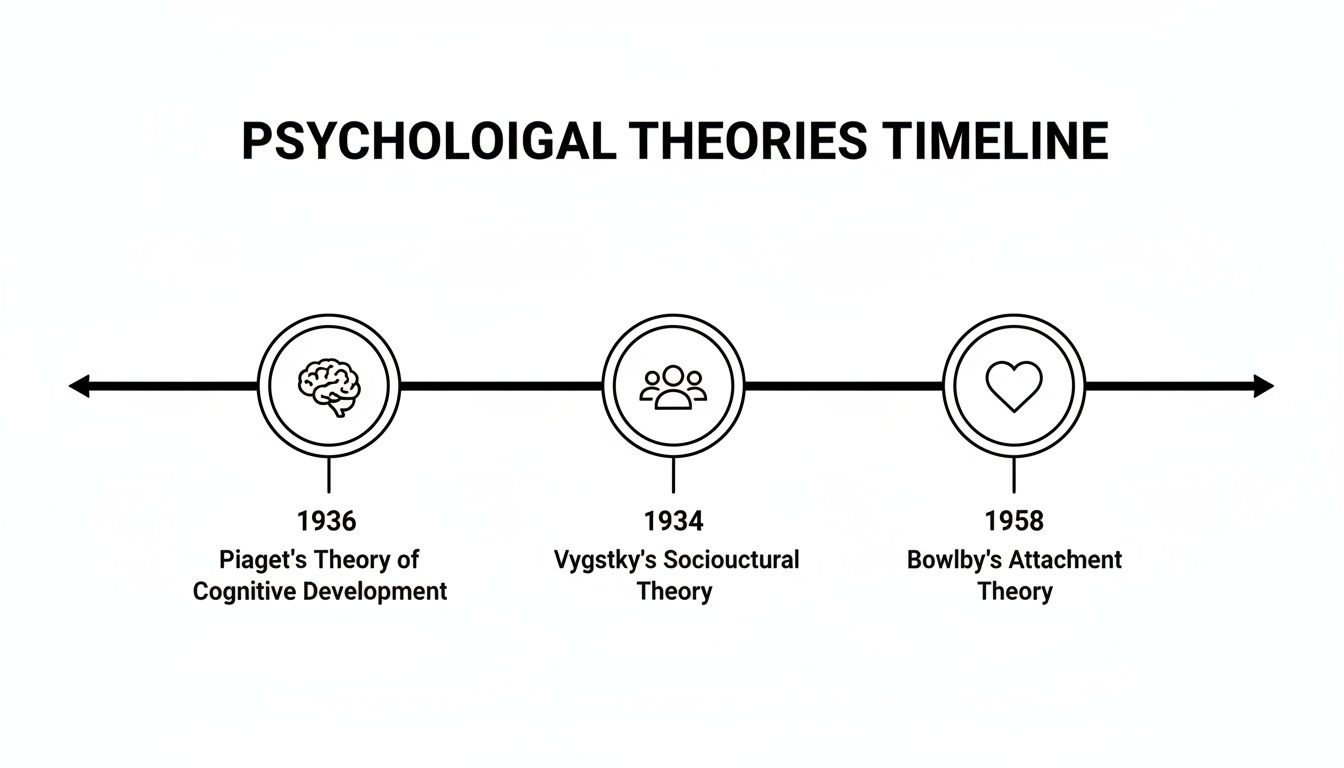
The key insight here is that development isn’t just one thing; it’s a rich blend of how children think, interact, and form bonds, all happening at the same time.
The World of Infancy: 0 to 2 Years
The first two years are an explosion of growth. A newborn, entirely dependent, transforms into a walking, talking toddler with a mind of their own. Cognitively, this is Piaget’s sensorimotor stage in full swing—they learn about the world by touching, tasting, and seeing everything they can get their hands on.
Emotionally, this is where Bowlby's attachment theory is most visible. The bond formed with caregivers becomes their secure base, their safe harbour. Understanding typical infant development, including a predictable newborn sleep schedule by week, is so important for both the parents’ and the baby's wellbeing. This stage truly sets the foundation for trust and security.
Early Childhood, The Play Years: 2 to 6 Years
This stage is defined by imagination and a blossoming sense of self. Language skills develop at lightning speed, and children dive headfirst into pretend play, a vital tool for understanding social roles and navigating their emotions. It's also when tantrums can peak, as their fierce desire for independence often outpaces their ability to manage big, overwhelming feelings.
Socially, they start to shift from parallel play (playing alongside others) to cooperative play (actually playing with others). They begin to grasp the concept of empathy, slowly realising that other people have feelings, too. Nurturing these budding skills is a key part of supporting their growth during this vibrant, chaotic, and wonderful period.
Middle Childhood, The Social Butterfly: 6 to 11 Years
The primary school years are marked by a major shift towards the social world. Friendships become more complex and absolutely central to their identity. Children start to think more logically and get much better at seeing things from another person's perspective.
This is also a time when academic skills and personal interests take root, building a sense of competence and self-esteem. They develop a stronger moral compass, learning about rules and the importance of fairness.
Adolescence, The Search for Self: 12 to 18 Years
Adolescence is a profound period of change, where teenagers work to figure out who they are and where they fit in the world. Their thinking becomes more abstract, allowing them to grapple with complex ideas about life and their future. This search for identity is the hallmark of this stage.
However, this is also a period of heightened vulnerability. Sadly, 1 in 5 children and young people aged 8 to 25 in England now have a probable mental health disorder, a figure that highlights the immense emotional pressures of these years. Young women aged 16-24 are particularly affected, with 26% reporting common mental health problems weekly. These statistics show just how critical it is to understand and support their emotional development.
By understanding these distinct stages, we can better support the unique needs of children as they navigate their incredible journey to adulthood. For a deeper look into this topic, explore our article on emotional development milestones.
The Unavoidable Impact of Social Media on Modern Childhood
Today’s children are digital natives, the very first generation to have social media as a constant backdrop to their lives. When we think about its role in their development, it’s not about slapping a simple 'good' or 'bad' label on it. We need to get real about its profound effect on their social skills, self-esteem, and ability to manage their emotions.
Think about it: the online world is a never-ending stream of curated perfection. This creates an environment where comparing yourself to others isn't just common, it's unavoidable. For a child or a teenager whose identity is still a work in progress, this can be incredibly damaging. It’s no surprise that research links increased social media use to higher rates of anxiety and depression, especially among teenage girls.
This constant comparison often brews a deep-seated fear of missing out (FOMO) and can slowly chip away at a child's sense of self-worth. The pressure to present a flawless life can feel immense, turning what should be a time of messy, wonderful self-discovery into a performance for an invisible audience.
Mental Health and the Digital Playground
Beyond the endless comparison game, the digital world has its own unique set of challenges, like cyberbullying. Unlike a spat on the playground, online harassment can follow a child home, into their bedroom, offering no real escape. The anonymity of the internet can embolden cruel behaviour, leaving lasting emotional scars that are often invisible to parents and teachers.
The impact of this isn't just personal; it ripples outwards. Poor mental wellbeing among our young people costs the UK economy billions every year in lost productivity and healthcare expenses. Businesses feel this knock-on effect when the next generation enters the workforce without the emotional resilience needed to cope and thrive.
Addressing mental health early isn't just a kindness; it's a social and economic necessity. By equipping children with the tools to navigate their emotional world—both online and off—we are investing in a healthier, more productive future for everyone.
Finding Balance and Building Resilience
So, what can we do? The answer isn't to ban technology—that ship has sailed. Instead, it's about building a strong foundation of open communication and healthy habits.
Simple relaxation techniques, like taking a few deep breaths or going for a walk without a phone, can help a child disconnect and recalibrate their nervous system. It’s amazing what a little screen-free time can do.
You can also find support in shared experiences. Books that explore feelings of anxiety or self-doubt can be fantastic conversation starters. Even supportive merchandise like mental health apparel can help to normalise these discussions and make kids feel less alone. By modelling a balanced digital life and keeping the lines of dialogue wide open, we can help our children build the resilience they so desperately need.
Practical Ways to Nurture Your Child's Emotional Well-being
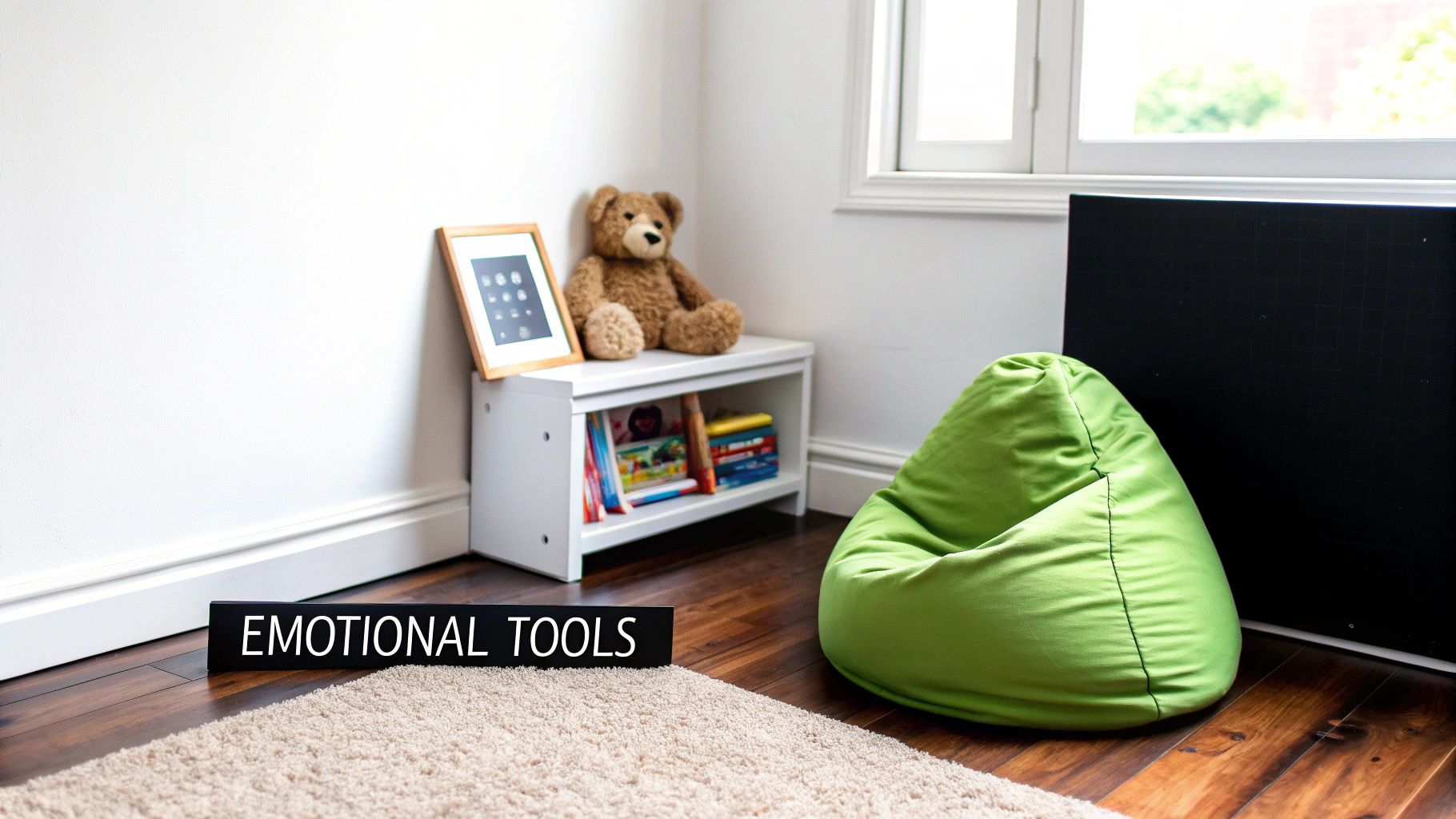
Understanding the theories is one thing, but this is where we roll up our sleeves and put that knowledge into action. Nurturing a child's emotional wellbeing isn't about grand, complicated gestures. It’s woven into the small, everyday moments you share. It’s about creating a safe space where all feelings are valid, even the big, messy, inconvenient ones.
One of the most powerful things we can do is simply validate what they're feeling. Instead of rushing to fix it with a "don't be sad," try sitting with them in the moment and saying, "I can see you're feeling really sad right now." This tiny shift shows them it’s okay to feel whatever they feel, building a foundation of trust and emotional intelligence for life.
The latest mental health statistics in the UK show us just how vital this is. One in six children aged 5-16 has a probable mental health problem. Building their emotional toolkit from an early age is more crucial than ever. It's not just about childhood; poor mental health costs UK businesses up to £56 billion a year, which really highlights the long-term impact of not prioritising wellbeing from the start.
Simple Techniques for Big Feelings
You don’t need to be an expert to help your child find their calm. Introducing some practical, simple relaxation tips can make a huge difference when emotions feel overwhelming.
Here are a few age-appropriate ideas you can try today:
- Teddy Bear Breathing: Perfect for little ones. Ask them to lie down and pop a favourite stuffed animal on their belly. Then, guide them to breathe so slowly and deeply that the teddy gently rises and falls. It's a lovely visual that makes deep breathing less abstract.
- The Calm-Down Corner: Create a cosy, quiet space in your home with soft cushions, a few favourite books, and maybe some colouring pages. This isn't a time-out spot for punishment, but a safe retreat where they can choose to go when they need to manage big feelings.
- Feelings Check-in: Make it a regular habit to chat about emotions. Over dinner, you could ask, "What was a happy moment for you today?" followed by "Was there a tricky moment?". This normalises talking about the entire spectrum of feelings.
A huge part of nurturing emotional wellbeing is also about teaching resilience and a positive approach to challenges. It’s about showing them that effort, not just innate talent, is what matters. This is where learning how to develop a growth mindset in children becomes such a game-changer.
Resources to Start the Conversation
It can feel a bit daunting to open up conversations about mental health, but thankfully, there are resources that can help bridge that gap. Books are a fantastic way to introduce complex emotions through gentle, accessible stories. Little Fish Books offers a wonderful collection of mental health books and activities specifically designed to help children name, understand, and navigate their feelings.
Sometimes, even wearing mental health apparel can be a quiet but powerful statement of support, helping to break down the stigma one conversation at a time. Ultimately, it’s all about creating an environment where asking for help is seen as a sign of strength, not weakness.
Important Reminder: I am not a mental health professional. The tips provided are for informational purposes. If you are worried about your child’s mental health, it is essential to seek help from your doctor or a qualified professional. They can provide the expert guidance and support your family needs.
Knowing When to Seek Professional Support
It’s completely normal to worry about your child's development. Every parent does. Most of the time, those little quirks and tricky phases are just a standard part of the growing-up rollercoaster. But it’s also important to recognise when a challenge isn’t just a phase, and might be a sign that a little extra support is needed.
The goal is to feel confident in spotting these signs and to act early, without any stigma about asking for help.
Looking at the bigger picture in the UK, this becomes even more crucial. A staggering one in six children aged 5-16 is thought to have a probable mental health problem. Spotting things early is key. When these issues aren't addressed, they don’t just vanish; poor mental wellbeing can ripple into adulthood, costing UK businesses up to £56 billion a year in lost productivity. Supporting our children now is an investment in their future, and ours.
Recognising the Signs
Every child is wonderfully unique, but there are certain patterns in behaviour, mood, or how they interact with others that might suggest it’s time to chat with a professional. Think of these not as red flags, but as gentle nudges to pay closer attention.
Some general signs to look out for can include:
- Significant changes in behaviour: This could be sudden aggression, pulling away from activities they once adored, or a persistent sadness that hangs around for weeks.
- Difficulties at school: Maybe their performance has taken a sharp dip, they’ve started avoiding school, or they’re finding it really tough to get along with their friends.
- Intense emotions: Big feelings are part of childhood, but overwhelming anxiety, frequent panic, or a deep sense of despair that gets in the way of daily life is a real concern.
Disclaimer: Please remember, I am not a mental health professional. This guide is for informational purposes only. If you are worried about your child's mental health or development, it is essential to seek help from your GP or a qualified professional. They can provide the expert guidance your family needs.
Figuring out the next steps can feel overwhelming, but you are not on your own. Your GP is always the best first port of call. They can listen to your concerns and refer you to specialised services like Child and Adolescent Mental Health Services (CAMHS).
For more guidance, you can also explore fantastic resources on finding mental health support for young people.
Your Questions About Developmental Psychology Answered
It’s a worrying statistic, but an important one: here in the UK, one in six children between 5 and 16 has a probable mental health problem. Looking after our children’s mental wellbeing isn’t just about helping them feel good today; it’s a necessity for their future and for society.
When children struggle, the ripple effects can last a lifetime. In fact, poor mental health in young people eventually costs UK businesses up to £56 billion every year in lost productivity. This really highlights just how crucial that early support is.
Social media adds a whole new layer of complexity. The constant pressure to measure up can really chip away at a child’s self-esteem and make it harder for them to manage their own emotions. Simple things, like screen-free walks or just taking a few deep breaths, can help them find a bit of space to disconnect and cope with stress.
The most powerful thing we can do is normalise talking about our feelings. Resources like specialised mental health books can be a wonderful, gentle way to start those conversations. Even something like supportive mental health apparel can help a child feel seen and less alone in their struggles. Every step we take to create this kind of supportive environment helps build resilience.
Important Reminder: I am not a mental health professional. This information is educational. If you have concerns about your child's mental health, please seek advice from your doctor or another qualified expert. Reaching out is a sign of strength and the most important step you can take.
At Little Fish Books, we create gentle, engaging resources to help children and their families navigate big emotions. Explore our collection of stories and activities designed to build emotional literacy. https://thatsokay.co.uk