
What Is Narrative Therapy? A Guide for UK Parents
Narrative therapy is a respectful and collaborative way of looking at counselling. At its heart is one powerful idea: you are not the problem; the problem is the problem. It’s all about separating a person's identity from the challenges they're facing, helping them to pick up the pen and rewrite their own story from a place of strength.
Disclaimer: Please note, I am not a mental health professional. This article is for informational purposes only. If you are worried about your own mental health or that of your child, it is crucial to seek advice from a GP or another qualified professional.
A Hopeful Approach to Mental Wellbeing
The world today can feel like a pressure cooker for kids and teenagers. Between the picture-perfect lives splashed across social media and the relentless stress of school, the stories young people tell themselves can easily become tangled up in anxiety and self-doubt. The impact of social media on youth mental health is significant, often creating a landscape of comparison that can erode self-esteem.
With worries about youth mental health on the rise across the British Isles, finding supportive and truly empowering ways to help has never been more vital. Addressing mental health early is incredibly important; research shows that 50% of mental health problems are established by age 14. This is exactly where narrative therapy comes in, and understanding what it is can make a world of difference.
Think of your child's life as a storybook. Narrative therapy starts from the belief that your child is the one holding the pen. They are the expert in their own life. The therapist's role isn't to dictate the story, but to act as a kind of co-author, helping them to explore, question, and ultimately rewrite the chapters where they feel stuck.
The Person Is Not the Problem
This is the big one. The absolute foundation of the whole approach is a simple but profound shift in perspective. It externalises the problem—treating things like 'Anxiety' or 'The Anger' as separate characters in the story, not as a core part of who your child is.
So, a child isn't an "anxious person." They are a creative, kind, and brilliant person who is currently being pushed around by 'the Worries'. Just that little change in language can be incredibly powerful. It lifts the heavy weight of blame and shame, creating space for curiosity instead of criticism. From there, a child can team up with their therapist and family to investigate how the problem works, what its sneaky tricks are, and how they can start standing up to it.
This perspective is so important. We know that a huge chunk of long-term mental health issues take root in childhood, making positive, early support absolutely essential. And the cost of poor mental health isn't just personal; it ripples out into our communities and the economy. It is estimated that mental ill-health costs UK businesses up to £56 billion per year. By tackling these challenges early with non-blaming methods, we can help build a foundation for lifelong resilience.
To help make these core ideas clearer, here’s a quick summary:
Core Principles of Narrative Therapy at a Glance
This table breaks down the fundamental ideas that make narrative therapy such a unique and empowering approach for children and young people.
| Principle | What It Means for Your Child |
|---|---|
| You are not the problem | Your child learns to see challenges like 'Anxiety' or 'Sadness' as separate from their identity. This lifts the burden of shame and self-blame. |
| Externalising the problem | By giving the problem a name (e.g., 'The Worry Monster'), it becomes something your child can investigate, challenge, and stand up to. |
| Unique Outcomes | The focus shifts to finding 'sparkling moments'—times when the problem wasn't in control. This builds a new story based on their strengths and resilience. |
| You are the expert | Your child's voice and experience are central. They are the expert in their own life, and the therapist is a respectful collaborator. |
Seeing it laid out like this really highlights how the approach is designed to hand the power back to the young person, helping them see they have the resources to change their own story.
Why This Matters for Young People
The stories that young people absorb about themselves have a massive impact on their sense of who they are. When those stories are filled with problems and struggles, their view of themselves—and what's possible for their future—can really start to shrink.
Narrative therapy works to broaden that view.
The therapist works collaboratively with the client to create a new narrative based on resilience and strength. In helping clients uncover and appreciate their larger narratives, we assist in bringing deeper meaning to their lives.
This process involves actively looking for 'unique outcomes' or 'sparkling moments'—those times, however small, when the problem didn't win. By shining a spotlight on these moments of strength, resourcefulness, and resistance, a new, more hopeful and empowering story starts to emerge. For those times when finding the right words is tough, narrative therapy creates gentle pathways for articulating difficult experiences.
It's a gentle but incredibly effective way to help a child reclaim their own agency. It gives them the powerful understanding that while problems are very real, they do not get to define who they are or who they can become.
The Core Techniques of Narrative Therapy Explained
To really get what narrative therapy is all about, we need to look at the practical, creative techniques a therapist uses. These aren't rigid, complicated procedures but collaborative conversations designed to help a child find their own strength and rewrite their story. It all begins with a simple, yet incredibly powerful, shift in perspective.
This diagram shows the basic journey of narrative therapy: moving from a tangled problem, to separating the person from that problem, and finally, creating a new, more empowering story.
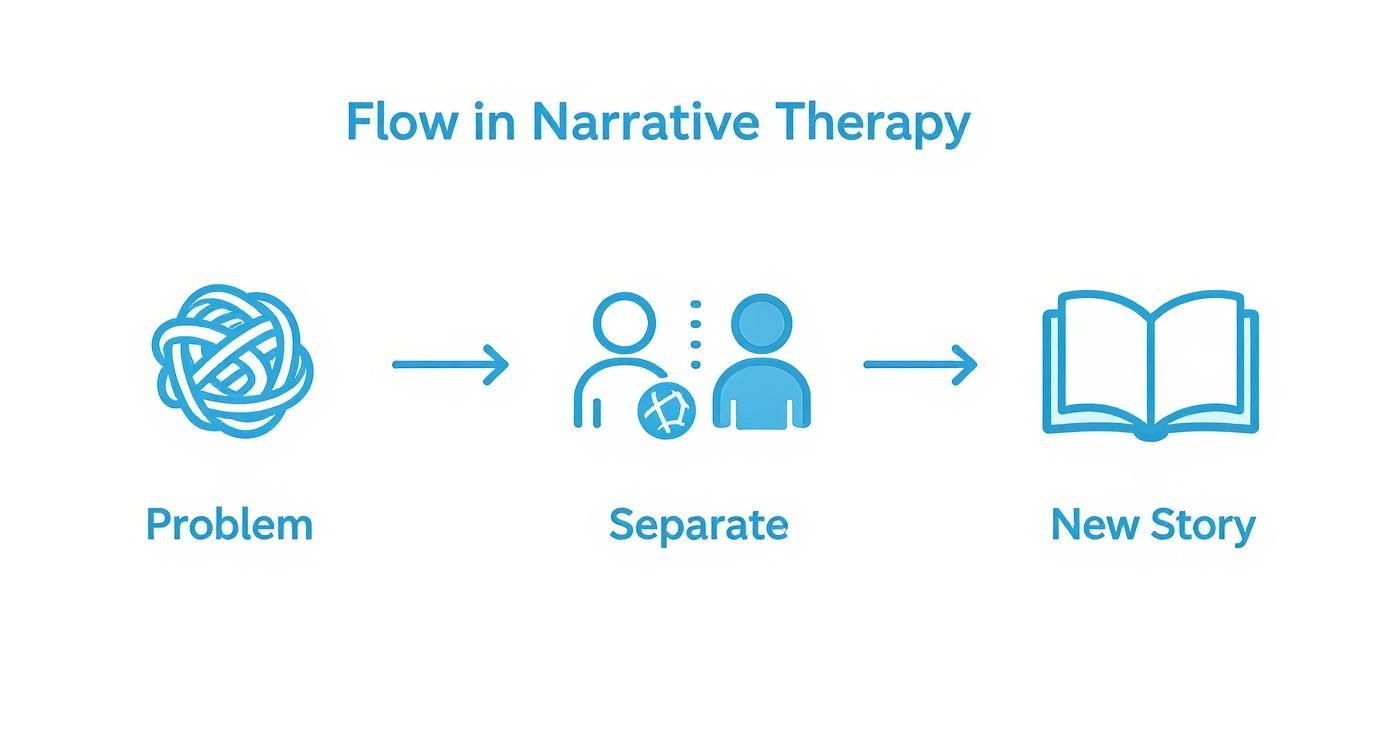
As you can see, the process isn't about erasing problems. It’s about changing our relationship with them so a better story can take centre stage.
Giving the Problem a Name: Externalising Conversations
The first and most important technique is called externalising the problem. This simply means separating the child from their struggle by treating the problem as its own character in their life. Think of it like giving a bully a name so you can stand up to them.
For a child wrestling with anxiety, a therapist might help them name it 'The Worry Monster' or 'The Jitters'. An issue with anger could become 'The Red Mist' or 'The Grump'.
This simple act achieves two crucial things almost immediately:
- It lifts the heavy weight of blame. The child isn't "bad" or "anxious"; they are a person who is dealing with a tricky character called 'The Worry Monster'.
- It turns the problem into something that can be observed and understood. Once it has a name, you can start asking questions about it.
Therapist: "It sounds like 'The Worry Monster' was being very loud this morning before school. What kind of sneaky tricks was it using to make you feel wobbly?"
Child: "It was telling me that no one would play with me at break time."
This kind of dialogue opens up a space for curiosity instead of shame. It allows the child and therapist to become a team of detectives, investigating the problem's influence together. A practical example is a therapist asking a child to draw what 'The Worry Monster' looks like, giving it a shape and form outside of themselves.
Unpacking the Problem's Rules: Deconstruction
Once the problem is externalised, the next step is deconstruction. This involves exploring the 'rules' and beliefs that the problem uses to keep its power. The therapist helps the child investigate where these ideas came from and whether they really hold true.
Take a teenager battling 'The Perfectionism Pest', a problem telling them that anything less than 100% on a test is a total failure. This belief can be amplified by social media, where everyone seems to be showcasing flawless achievements.
To deconstruct this rule, the therapist might ask questions like:
- "Where did 'The Perfectionism Pest' learn this all-or-nothing rule from?"
- "Has there ever been a time you got less than perfect but still felt proud of your effort?"
- "Whose voices does this problem sound like—a teacher's, something you saw online, or its own?"
This detective work helps the young person realise that the problem's rules aren't universal truths. They are just ideas that can be challenged and rewritten, weakening the problem's grip by showing how flimsy its foundations really are.
Finding the Sparkle: Re-authoring Conversations
The most hopeful part of the process is re-authoring. This is where the focus shifts away from the problem story towards building a new, preferred one. This isn't about pretending difficulties don't exist, but actively looking for evidence that contradicts the problem's narrative.
A key part of this is spotting 'unique outcomes' or 'sparkling moments'. These are any times, no matter how small, when the child resisted the problem's influence or when the problem simply wasn't in charge.
For instance, if a child is dealing with 'The Shy Shadow' that stops them speaking in class, a unique outcome might be the one time they whispered an answer to their friend. This small act of resistance is a 'sparkling moment'.
The therapist then helps the child explore this moment in detail, building a story of competence and agency around it. While narrative therapy focuses on stories, other approaches like solution-focused therapy also concentrate on finding exceptions to problems, showing a shared interest in building on what’s already working.
By collecting these sparkling moments, a new narrative starts to take shape—one where the child is not a victim of 'The Shy Shadow' but someone who is brave, capable, and has moments of connection. This re-authored story becomes a powerful resource they can draw on long after therapy has finished.
How Narrative Therapy Helps Children and Teenagers
Children and teenagers today are navigating a world filled with unique pressures. From academic expectations at school to the carefully curated lives seen on social media, it's easy for young people to develop stories about themselves that feel heavy with anxiety, self-doubt, or failure. Narrative therapy offers a creative, gentle, and non-blaming space that really resonates with young minds who might find it hard to talk about their feelings directly.

The approach is wonderfully adaptable. Its real strength lies in meeting children where they are, using methods that feel natural and engaging for their age. This ensures the therapy doesn't feel like a clinical examination but a collaborative adventure.
Tailoring the Storytelling for Different Ages
For younger children, talking about big feelings can be intimidating. A narrative therapist might use play, drawing, or puppets to help a child give their anxiety a character, like ‘The Worry Gremlin’. By drawing the gremlin and talking about its sneaky tricks, the child begins to see the worry as something separate from them—something they can stand up to.
For teenagers, the tools might be different but the principle is the same. A therapist could use journaling, story mapping on a whiteboard, or even exploring song lyrics to help a teen deconstruct the pressures of social media. They might work together to map out how ‘The Comparison Thief’ steals their confidence and then co-author a new story focused on their unique strengths and values, building a healthier self-image.
By separating a young person from their difficulties, narrative therapy creates space for them to see their own strengths more clearly. The problem is positioned as just one part of their story, not the whole book.
This creative approach is especially helpful as it aligns with a child's natural inclination towards imagination and play. It turns the therapeutic process into an act of discovery rather than a difficult chore. Many of the principles used can be supported by a trauma-informed practice, which also prioritises safety and empowerment.
Seeing Real-World Results
The tangible outcomes of this approach are what make it so powerful for families. By focusing on strengths and resilience, narrative therapy helps children and teenagers build a stronger sense of personal agency—that belief that they can influence their own lives.
Consider these practical examples of change:
- Improved Self-Esteem: A child who saw themselves as "shy" rewrites their story to be about being a "thoughtful observer" who chooses when to speak, boosting their confidence in social situations.
- Stronger Resilience: A teenager learns to view a failed exam not as a story of "I'm not smart enough," but as a chapter about overcoming a challenge, giving them the resilience to try again.
- Healthier Coping Skills: Instead of being overwhelmed by anger, a child learns to recognise ‘The Hot Temper’ arriving and uses strategies to shrink its influence before it takes over. For example, they might agree to take five deep breaths or step away for a moment when they feel 'The Hot Temper' bubbling up.
Research has shown promising results in UK settings. For instance, one study with vulnerable youths found significant increases in resilience scores after a narrative therapy intervention. Another small study with veterans experiencing PTSD showed that several participants no longer met the diagnostic criteria after treatment, highlighting its potential to create meaningful change. You can discover more insights about these findings and the evidence supporting this approach.
Ultimately, by helping young people change the stories they tell about themselves, narrative therapy equips them with tools not just for today's problems, but for a lifetime of wellbeing.
Applying Narrative Ideas at Home and School
Bringing the core ideas of narrative therapy into a child's everyday world is one of the most effective ways to support their journey. You don't need to be a therapist to do this. Simple, small shifts in how we talk and listen can make a huge difference, creating a supportive environment at home and in the classroom that strengthens the new, positive stories a child is building about themselves.
The goal is to connect the dots between the therapy room and real life.
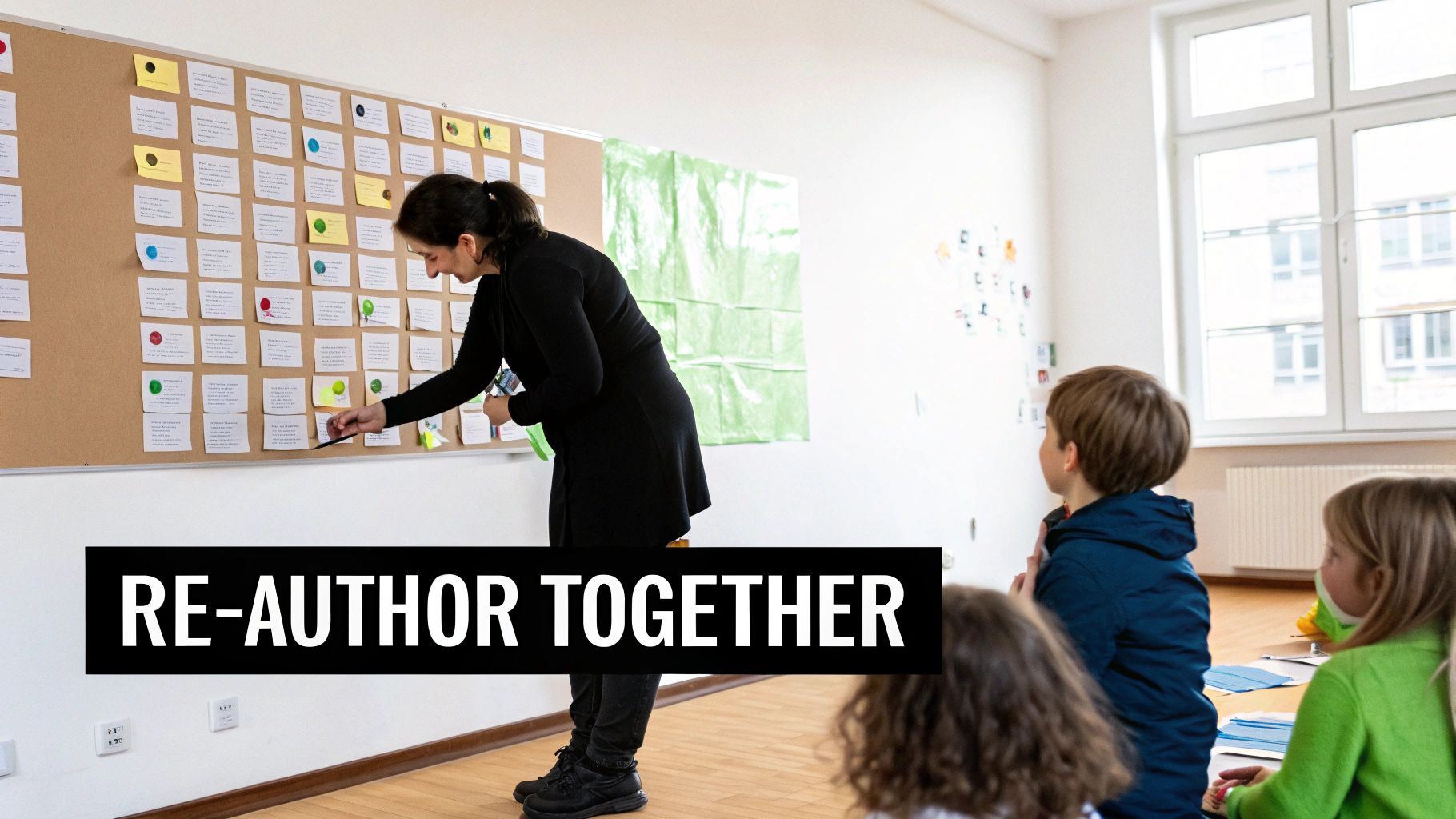
This consistency helps a child feel truly seen and understood. It empowers them to recognise their own strengths more clearly, especially when things get tough, allowing their preferred story of resilience and capability to really take root and grow.
Using Externalising Language in Daily Conversations
One of the most practical narrative ideas you can start using today is externalising language. It’s all about talking about a problem as if it were a separate thing, not some fixed part of your child’s identity. This simple change helps to lower the shields, reducing blame and opening the door to curious, collaborative chats.
So, instead of asking, "Why are you so frustrated?" which can feel like an accusation, you could try something like, "It looks like Frustration is trying to take over this afternoon. What tricks is it playing on you?" This subtle shift reframes the situation from a personal failing into a shared challenge to outsmart together.
This non-blaming approach is more important than ever. With statistics showing that one in six children aged 7 to 16 in the UK now has a probable mental health problem, creating a safe space for them to talk about their struggles without fear of judgement is vital.
To give you a better idea, let's look at how you can tweak common questions to be more narrative-inspired.
Applying Narrative Ideas in Daily Conversations
Making small changes in how we phrase questions can invite a child to see their problems from a different perspective. It separates them from the issue and highlights their ability to influence it.
| Common Question | Narrative-Inspired Alternative |
|---|---|
| "Why are you being so anxious?" | "What is 'The Worry' whispering to you right now?" |
| "Stop being so angry." | "That 'Anger Storm' seems really powerful. How have you managed to shrink it before?" |
| "You're always so shy." | "It seems like 'The Quiet' is making it hard to speak. What helps you find your voice?" |
| "You need to stop procrastinating." | "What rules is 'The Procrastination Bug' making you follow today?" |
These small adjustments can transform a conversation from one of confrontation to one of curiosity and teamwork.
Highlighting Strengths and Unique Outcomes
Another brilliant strategy is to become a detective for your child's 'unique outcomes' or 'sparkling moments'. These are those little instances when the problem wasn't in charge. When you actively notice and celebrate these moments, you help build your child’s story of competence and strength.
You could say something like, "I noticed that even though 'The Grump' was trying to spoil our morning, you still managed to give your brother a smile. How did you do that?" This shines a light on their own agency and resilience.
Simple relaxation techniques can also create space for these new stories to emerge. When a problem feels overwhelming, taking a moment for deep breathing can help. Encourage your child to take five slow, deep breaths, imagining they are blowing the problem's power away with each exhale. Another helpful tip is the '5-4-3-2-1' grounding technique: notice five things you can see, four things you can feel, three things you can hear, two things you can smell, and one thing you can taste. This can help bring focus back to the present moment.
Creating a Narrative-Friendly Classroom
Teachers and educators have an amazing opportunity to foster a narrative-friendly environment at school. The classroom can be a high-pressure place, so finding ways to reinforce a child's strengths is incredibly valuable.
Here are a few ideas to try:
- 'Wall of Awesome': Create a space where students can post notes about times they overcame a challenge or helped a friend. This is a brilliant, visual way to celebrate 'unique outcomes'.
- Story Circles: Hold regular, informal sessions where students can share stories about their skills, hobbies, or achievements, focusing on what makes them feel proud.
- Problem-Solving Characters: Use storytelling to externalise common classroom issues. You could talk about 'The Distraction Demon' or 'The Confidence Goblin' and brainstorm strategies as a group to outsmart them.
Finally, while these tips can be incredibly helpful, it's so important to remember that I am not a mental health professional. If you are worried about a child's wellbeing, please seek support from your GP or a qualified therapist. For daily reminders of strength, you can also explore resources like children's mental health books or even mental health apparel with positive affirmations that help reinforce a new, empowering narrative.
Knowing When to Seek Professional Help
While using narrative ideas at home can create a wonderfully supportive environment, it's absolutely crucial to recognise when professional guidance is needed. These techniques are designed to complement, not replace, the incredible work of a trained therapist.
Knowing the signs that a child needs more specialised support is a proactive and loving step. Deciding to seek help can feel daunting, but it’s a real sign of strength. You are your child's best advocate, and noticing they need extra support is the first step towards helping them thrive.
Recognising the Signs
Sometimes, the signals that a young person is struggling are clear as day. At other times, they can be much more subtle. The most important thing is to trust your instincts as a parent or carer. If you notice persistent changes that are impacting their daily life, it might be time to speak to a professional.
Look out for patterns like these:
- Persistent Changes in Mood: This could be ongoing sadness, irritability, or a sudden loss of interest in hobbies and activities they once loved.
- Significant Behavioural Shifts: Uncharacteristic anger, aggression, or frequent emotional outbursts that seem completely out of proportion to the situation.
- Social Withdrawal: Actively avoiding friends, family, or social events and preferring to be isolated for long stretches of time.
- Difficulties at School: A sudden drop in grades, trouble concentrating, or trying to avoid school altogether.
These signs often mean the problem's influence has become too strong for home-based strategies alone. Seeking professional help gives your child a dedicated, safe space to explore these challenges with an expert. Our guide on mental health support for young people offers some more insights into navigating this journey.
The Path to Getting Help in the UK
For most families in the UK, the process of finding a qualified narrative therapist begins with a visit to your GP. They can discuss your concerns, assess your child's needs, and make a referral to your local Child and Adolescent Mental Health Services (CAMHS) or suggest other therapeutic avenues.
Taking the step to seek professional help is not an admission of failure; it is an act of empowerment. It's about giving your child the best possible tools to rewrite their story in a way that serves them for a lifetime.
Unfortunately, accessing services isn't always straightforward. Statistics on mental health service use in the UK show there are significant unmet needs. This highlights a treatment gap that empowering, accessible approaches like narrative therapy are perfectly placed to help address.
This reality underscores why understanding what narrative therapy is and how it works is so vital for families today. Beyond general resources, for more tailored guidance on narrative therapy or any mental health concerns, it can be beneficial to consult experts for personalized advice. Please remember, I am not a mental health professional, and seeking advice from a qualified doctor is always the most important step if you are worried.
Finding Your Toolkit: Resources and Extra Reading
Supporting a young person on their mental health journey is always a team effort, and having the right tools can make a world of difference. Here, I’ve put together a list of resources—from brilliant organisations to simple everyday items—that all echo the empowering ideas of narrative therapy.
The conversations that start in a therapy room need nurturing to grow. The idea is to build a supportive world around a child, one that helps their new, stronger story flourish in every part of their life.
Reputable UK Organisations
When you’re looking for trustworthy information or just need a bit more support, these UK charities are fantastic places to start. They offer solid advice, great resources, and a real sense of community for families figuring this all out.
- YoungMinds: A leading voice for young people's mental health in the UK. They have a parents' helpline, easy-to-understand guides on different conditions, and resources made just for young people.
- Anna Freud Centre: A world-class mental health charity for children and families. They’re at the forefront of clinical expertise, research, and training to support young minds.
Mental Health Books for Young Readers
Stories are such a powerful way to explore feelings and see what resilience looks like. These mental health books are a great fit for narrative principles, showing characters who tackle their challenges and find their own strength.
- For Younger Children: Books like The Huge Bag of Worries by Virginia Ironside are perfect for externalising anxiety. It shows children that worries are something you carry, not something you are. Another excellent choice is The Invisible String by Patrice Karst, which can help children understand connection and cope with separation anxiety.
- For Teenagers: Novels that dig into identity and overcoming tough times can be incredibly validating. The Perks of Being a Wallflower by Stephen Chbosky explores themes of trauma and finding one's place, while Turtles All the Way Down by John Green offers an honest portrayal of living with anxiety.
Everyday Reinforcements
Sometimes, the smallest daily reminders can be powerful anchors to the work done in therapy. Simple, tangible tools can help make a child’s new story feel real and positive.
Think about something like mental health apparel – a hoodie with an empowering phrase on it. It becomes a quiet but constant reminder of a child's chosen story. It’s a way for them to literally wear their new narrative of strength and self-compassion.
This kind of gentle, everyday reinforcement really helps ideas of self-worth and resilience to stick. Just a quick reminder: I'm not a mental health professional, and you should always chat with a doctor if you have concerns. Think of these resources as valuable extras for your support toolkit.
Your Narrative Therapy Questions Answered
To help pull all these ideas together, let's tackle some of the common, practical questions that parents often have when considering narrative therapy for their child.
How Long Does Narrative Therapy Usually Take?
Narrative therapy is generally a short-term, focused approach. It’s not about years on the couch; it’s about making meaningful shifts in a compact timeframe. While it varies depending on your child’s specific needs, many families notice real, positive changes within 8-12 sessions.
The whole point is to give your child new tools and ways of seeing themselves that they can carry forward on their own. The aim is empowerment and lifelong resilience, not a long-term dependence on therapy.
Is It a Good Fit for Every Child?
This approach works wonders for a whole host of challenges, particularly those tangled up with anxiety, low self-esteem, trauma, and some behavioural issues. Its collaborative, non-judgemental style makes it a great fit for lots of kids and teenagers, especially those who might push back against more rigid or clinical methods.
That said, for some complex conditions, a therapist might weave narrative ideas in alongside other therapeutic models. A professional assessment is always the best starting point to figure out the most supportive path for your child and their unique story.
How Is It Different From Something Like CBT?
Think of them as different tools for different jobs, both incredibly useful. Cognitive Behavioural Therapy (CBT) is brilliant at homing in on specific negative thought patterns and behaviours to change them directly. It’s a very practical, structured way to manage symptoms.
Narrative therapy takes a wider view. Instead of just targeting thoughts, it looks at the bigger stories that shape our identity. The real magic is how it works to separate the person from the problem, empowering them to rewrite their life's story from a place of strength, agency, and hope.
At Little Fish Books, we believe in the power of stories to help children understand their emotions and build resilience. Our curated collection of books and resources is designed to support the very principles of narrative therapy, empowering young people to become the authors of their own positive futures.
Explore our collection and find the perfect story to support your child’s journey.