
What is reflective listening? A Practical Guide to Better Communication
Ever feel like you’re talking, but no one is actually listening? That’s a common feeling, and it’s what makes reflective listening so powerful. It’s the art of hearing what’s behind the words—the meaning, the emotion, the real message.
Think of it less like hearing and more like being a mirror. You’re carefully reflecting a person’s thoughts and feelings back to them, so they feel genuinely seen and heard. It's an absolute game-changer for building stronger, more meaningful relationships.
Why Reflective Listening Matters More Than Ever
In a world buzzing with notifications and digital noise, making a real connection can feel like a rare gift. Social media gives us a constant stream of curated, picture-perfect lives, which often makes it harder for young people to open up about how they're truly feeling. The pressure to present a flawless online persona can have a significant, negative impact on mental health.
This is all happening while mental health concerns among UK children are on the rise. In fact, it's estimated that one in five children aged 8 to 16 has a probable mental health condition. This is fuelled by immense pressure from school, peers, and their online worlds. It's vital we address this, as good mental health is as important to a child's development as their physical health.
This gap in communication has very real consequences. Poor mental health is estimated to cost UK businesses up to £56 billion a year in lost productivity, staff turnover, and sick days. But more importantly, it's affecting our homes and classrooms, leaving children and teenagers feeling disconnected and alone.
Real change starts with better conversations, and that’s why understanding what is reflective listening is so vital.
It’s a skill that helps us push past the small talk and build genuine empathy and trust. By practising it, we create safe spaces where children—and adults—feel comfortable sharing what’s on their mind without worrying about being judged. This practice is a cornerstone for helping a child develop the ability to understand and manage their feelings. You can dive deeper into this by exploring what is emotional literacy in our detailed guide.
Reflective Listening vs Passive Hearing at a Glance
So, what really separates reflective listening from just hearing someone speak? It's the difference between being a passive bystander in a conversation and being an active, engaged participant. One is simply letting sound waves enter your ears; the other is about connecting with the person behind the words.
The table below breaks down the key distinctions.
| Characteristic | Reflective Listening | Passive Hearing |
|---|---|---|
| Primary Goal | To understand the speaker's feelings and perspective. | To receive information or wait for a turn to speak. |
| Listener's Focus | On the underlying emotions and meaning behind the words. | On the literal words being spoken. |
| Response Type | Paraphrasing, reflecting feelings, and summarising. | Nodding, giving advice, or sharing a personal story. |
| Outcome | The speaker feels validated, understood, and respected. | The speaker may feel unheard or misunderstood. |
As you can see, the intention and outcome are worlds apart. One builds connection, while the other can, unintentionally, shut it down.
Please remember, I am not a mental health professional. This article offers guidance and is not a substitute for professional medical advice. If you have concerns about your or your child's mental health, please consult a GP or a qualified mental health professional.
The Three Pillars of Reflective Listening
To really get to grips with reflective listening, it helps to break it down into three core pillars. Think of these less as rigid steps and more as guiding principles that can turn a simple chat into a powerful moment of connection. Mastering them is like becoming a 'feelings detective,' gently uncovering the emotions tucked away behind someone's story.
This approach gets right to the heart of the communication gap so many of us feel at home and at work. At its core, reflective listening is built on three things: understanding, paraphrasing, and reflecting feelings.
This simple diagram shows how the process flows from a genuine desire to understand, to actively listening, and then to reflecting the emotions you pick up on.
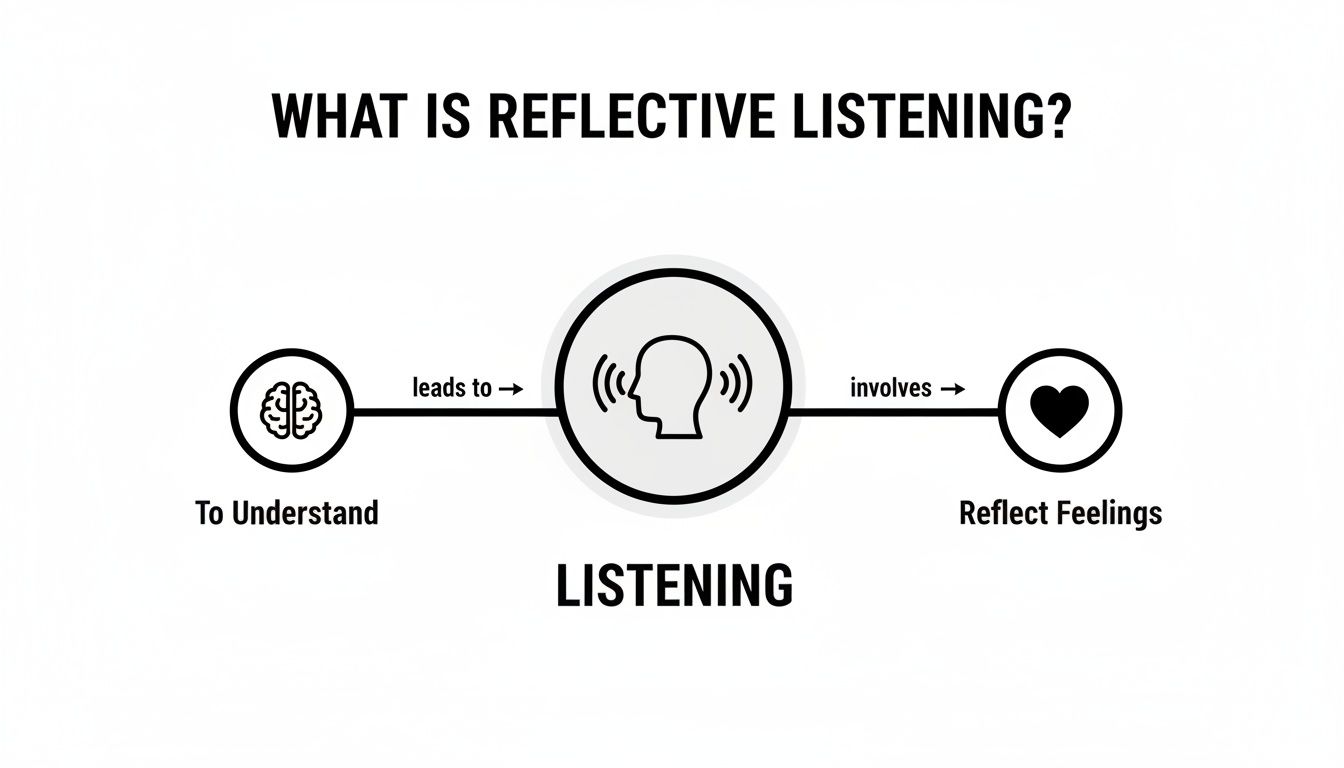
As you can see, true listening is an active process. It involves both the head and the heart—it’s about grasping the facts and the feelings.
Pillar 1: Listen to Understand, Not Just to Reply
The first pillar is easily the most important, and it’s all about shifting your intention. Most of us listen while mentally planning our response, waiting for our turn to speak, solve the problem, or share a similar story of our own. Reflective listening asks you to put all that aside.
Instead, your entire focus is on understanding the other person's world. Your goal is to hear their perspective without judgement. It’s about being curious, not about being correct.
Pillar 2: Paraphrase What You Heard
Next, you gently repeat back the main points of what they said, but in your own words. This isn’t about mimicking them like a parrot. It’s about summarising their core message to check that you’ve understood it correctly.
For instance, you might say:
- "So, it sounds like you're finding it difficult to manage everything at the moment."
- "If I'm hearing you right, you felt left out when that happened."
This simple act of paraphrasing proves you’re engaged and gives them a chance to correct any misunderstandings. It's a powerful way to build psychological safety, which is vital for any honest conversation about mental health. While this technique has been a cornerstone of effective communication since the 1950s, a huge gap remains. Research highlighted by Aon shows a staggering 83% of UK employees feel they are not heard 'fairly or equally'. You can read the full research on employee feedback to see just how deep this communication breakdown runs.
Pillar 3: Reflect the Underlying Emotion
The final pillar is where you tune into the feelings simmering beneath the words. This is the moment you move from just hearing the story to connecting with the emotion behind it. You make an empathetic guess about what they might be feeling.
"You sound really frustrated about that."
"It seems like you're feeling a bit lonely."
Putting a name to the emotion validates their experience and helps them feel truly seen. It's this pillar that transforms good listening into a deeply supportive and trust-building act.
Reflective Listening in Real-Life Conversations
Moving from theory to practice is where reflective listening really comes alive. It's one thing to understand the concepts, but it’s another thing entirely to use them in the middle of a tricky conversation. To help you bridge that gap, this section offers some concrete, scripted examples to show you just how this skill can reshape your interactions.
We’ll look at a few common scenarios you might find yourself in every day. You'll see the stark difference between a typical, almost knee-jerk reaction and a more thoughtful, reflective one. The idea is to give you some tangible phrases you can borrow and make your own, helping you build the confidence to try it out for yourself.

Scenario 1: A Child Worried About School
With mental health challenges affecting an estimated one in five children in the UK, creating a safe space for them to talk is more vital than ever. Let’s imagine your seven-year-old comes home looking withdrawn and quiet.
Typical Reaction:
Child: “I don’t want to go to school tomorrow.”
Parent: “Don’t be silly, you love school! You have to go. Did you finish your homework?”
This response immediately dismisses the feeling and jumps straight into problem-solving or distraction. It sends a clear signal that their emotions aren't important or valid in that moment.
Reflective Response:
Child: “I don’t want to go to school tomorrow.”
Parent: “Oh, it sounds like you’re feeling really worried about something at school.”
This acknowledges the emotion bubbling under the surface (worry) without any judgement. It gently opens the door for the child to share what’s really bothering them, building a foundation of trust and emotional safety.
Scenario 2: A Teenager Navigating Social Media
The constant pressure of social media is a massive factor in teenage mental health. Picture a teenager who is clearly upset after scrolling on their phone.
Typical Reaction:
Teen: “Everyone is out having fun without me. My life is so boring.”
Parent: “You shouldn’t compare yourself to them. Half of what you see online isn’t even real. Just put your phone down.”
While the advice might be technically correct, it completely invalidates their feelings of loneliness and comparison. It can sound like a lecture, which is a surefire way to shut the conversation down.
Reflective Response:
Teen: “Everyone is out having fun without me. My life is so boring.”
Parent: “It feels really lonely and isolating seeing all those posts, and it makes you feel like you’re being left out.”
This response mirrors back both the situation (seeing the posts) and the feeling (lonely and left out). It shows you're trying to see their world from their perspective, which helps them feel truly seen and understood.
Scenario 3: A Stressed Colleague at Work
Poor mental health costs UK businesses billions each year, often driven by workplace stress and burnout. How you respond to a colleague who is struggling can make a huge difference to the team’s atmosphere.
Typical Reaction:
Colleague: “I’m drowning in work. I’ll never get this project finished on time.”
You: “We’re all busy. You just need to power through it. Have you tried making a to-do list?”
This kind of response minimises their struggle ("we're all busy") and offers unsolicited advice. It can feel dismissive and unhelpful, rather than supportive.
Reflective Response:
Colleague: “I’m drowning in work. I’ll never get this project finished on time.”
You: “It sounds like you’re feeling completely overwhelmed by the pressure and deadlines right now.”
This simple reflection validates their stress without trying to fix it. It demonstrates that you’re really listening and helps create a culture of empathy and support in the workplace.
How Better Listening Boosts Mental Wellbeing
Reflective listening does far more than just improve a conversation; it's a powerful way to directly nurture positive mental wellbeing. When someone genuinely feels heard and understood, it creates an incredible sense of connection. This can be a real antidote to the feelings of loneliness and isolation that are huge challenges for so many children and young people today.
Think about the relentless pressure from social media and school—it's easy for them to feel completely disconnected. By simply offering a non-judgemental ear, you help them build emotional literacy, which is the vital skill of understanding and putting words to their own feelings. This simple act of validation helps them realise that their emotions are normal, acceptable, and something they can manage. You can explore more on our guide about what is mental wellbeing to see just how these small acts contribute to building resilience.
This kind of supportive environment is just as crucial in the workplace. With poor mental health costing UK businesses billions every single year, fostering a culture of genuine listening is a powerful, preventative step.
A Tool for Resilience and Productivity
When employees feel properly heard, it can transform the entire workplace atmosphere from one of stress to one of support. Managers trained in reflective listening techniques often see remarkable results, with some data showing as much as a 30% improvement in employee satisfaction.
What's more, this skill has been shown to boost collaboration and productivity by up to 25%, which in turn reduces absenteeism and improves overall wellbeing. It just goes to show that investing in better communication isn't just a "nice-to-have"—it's good for people, and it's good for business. You can discover more insights about how listening impacts the workplace on imagine-beyond.co.uk.
Preparing for Important Conversations
Knowing how to listen is one part of the puzzle; feeling calm and present enough to actually do it is the other. If you know you've got a difficult but important conversation coming up, preparing yourself mentally beforehand can make all the difference.
Before you even start talking, just take a moment to centre yourself. Simple relaxation techniques can ground you, allowing you to be fully present for the other person instead of getting tangled up in your own anxieties.
Here are a couple of quick tips to help you get ready:
- Mindful Breathing: Take three slow, deep breaths. Breathe in for a count of four, hold it for four, and then breathe out for a count of six. This simple exercise really helps to calm your nervous system and bring your focus back to the present.
- Set an Intention: Quietly tell yourself, "My goal here is to understand, not to fix." This small reminder can completely shift your entire approach to the conversation for the better.
These little actions create the headspace you need to listen reflectively and with genuine empathy.
Disclaimer: I am not a mental health professional. The information in this article is for educational purposes only and should not be seen as a substitute for professional medical advice. If you are worried about your or someone else's mental health, please consult a GP or a qualified therapist.
Developing Your Reflective Listening Skills

Knowing what reflective listening is and seeing it in action are the first steps. Now, it's time to build your own skills. It's important to remember that this isn't some innate gift people are born with; it’s an ability developed with patience and conscious effort.
Before diving into practice, it’s useful to recognise the common roadblocks that can so easily derail a conversation. Just being aware of them is the key to sidestepping these pitfalls.
Common Pitfalls to Avoid
Even when our intentions are good, it's surprisingly easy to slip back into old communication habits. Keep an eye out for these common tendencies that get in the way of real understanding:
- Jumping to Fix the Problem: It's a natural instinct to want to help by offering solutions. But for now, resist that urge. Your first goal is simply to understand the feeling, not to fix the situation that caused it.
- Passing Judgement: Try to avoid phrases like "you shouldn't feel that way" or "it's not that big a deal." The whole point is to validate their emotion, whether you personally agree with it or not.
- Making It About Yourself: Steer clear of turning the conversation back to your own experiences with lines like, "Oh, that happened to me once..." Keep the spotlight entirely on them and their story.
Recognising these habits in yourself is the first, crucial step toward changing them. The next is to start practising in low-stakes situations where you feel comfortable.
Simple Exercises to Sharpen Your Skills
You don’t need a formal setting to practise reflective listening. In fact, you can weave these simple exercises into your daily life to make the skill feel much more natural over time.
- Practise with a Friend: Ask a trusted friend if you can practise with them. Choose a simple, low-stakes topic and focus solely on reflecting their thoughts and feelings back to them without adding your own spin.
- Listen to a TV Drama: This might sound a bit silly, but it works. While watching a programme, pause it after an emotional scene. Try to say out loud what a character is feeling and why. For example, "It seems like he's feeling betrayed because his secret was shared."
These small, consistent efforts build muscle memory. They make it much easier to use reflective listening when it truly matters, like during important conversations about mental health. For parents wanting to apply this, understanding the principles of emotional coaching for parents can provide a really supportive framework.
Resources for Continued Growth
Developing your communication skills is an ongoing journey, not a destination. Thankfully, there are some fantastic resources out there that can offer deeper insights and practical advice.
To really hone your abilities, you can explore valuable insights on the art of truly listening to understand what people are communicating beyond their words.
Additionally, many mental health books champion the power of better communication. Titles like 'Lost Connections' by Johann Hari or 'Maybe You Should Talk to Someone' by Lori Gottlieb offer powerful stories and expert advice that can inspire you and provide new perspectives on how to connect more deeply with the people you care about.
Fostering Connection in a Disconnected World
As we've explored, getting to grips with what is reflective listening isn't about memorising a script or learning a new tactic. It's really about shifting your mindset towards one of genuine curiosity and empathy. When you start applying this skill, you'll find it's fundamental to strengthening your relationships with family, friends, and colleagues. It builds the supportive foundation we all need for those important, sometimes tricky, conversations about mental health.
In a world that often feels quite disconnected, genuine human connection is one of the most powerful tools we have for improving our wellbeing. This isn't just true in our personal lives; it's a huge deal in the professional world too, where feeling understood can make all the difference. In fact, 56% of UK customers said their satisfaction hinged on whether a company understood and cared about their needs – a principle that sits right at the heart of reflective listening. You can discover more insights about the importance of listening on uk.indeed.com and its impact.
Reflective listening is more than just a technique; it's a powerful way to enhance personal bonds. To see how these skills create real trust and understanding, it's worth looking into strategies for consistently strengthening family relationships.
Sometimes, the simplest acts make the biggest difference. From wearing mental health apparel like a supportive slogan T-shirt to just having an honest chat, you signal support and help chip away at the stigma. Ultimately, it’s these small moments of true connection that matter most.
Frequently Asked Questions
As you start to explore reflective listening, it's completely normal for a few questions to pop up. Let's tackle some of the most common ones to help you practise this skill with more confidence.
What Is The Difference Between Active And Reflective Listening?
This is a great question, as the two are definitely related. Think of it this way: active listening is the foundation. It's about showing you're paying attention – making eye contact, nodding, and giving your full focus to the speaker. You're switched on and engaged.
Reflective listening is the next level up. It takes all that great focus from active listening and adds a crucial step: you gently reflect back what you've heard, not just the words but the feeling behind them. You're essentially holding up a mirror to their emotional experience to show you truly get it.
Will Reflective Listening Sound Robotic?
Honestly, it might feel a bit clunky at first. That’s perfectly normal! Most of us aren't used to communicating this way, so it can feel like you're following a script.
The trick to making it feel natural is to avoid simply repeating what the other person said, like a parrot. Instead, try to capture the essence of their message in your own words. Over time, what starts as a conscious technique will blend into your natural way of connecting with people. It just takes a bit of practice.
How Can I Use It If I Disagree With The Speaker?
This is such an important point, because it gets to the heart of what this skill is all about. Reflective listening is about understanding, not agreeing. Your goal is simply to show the other person that you can see the situation from their perspective.
You can validate their emotion without having to validate their argument. You're acknowledging their feelings are real for them, which is incredibly powerful for keeping a difficult conversation going.
For example, you could say, "It sounds like you feel really strongly about this, and you're frustrated that others don't see it your way." This shows them they’ve been heard and understood on an emotional level, but it doesn't mean you agree with their point of view. It keeps the door open for a real discussion, rather than slamming it shut.
At Little Fish Books, we believe that better communication starts with understanding. Explore our collection of books and resources designed to nurture emotional literacy in children and adults. Discover tools to build stronger connections at https://thatsokay.co.uk.