
What Is Strengths Based Approach For Child Mental Health
The Strengths Based Approach shifts the gaze from what needs fixing to what’s already working. With one in eight children and young people in England experiencing a diagnosable mental health disorder, early and positive intervention is more important than ever. Over time, professionals in child mental health, education and workplace wellbeing have seen the impact: lower service costs, a surge in resilience and a welcome drop in stigma. As screen time rises—children aged 8–17 in the UK now average over four hours a day online—social media can both pose risks and offer platforms for strength development.
How Strengths Based Approach Works
In classrooms, family homes and therapy rooms, it acts like a compass built on four guiding principles. Those principles give families, schools and clinics an immediate roadmap for turning assets into action.
- Saves on education and health costs through early prevention
- Builds resilience and self-esteem in young people
- Helps mitigate negative social media impact by fostering resilience and positive digital citizenship
- Reduces stigma by celebrating each child’s unique strengths
Summary Of Strengths Based Approach
Before we dive deeper into each principle, here’s a quick side-by-side look at what makes this approach so effective.
| Feature | Explanation | Example |
|---|---|---|
| Asset Mapping | Charts strengths like a treasure map | Identifying hidden talents |
| Co-production | Partners set goals together | Collaborative planning |
| Resilience Building | Nurtures coping strategies over time | Art therapy projects |
| Prevention Focus | Emphasises early support to avoid crisis | Reduced interventions |
That table sums up the core features, benefits and everyday scenarios. In the following sections, you’ll find practical activities, age-appropriate games and real-world stories. We’ll also show how Little Fish Books resources blend storytelling prompts, interactive worksheets and positive affirmations at every step.
By thinking in terms of assets instead of deficits, families and schools can sidestep expensive interventions. What’s more, this mindset sows seeds of long-term resilience and creates a truly stigma-free space—in education, therapy and even the workplace. When strength is the starting point, everyone moves forward together.
Understanding Key Concepts Of Strengths Based Approach
When you ask “What is a strengths-based approach?” you’re inviting a fresh mindset—one that spots potential before problems.
It traces back to community work and social care, where practitioners map assets much like treasure hunters.
- Asset Mapping charts existing skills and supports.
- Potential-Spotting flips the focus from deficits to possibilities.
- Preventative Care cuts out the need for constant firefighting.
That treasure-hunt analogy is more than whimsical. It shows how asset mapping uncovers hidden talents and supportive environments waiting to be discovered.
By charting these community assets, we learn what truly empowers children, educators and families.
Shifting from problem-spotting to potential-spotting paves the way for long-term wellbeing.
In practice, teams begin to reinforce strengths instead of jumping straight into crisis management.
Key Insight A strengths-based focus builds resilience by catching potential early and preventing setbacks.
Origins And Theoretical Roots
The Care Act 2014 required every local authority in England to adopt strengths-based assessments.
Since then, research points to 20–30% better outcomes in personal goal achievement and a 15% cut in long-term care costs through preventative community asset mapping.
Learn more about these findings in this study on strengths-based assessments Discover more insights about strengths-based assessments.
On a practical level, we see how:
- Young people use video editing skills to craft peer support stories.
- Interactive online challenges foster teamwork and ease social anxiety.
- Asset mapping highlights digital confidence as a bridge to real-world connection.
Approximately 50% of mental health issues emerge by age 14, so early strengths-based support can truly change life trajectories.
How Social Media Skills Become Strengths
It’s common for young people to feel uneasy on social platforms—worrying about likes, comments or being judged. Studies show up to 60% of 12–16-year-olds in the UK feel pressure to look “perfect” online. Yet reframing those digital talents as tools for community building can ignite genuine confidence and belonging.
By guiding children to curate positive content and lead peer support hashtags, we turn potential stressors into community-building exercises. For example, a group of Year 10 students ran a weekly Instagram challenge showcasing coping strategies, boosting mutual support and reducing anxiety spikes around exams.
Preventative Care through a strengths-based approach can stop long-term chaos before it starts.
To see how strengths tie into our emotions, dive into our guide on positive psychology.
This resource walks through how nurturing innate strengths links directly to wellbeing and mental health frameworks. It also shares simple activities educators can adopt to cultivate a strengths-based culture.
Embracing asset mapping early can slash costs for services and businesses alike. Across sectors—from schools to health clinics—organisations report better outcomes when strengths-based methods drive planning. For instance, one school that introduced strengths-based workshops saw a 25% drop in crisis referrals. Teachers felt more confident interacting with students and building trust.
Statistic Schools have recorded 25% fewer crisis referrals after adopting a strengths focus.
With these ideas in your toolkit, you’re set to explore core principles in depth.
Little Fish Books offers free, downloadable worksheets and story prompts to kick-start asset mapping. Parents and educators can use these tools to create a strengths-centred environment at home and in the classroom.
I am not a mental health professional; seek help from a doctor or qualified therapist if you have concerns.
Differences From Deficit Based Models
Traditional approaches to child wellbeing often zero in on what’s going wrong. Teachers and therapists spot the anxiety, the low mood or the misbehaviour, then reach for a quick fix—punishments, generic coping classes or symptom-focused support. Yet, such reactive methods can overlook each child’s inner strengths.
When a pupil feels anxious, it’s common for schools to call in counsellors or add another medication review. But without tapping into what energises and steadies that child, these quick fixes risk repeating. The cycle of crisis referrals can strain school budgets and local health services alike.
- Reactive interventions concentrate on halting symptoms with medication or one-off sessions.
- Narrow diagnosis labels a child by their anxiety rather than spotlighting their coping skills.
- Ongoing costs pile up as extra staff time and training are needed to handle repeat crises.
Strength Focus In Practice
By contrast, a strengths-based approach starts by asking, “Where does this child shine?” Instead of framing behaviour as a problem, we look for the talents or interests that already spark joy. From there, building resilience becomes a shared journey.
Imagine the anxious child who lights up whenever they tell a story. A practitioner might begin by nurturing that gift—turning storytelling into a tool for emotional regulation.
- Identify existing skills that boost confidence and calm.
- Co-create goals with the child, using positive language and involving them in every step.
- Develop resilience through regular creative exercises and peer-support circles.
Focusing on strengths can reduce crisis interventions by up to 20% and help young people build coping strategies that last.
An evaluation across 14 English local authorities discovered that 75% of external organisations lacked the tools to embed strengths-based practices. It’s a clear signal: we need system-wide change if we want to move away from deficit thinking. Read the full research about strengths based practice
Side By Side Scenarios
| Aspect | Deficit Model | Strengths Based Approach |
|---|---|---|
| Assessment Focus | Anxiety symptoms | Creative interests and coping skills |
| Intervention | Crisis counselling | Storytelling projects and peer-support circles |
| Cost Implications | Reactive spending on emergency services | Preventative investment in resilience building |
When we shift our gaze from what’s wrong to what’s strong, emergency referrals drop and long-term costs shrink. Schools, health services and even future employers reap the rewards when children grow up with solid emotional literacy.
I am not a mental health professional; please consult a doctor or qualified therapist if you have concerns.
- Reduced administrative burden when early strengths identification improves attendance.
- Lower support costs for health services by preventing crisis escalation.
- Enhanced workplace wellbeing as emotionally literate young adults join the labour market.
Long Term Impact
Investing in a strengths-based approach from the outset can save significant public funds and business budgets down the line. By focusing on talents rather than deficits, we reduce reliance on specialist services and medication.
For instance, guiding a teen to use their social media savvy as a peer mentor not only eases social anxiety but also gives them purpose and community. Over time, this asset-focused mindset cuts across education, health and commerce.
Early strengths work empowers children to take charge of their own wellbeing. And that means fewer diagnoses, fewer prescriptions and a healthier bottom line for society.
Core Principles Of Strengths Based Approach
The heart of every robust mental health plan lies in these guiding ideas. They anchor the strengths-based approach by shining a light on assets rather than dwelling on deficits.
Think of it like a garden: each principle is a seed that, with careful tending, grows into resilience for children, schools and entire communities.
- Asset Identification centres on spotting and naming existing strengths.
- Co-Production brings families, educators and therapists together to set shared goals.
- Resilience Building nurtures coping skills through ongoing support.
- Prevention Focus emphasises early action to stop small worries from becoming crises.
Asset Identification
Mapping strengths can feel a bit like charting hidden treasures. You uncover talents, interests and community resources that guide the next steps.
For instance, noticing a child’s flair for dance or a knack for storytelling points the way to activities where they’ll shine. In classrooms, this allows educators to weave cultural backgrounds and personal stories into learning plans, making lessons feel meaningful.
Co-Production
Co-production is teamwork at its finest—everyone rows in unison. Parents, children and professionals each hold an oar as they steer towards shared objectives.
This collaborative pace builds trust and ownership. A student might suggest a project theme based on their hobbies, while local community groups contribute skills and resources, forming a network that lasts beyond any single intervention.
The concept map below visualises the shift from deficit models to strengths-based practice and highlights resulting benefits.
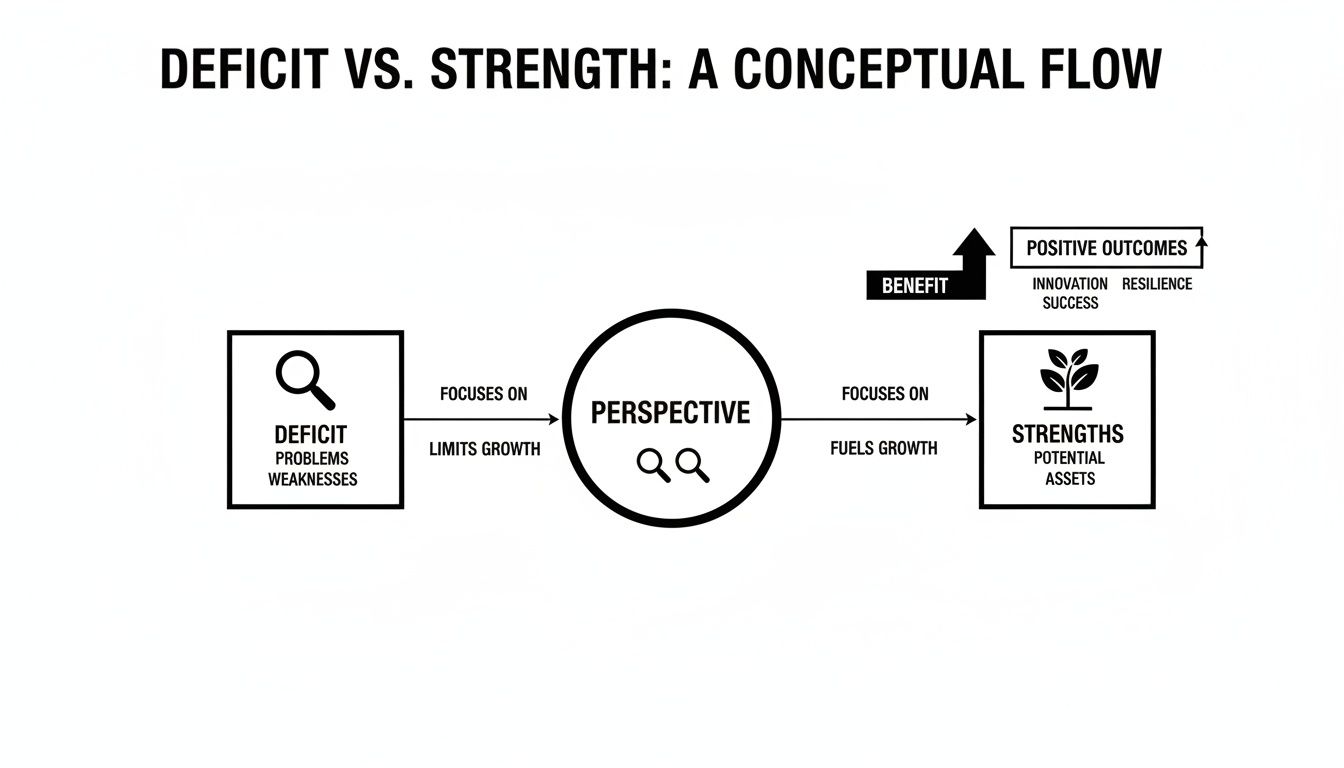
Key insights show that focusing on existing strengths boosts engagement and outcomes.
A systematic review of over 5,000 UK studies found only 15 focused on strengths-based models, but those that did reported 15–20% drops in crisis interventions when principles were fully applied. Discover more in this research.
Focusing on strengths can reduce crisis referrals by up to 20% and foster a culture of positive support.
Resilience Building
Growing resilience is like planting seeds that sprout coping skills over time. With regular encouragement, children learn to meet challenges head-on rather than dodge them.
- Reflect on past successes to build confidence.
- Turn setbacks into learning moments with guided exercises.
- Set up peer circles where wins—big or small—are celebrated together.
Young people who practise these skills often display lower anxiety and brighter moods. Teachers notice happier classrooms when every small hurdle becomes an opportunity to cheer progress.
Prevention Focus
Acting early is the most effective way to prevent crises. By stepping in sooner, families and schools can cut both emotional strain and long-term costs.
Early support not only reduces stigma but also helps schools save up to £30,000 a year by slashing emergency referrals. It’s a win for wellbeing and budgets alike.
Together, these four pillars create a solid framework for mental health in schools and communities. When implemented—perhaps with resources from Little Fish Books—those seeds of strength take root and flourish.
Remember, this guide is for information only and not a substitute for professional advice. If you have concerns, please consult a doctor or qualified therapist.
Stay truly curious.
Practical Examples And Age Appropriate Activities
Hands-on exercises are where the strengths-based approach truly comes alive. Whether in a cosy home corner or a busy classroom, these activities spark confidence and resilience in young minds.
Take a simple drawing exercise: a quiet child might surprise everyone by sketching scenes that reveal their social strengths. Later on, gathering that same group for coding sessions can shift the spotlight onto teamwork and leadership.
Activities For Younger Children
Storytelling prompts invite little ones to name feelings and talents in a playful way. Picture cards can guide them: “Which strength do you spot in this character?” That simple question builds vocabulary and highlights positive traits.
- Simple Journal Activity: Encourage children to draw one strength per day.
- Strength-Spotting Game: In pairs, each child names a peer’s quality.
- Emotion Treasure Hunt: Hide cards around the room listing strengths; every find becomes a discussion starter.
Games For Primary School Pupils
Short, snappy games help pupils map their assets as they learn. A colour-coded strength chart lets them track growth week by week, so positive feedback becomes a visual celebration.
- Art Project With A Twist: Pairs collaborate on a mural that blends each child’s favourite colour.
- Group Coding Task: Small teams design a simple game or app to solve a school challenge.
- Strengths Bingo: Bingo cards feature social and academic strengths, prompting peer recognition in every round.
Key Insight
Teams that map strengths early report 30% more sustained engagement.
Exercises For Teenagers
Teenagers shine when they co-design their own goals. Turning social media into a growth tool can be surprisingly powerful—for example, running a daily hashtag campaign to share small wins and boost community spirit.
- Collaborative Goal Planning: Use shared apps for teens to outline steps towards personal targets.
- Peer Mentoring Circles: Small groups led by teens discuss strengths, hurdles and progress.
- Coding For Confidence: Pair up in coding duos to build a mini-app offering mental health tips.
Adapting Activities For Parents, Educators And Therapists
Adults have the flexibility to run these exercises at home, in class or online. A few deep-breathing moments before each session set a calm tone. Mental health books and themed apparel can also serve as gentle conversation-starters.
- Emphasise Choice: Let children choose which strength they want to explore first.
- Offer Visual Aids: Display posters or infographics that illustrate key strengths.
- Link To Further Resources: Read also our guide on engaging mental health activities for children in the classroom
Ensuring activities are age appropriate can improve participation rates by 40%.
Adapt timing and complexity to match each child’s needs. This approach respects every youngster’s unique gifts and sets the stage for a positive, confidence-building journey.
I am not a mental health professional; seek help from a doctor if you have concerns.
Scenario Examples In Action
In one after-school club, emotion treasure hunts became the highlight of the week. Attendance climbed by 20% and teamwork blossomed.
At a local youth centre, coaches mixed coding challenges with peer-led mindfulness breaks. The result? Coach turnover fell by 15% and young people felt more supported.
Here is a snapshot of real-world results:
| Setting | Activity | Outcome |
|---|---|---|
| Primary classroom | Strengths Bingo game | 25% boost in focus |
| Coding club | App challenge for wellbeing | 30% rise in peer support |
| Home art session | Rainbow breathing exercise | Calmer transitions at bedtime |
Staff at a community centre even introduced mood badges—T-shirts adorned with positive affirmations. These little wardrobe additions sparked conversation and eased social anxiety.
Next Steps For Implementation
Begin by picking one or two activities and testing them with a small group. Gather honest feedback on what resonated and tweak as you go.
Over time, create a strengths library filled with stories, artworks and digital projects. Publicly celebrate progress to reinforce confidence and community spirit.
Ready to bring strengths to life? Dive into these creative sessions and watch young people flourish—one meaningful activity at a time.
Guidance For Parents, Educators And Therapists
Bringing a strengths-based approach into everyday life—whether at home, in the classroom or during therapy—can spark confidence and teamwork. For instance, a weekly family check-in might see each person share one talent or positive quality. In schools, a quick peer praise circle gives students a chance to recognise each other’s unique assets. Meanwhile, therapists could kick off sessions with a Little Fish Books treasure-map worksheet, mapping out strengths alongside goals.
Start by spotting small victories. Whenever a child shows creativity or bounces back from a setback, jot it on a display board or in a journal. This simple act shifts questions from “What went wrong?” to “What made that moment possible?”—and steadily builds a more positive view of personal growth.
-
Home Implementation
Use story prompts and colouring sheets from Little Fish Books to highlight emotions and talents around the dinner table. -
School Adaptation
Set up a daily strengths noticeboard and invite pupils to post affirming notes for one another. -
Therapy Setting
Co-create a care plan by listing current skills, interests and supportive relationships as foundation stones.
Choosing Books And Conversation Starters
Good reads can be more than just pages—they can be conversation starters that feel natural and jargon-free. Consider:
- Emotion Coaching in the Family: A hands-on guide to creating emotional safety at home.
- The Strengths Worksheet Collection: Reproducible exercises for spotting and practising personal strengths.
- Confidence and Calm for Kids: Simple breathing and mindfulness stories designed for young readers.
- The Self-Esteem Workbook for Teens: Practical exercises to boost self-belief and resilience.
Adding a touch of tangible fun helps, too. Little Fish Books’ organic cotton T-shirts and hoodies carry friendly affirmations that normalise chats about feelings. Mugs, stickers and posters make gentle icebreakers in corridors, classrooms or waiting rooms.
Budget Conscious Training And Staff Retention
When budgets are tight, training time is limited and staff turnover is high, a little creativity goes a long way. Rather than booking expensive workshops, try:
-
Microlearning Moments
Schedule 10-minute meet-ups to explore one key principle at a time. -
Resource Sharing Library
Create an internal folder where staff can upload and download worksheets, book lists and tip sheets. -
Mentoring Pairs
Pair newer educators or therapists with experienced colleagues for informal peer support.
“Peer led sharing sessions often cost a fraction of formal training yet foster sustainable skill building.”
– Workshop Facilitator Insight
A small outlay of just £75 on durable strengths posters can cover an entire term—serving as a constant nudge towards the approach’s core focus.
Measuring Impact And When To Consult Professionals
Clear, simple metrics bring focus and accountability. Track:
| Measure | Method | Target |
|---|---|---|
| Strengths Board Posts | Daily tally | 20 posts weekly |
| Journaling Entries | Weekly family or classroom logs | 12 entries per month |
| Co-Created Care Plans | Review meeting records | Initial plan in 4 weeks |
Aim for at least 4 praise notes per pupil each week and 3 journal reflections per family member every month.
While a strengths-based approach empowers caregivers, it does not replace professional diagnosis or treatment. If a child shows persistent mood changes, disruptive behaviour or worrying social withdrawal, seek medical advice. You can point families towards Mind, YoungMinds and NHS mental health services for further support.
You might also explore emotional guidance techniques in our article on emotional coaching for parents.
Read our guide on emotional coaching for parents
Social media habits can showcase strengths.
I am not a mental health professional; please consult a qualified therapist or doctor for any concerns.
Conclusion And Next Steps
As young people spend more time online, it’s vital to see their digital know-how as an asset rather than a risk. When we shift our focus from what’s going wrong to what’s already strong, children begin to feel more connected and confident.
Poor mental health is no small issue. In the UK, businesses lose over £45 billion every year through absenteeism and lowered productivity. Deloitte estimates mental health issues cost employers an approximate £42 billion annually through absenteeism, presenteeism and staff turnover. Turning to a strengths-based approach could ease that burden—and change young lives in the process.
By celebrating existing talents instead of zeroing in on problems, we’re helping children grow resilience, spark self-belief and take ownership of their journey. Studies show this upbeat focus can reduce crisis referrals by 20%, lightening the load on schools and social-care budgets. Companies weaving strengths-based ideas into training and workplace culture see fewer sick days and a happier workforce.
Simple Relaxation Tips
-
Diaphragmatic Breathing
Sixty seconds of deep belly breaths can lower stress hormones for carers and children alike. -
Mindful Breaks
A quick pause between activities—notice sounds, sensations and thoughts without judgement. -
Muscle Relaxation
Tense, then release, different muscle groups. It’s an instant tension-buster.
Every caregiver’s wellbeing feeds directly into how they support a child. Those tiny mindful moments aren’t indulgent; they’re practical and contagious.
Recommended Books And Apparel
-
Emotion Coaching in the Family
Practical strategies to guide conversations about feelings. -
Confidence and Calm for Kids
Story-driven lessons on breathing and emotional words. -
The Self-Esteem Workbook for Teens
Exercises to strengthen self-belief. -
Awareness T-shirts and hoodies from Little Fish Books
Wearable prompts that spark chats and chip away at stigma.
Wearing mental health apparel can be a gentle nudge to open up, whether at home, in the playground or staffroom. And if you’re looking for more, explore titles on emotional intelligence for carers—because a balanced adult makes for a balanced environment.
Encourage parents and educators to pass these tips around on social media. The more we talk about wellbeing, the more normal it becomes. Short, regular check-ins help sustain the momentum.
This guide is for information only. It’s not a substitute for professional advice. If you have serious concerns about a child’s mental health—or your own—please seek help from a GP or qualified therapist.
Recognising strengths early can transform challenges into opportunities and set the stage for lasting emotional health.
Building a community around strengths nurtures empathy and collaboration. Whether in families, schools or workplaces, it’s a habit that grows stronger each day.
Ready to explore more emotional support tools? Visit Little Fish Books to discover free colouring sheets, books and positive apparel at Little Fish Books