
Why Is Reading Important: why is reading important for your child's growth
In a world buzzing with screens and notifications, it’s easy for parents to feel overwhelmed, wondering if they’re doing enough to give their child the best possible start. The answer, though, might be simpler than you think. It's probably sitting on a bookshelf right now, because reading is one of the most powerful tools for shaping a child's future, building a stronger brain and nurturing real emotional resilience.
Why Reading Is So Much More Than a School Skill
Let’s reframe this. Reading isn't a chore or just another box to tick for school. Think of it as a mental playground, a space where children build empathy, fire up their creativity, and develop the kind of focus they’ll need to thrive in life. The academic benefits are obvious, of course, but the real reasons why reading is important run much deeper, touching the very core of a child's mental and emotional wellbeing.
With concerns around children's mental health growing, giving them tools to build resilience has never felt more urgent. According to the NHS, one in five children and young people in England aged 8 to 25 had a probable mental health problem in 2023. The endless scroll of social media can heap on pressure and anxiety, but a good book offers a quiet escape—a chance to disconnect, breathe, and just be. For example, spending just 15 minutes immersed in a story can lower heart rate and ease muscle tension, providing an immediate sense of calm.
Finding a Safe Space in Stories
Stories give children a safe space to meet and understand big, complicated feelings. This is incredibly important, as addressing mental health early on is vital; unresolved challenges in childhood can cast a long shadow into adult life. In the business world, the impact is clear. A 2022 Deloitte report found that poor mental health costs UK employers up to £56 billion per year. By fostering emotional literacy from a young age, we’re not just helping children now; we're giving them a foundation for a healthier, more resilient future.
You’ll even see things like mental health apparel and specially chosen mental health books designed to get these conversations started for the whole family. But it’s crucial to remember that while books are an amazing support, I am not a mental health professional.
If you ever have worries about your child's mental health, please seek help and advice from a doctor or another qualified professional. They are the best people to provide the guidance and support your family needs.
How Reading Builds a Better Brain
Think of a child's brain like a muscle. Just like lifting weights at the gym makes our bodies stronger, settling down with a book gives the mind a powerful workout. Every time a child dives into a story, they are literally building a stronger, quicker, and more efficient brain. This isn’t just a nice idea; it’s a real process that sharpens essential thinking skills.
Following a story from beginning to end is a surprisingly complex job. The brain has to juggle character details, track the plot, and connect the dots between cause and effect. This mental gymnastics forges and strengthens neural pathways – a bit like creating a well-trodden path through a forest. The more a child reads, the clearer and faster those connections become.
Sharpening Focus and Critical Thinking
This consistent mental workout is precisely why reading is so crucial for developing focus. In a world full of notifications and lightning-fast video clips, a book asks for something different: sustained attention. It trains the brain to concentrate for longer stretches, a skill that's absolutely fundamental for success in the classroom and, let's be honest, in life.
When a toddler points at pictures in a book, they're not just looking at colours; they're learning to recognise patterns. When a pre-teen gets hooked on a mystery novel, they're doing more than just reading; they're practising predictive analysis and critical thinking. They learn to weigh up clues, make educated guesses, and figure out what might happen next—all vital life skills, cleverly disguised as a great story.
This chart breaks down the powerful link between reading and the benefits for a child's mind, emotions, and concentration.
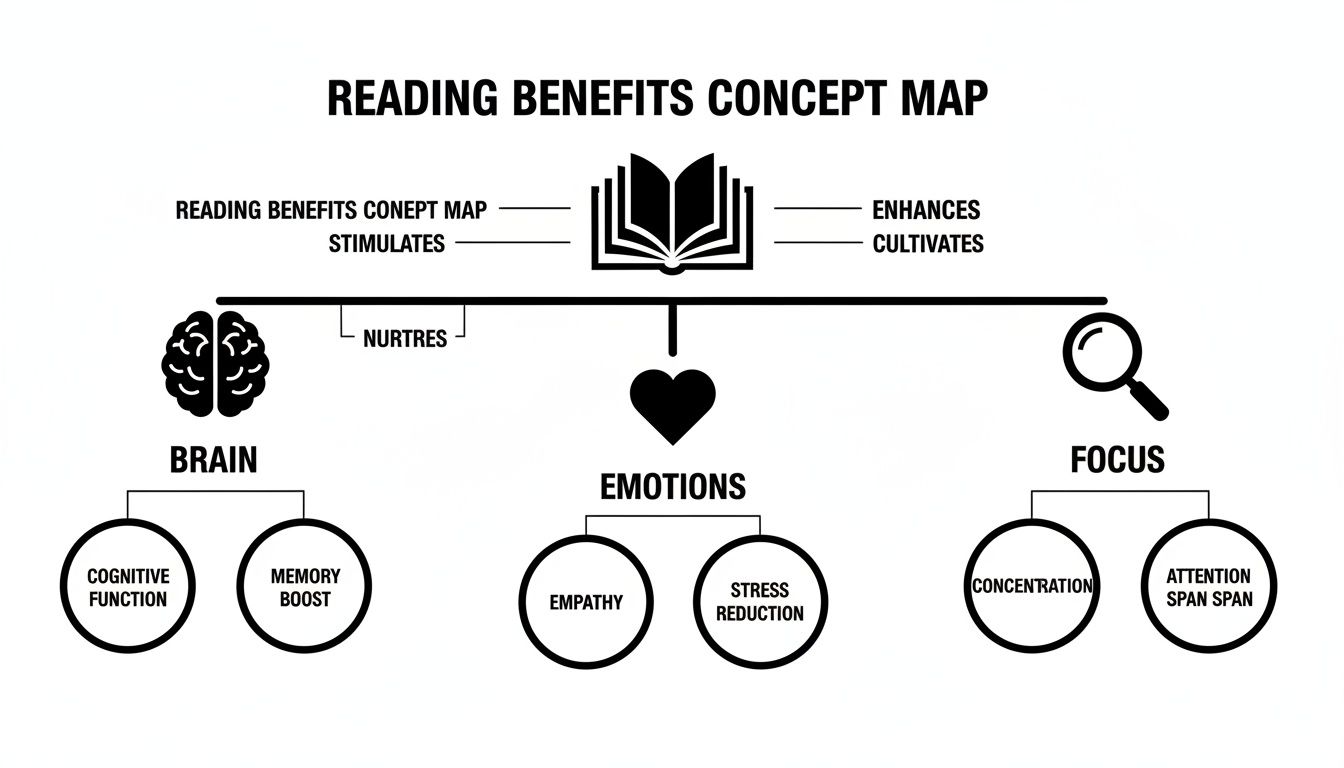
As you can see, reading isn’t a one-trick pony. It’s a central activity that sends out positive ripples across so many different areas of a child’s development, all at the same time.
Expanding Vocabulary for a Richer World
One of the most immediate perks of all this brain-building is a dramatically bigger vocabulary. Books are treasure troves of words that kids just won't bump into in everyday chats. This linguistic richness doesn’t just help them sound smart; it gives them the exact tools they need to grasp complex ideas and, crucially, to express their own feelings and thoughts with real clarity.
A strong vocabulary isn't just about acing a spelling test. It gives a child the building blocks to understand their world, say what they need, and connect more deeply with the people around them.
This beautiful cycle of strengthening memory, sharpening focus, and growing vocabulary creates a powerful upward spiral. Each new book builds on the last, making the brain even better at learning. To dig a little deeper, you can find more great insights into why reading books is important for a child's all-round growth.
Ultimately, reading is the best brain-building activity there is, laying the groundwork for a lifetime of curiosity and learning.
Building Emotional Resilience One Story at a Time

Beyond helping children get ahead in school, one of the most powerful reasons why reading is important is its deep connection to their mental and emotional wellbeing. With growing concerns around children's mental health in the UK, it’s never been more crucial to build emotional literacy from the very beginning.
Stories give children a safe place to meet characters who are navigating complex feelings like sadness, anxiety, or loneliness. This process helps them realise that their own big feelings are valid and that, most importantly, they aren't alone in feeling them.
When a child reads about a character who's scared of the dark or feels left out at school, they feel an instant connection. Seeing their own experiences mirrored in a story, even a fictional one, is a powerful way to normalise their inner world.
A Gentle Gateway to Big Conversations
Talking about a character’s journey can be a gentle way to open up conversations about what’s happening in your child's own life. It feels a lot less intimidating than a direct question. Instead of asking, "Are you feeling worried?", you could try something like, "I wonder why the little bear felt so nervous before his first day?" This simple shift helps build a foundation for honest, open communication.
Reading doesn't just build vocabulary; it shapes how we understand ourselves and others. Different kinds of stories contribute to this in different ways, like how interactive stories can enhance empathy and critical thinking.
By walking in someone else's shoes, even fictional ones, children learn empathy—the ability to understand and share the feelings of another. This is not just a social skill; it is a cornerstone of emotional intelligence.
A Quiet Escape in a Noisy World
In a world full of noise and constant stimulation from social media, a good book offers a quiet escape. It's a natural relaxation tool, helping to lower stress and anxiety by letting a child's mind focus on a single, immersive story. For instance, research from the University of Sussex found that reading for just six minutes can reduce stress levels by up to 68%.
Sadly, this vital habit seems to be slipping away. In the UK, only 18.7% of 8-18-year-olds now read for fun every day—the lowest level ever recorded. This is worrying, especially as research consistently shows that children who read daily report far better emotional wellbeing. It really highlights the vital role reading plays in building mental resilience.
Practical Tips for Emotional Reading
You don't need a special strategy to get started; weaving emotional growth into storytime can be simple and natural. Here are a few ideas:
- Choose relatable books: Look for stories with characters who are dealing with recognisable emotions and situations.
- Pause and ask: Stop for a moment during the story to ask gentle, open-ended questions like, "How do you think they're feeling right now?"
- Share your own feelings: Model emotional openness by saying something like, "That part of the story made me feel a little sad, too."
For more inspiration on how to make reading a core part of your family’s routine, you can explore the benefits of reading.
While books and related tools are wonderful supports for opening up conversations, it is vital to stress that I am not a mental health professional. Please seek help from a doctor if you are worried about your child's mental health.
Practical Ways to Nurture a Love for Reading
Knowing why reading is important is one thing, but actually weaving it into the fabric of daily life is another challenge entirely. We have to move past just telling children to read and start showing them how to build a life where stories can flourish. It’s all about creating an environment where picking up a book feels like a treat, not a chore.
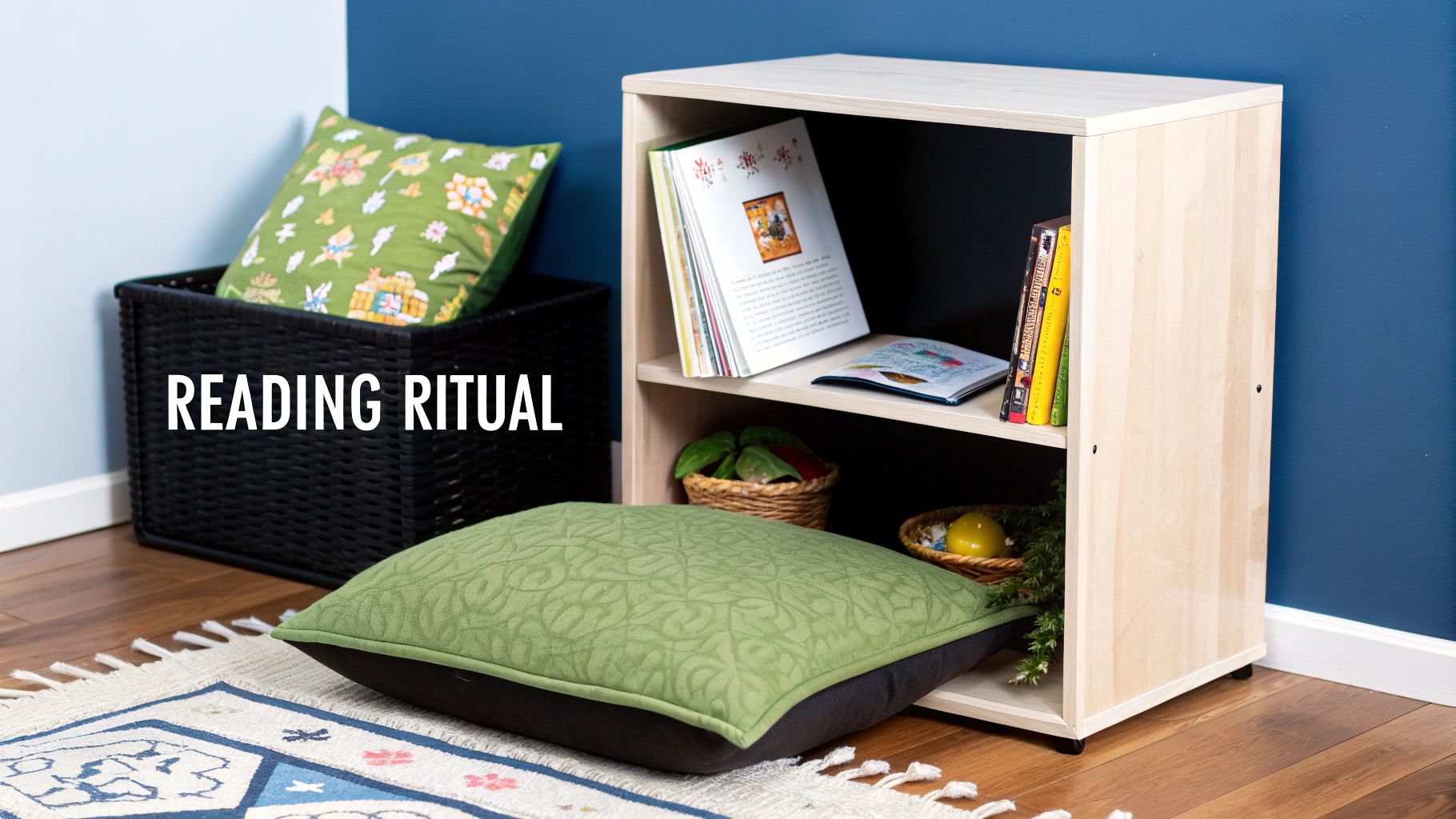
It often starts with the physical space. You don’t need a dedicated library; even a small corner can be transformed into a magical reading nook. A few comfy cushions, a soft blanket, and a good lamp can make a spot feel special and inviting.
This cosy corner then becomes the perfect stage for a family reading routine. Setting aside just 15-20 minutes each day, maybe before bed, sends a powerful message: reading is a cherished, protected part of your time together. This simple habit can turn reading from a solitary task into a moment of shared connection.
Empowering Young Readers with Choice
One of the best things you can do to spark a genuine love for reading is to hand over the reins. It’s so tempting to guide them towards the books we think they should be reading, but letting a child choose their own material gives them a profound sense of ownership.
Whether they gravitate towards a graphic novel, a silly book of poems, or a factual book about dinosaurs, their interest is the magic ingredient. This autonomy can be the key that turns a reluctant reader into an avid one. A trip to the local library or bookshop where they have free rein can feel like a grand adventure, and it’s the perfect place to stumble upon brilliant books for first readers that click with their personality.
By letting a child follow their own curiosity, you're not just helping them find a book; you're helping them find their identity as a reader. Their choices are a reflection of who they are, and validating those choices builds their confidence.
Bringing Stories to Life
The magic doesn't have to stop when you close the book. When you bring the story into your everyday world, it becomes far more memorable and real. This is where you can get creative and make reading a truly interactive experience.
You could act out a favourite scene in the living room or put on different voices for each character as you read aloud. Talking about a character’s choices over dinner—asking things like, “What would you have done?”—is a brilliant way to build critical thinking and empathy.
Here are a few more ideas to get you started:
- Create a Story Jar: Pop characters, settings, and simple plots on slips of paper. Pull one of each from the jar and invent a daft story together on the spot.
- Draw the Characters: After finishing a book, spend some time drawing what you imagined the characters or scenes looked like. It's a fantastic way for visual learners to connect with the story.
- Connect to Real Life: If you read a book about animals, why not plan a trip to a local farm or nature reserve? This helps bridge the gap between the world in the book and the world around them.
To take this even further, we’ve found that activities built around stories are an incredible tool for connection. When you pair reading with hands-on resources like colouring sheets, you’re not just reading a book; you’re creating a shared experience. It reinforces the idea that books are a launchpad for imagination, fun, and feeling understood.
Age-Appropriate Reading Activities to Nurture Emotional Literacy
To help you get started, here are some practical, age-specific ideas for using reading to build emotional literacy. These activities are designed to make conversations about feelings natural and engaging, turning story time into a powerful tool for connection.
| Age Group | Activity Idea | Emotional Skill Developed | Little Fish Books Resource |
|---|---|---|---|
| Toddlers (1-3) | Feeling Faces Match-Up: Read a simple board book about emotions. Afterwards, make exaggerated happy, sad, and angry faces in a mirror together. Ask, "Can you show me a happy face?" | Early Emotion Recognition: Connecting facial expressions to feelings. | Our board books with simple, clear character expressions. |
| Preschool (3-5) | Character Puppets: Create simple stick puppets of characters from a book. Use them to re-enact a scene where a character felt a strong emotion. Ask, "How did the bear feel when he lost his toy?" | Empathy & Perspective-Taking: Understanding that characters (and others) have feelings. | Our colouring sheets can be cut out and used as puppets. |
| Early School (6-8) | 'What Would You Do?' Scenarios: After reading a story with a tricky social situation, pause and ask, "What do you think you would do if that happened to you?" Discuss different possible solutions. | Problem-Solving & Self-Regulation: Thinking through emotional responses and consequences. | The discussion prompts included with our storybook activity packs. |
| Older Children (9-12) | Emotion Journaling: Encourage them to keep a reading journal. After a chapter, they can write or draw about how a character might be feeling, or how a scene made them feel. | Complex Emotional Awareness: Identifying nuanced feelings and self-reflection. | Our upcoming journaling resources designed for older kids. |
These activities are just a starting point. The goal is to show children that stories are a safe place to explore the big, messy, wonderful world of emotions—both the characters' and their own.
Resources to Support Your Family's Journey
Knowing why reading is so important is one thing, but finding the right tools to bring those benefits home is the real challenge. That’s exactly why we created Little Fish Books. It's more than just a collection of stories; it's a complete ecosystem designed to help your family explore emotional wellbeing together.
We want to turn storytime into a powerful moment of connection and growth.
At the heart of it all are our specially crafted mental health books. Every story is written with care to gently open up big emotional themes in a way that feels safe, accessible, and reassuring for little ones. They are the perfect starting point for conversations about feelings like anxiety, sadness, and self-worth.
More Than Just Books
To take the learning off the page, we also have a whole range of engaging downloadable activities and colouring sheets. These are brilliant for helping children process the ideas from the books in a creative, hands-on way.
For families, educators, and therapists looking to dive deeper, our membership offers exclusive content. We also have wholesale options to make it easy to bring these resources into classrooms and clinics.
And if you're just starting out on your child's reading adventure, knowing what to look for can make all the difference. This guide on finding the best books for early readers is a fantastic resource for empowering yourself as a parent.
Supporting the Grown-Ups Too
We know that a child’s wellbeing is deeply tangled up with the wellbeing of the adults who care for them. The pressure on parents is huge, and it's vital that we talk about mental health openly for the whole family's sake. That’s why we created something a bit different: a unique line of mental health apparel for adults.
Our organic cotton t-shirts and hoodies are more than just comfortable. They feature positive affirmations that act as conversation starters, helping to chip away at the stigma around mental health. They're also a gentle reminder to practise the same self-compassion you’re teaching your children.
By wearing these messages, you’re modelling emotional awareness. You’re showing them that it’s okay not to be okay.
Remember, you cannot pour from an empty cup. Prioritising your own mental health isn't selfish; it's a necessary act of love for yourself and your family. It gives you the strength to be the calm, supportive presence your child needs.
Our whole approach is about connecting the dots, giving children practical tools while offering supportive reminders for the adults guiding them.
Disclaimer: It's important to remember that I am not a mental health professional. These resources are designed to support, not replace, professional advice. If you have any worries about your child's mental health, please seek help from a doctor or a qualified professional.
Your Reading Questions Answered
We get it. Knowing why reading is so important is one thing, but actually getting a book into your child’s hands can feel like a whole different challenge. Here are our thoughts on some of the most common questions we hear from parents trying to build a love of reading and navigate those tricky emotional chats.
My Child Says Reading Is Boring. How Can I Change Their Mind?
This is a familiar hurdle for so many parents, so you're not alone. The secret is to shift reading from being a chore to being a treat. Let them catch you enjoying a book, showing them it’s a relaxing, grown-up thing to do, not just homework.
It also helps to broaden your definition of what "reading" actually is. Graphic novels, audiobooks, and magazines about their favourite hobby all count. They're all building literacy. Give them total freedom in the library or bookshop; when they choose the book themselves, they have a personal stake in it. Make it a special shared activity by reading an exciting chapter aloud before bed, or connect stories to real life—try a book about castles just before a family trip to see one.
At What Age Should I Start Reading to My Child?
Honestly? You can start from day one. Newborns get so much from the simple rhythm and tone of your voice. It lays the groundwork for language and creates a powerful, comforting bond between you.
In those first few months, think about high-contrast board books or those with different textures to engage their developing senses. As they grow into toddlers, you can introduce simple stories with bright, colourful pictures, pointing to objects as you say the words. It’s not about comprehension at this stage; it’s all about creating a warm, happy, and positive feeling around books.
By making reading a cherished part of your daily routine right from the start, it becomes a natural and comforting habit that can last a lifetime.
How Can I Use Books to Discuss Difficult Emotions?
Books are a fantastic, gentle way to approach tough topics because they offer a safe, indirect route into the conversation. Let the characters be the bridge. Instead of a direct question like, "Do you feel sad like that?", you could try a much softer approach. "I wonder why the little fox felt so worried," or "What do you think might have helped the bear feel better?"
This lets your child explore the emotion from a safe distance, without feeling like they're on the spot. Pick stories that handle feelings with empathy and offer constructive ways to cope. Always let your child lead the discussion and never force it; the aim is simply to open a door for them whenever they're ready.
Is Fiction Better for My Child Than Non-Fiction?
Think of it like a balanced diet—both are incredibly valuable and offer different benefits. Fiction is wonderful for building empathy, creativity, and understanding different perspectives. When a child steps into a character's world, they get to imagine a whole other life.
On the other hand, non-fiction is a powerhouse for building knowledge, satisfying curiosity, and developing analytical skills. It teaches children how to process facts and understand the world around them in a structured way. The most important thing, though, is your child's passion. A captivating book about sharks or planets can ignite a lifelong love of reading just as powerfully as any fantasy adventure.
At Little Fish Books, we believe every story is a chance to connect and grow. Our books and activities are designed to help you have these important conversations, building emotional resilience one page at a time.
Explore our collection of resources to support your family's journey at https://thatsokay.co.uk.