

Using a Worksheet on Self Esteem for Better Wellbeing
A worksheet on self esteem is a thoughtful, structured tool designed to help someone explore their own thoughts, gently challenge those pesky negative beliefs, and build a much stronger sense of self-worth. Think of them as a practical, hands-on way to get into self-reflection and start building emotional resilience.
Why Self Esteem Support Is More Important Than Ever
In our non-stop, fast-paced world, looking after our mental wellbeing has become a top priority for families all across the UK. And tools like a worksheet on self esteem have shifted from being a 'nice-to-have' to a vital resource for building resilience in children and adults alike.
The pressures are coming from all angles, aren't they? From the picture-perfect lives we see on social media to the emotional hangover from the pandemic, it's a lot to handle. The relentless nature of social media, in particular, can create a constant cycle of comparison, negatively impacting the mental health of both young people and adults.
These challenges have left a real mark on our collective confidence. Recent data on the UK's mental health shows a worrying trend, making it clear there's a real need for accessible support we can use at home, in schools, or during therapy. Addressing mental health early is crucial; poor self-esteem in childhood can lead to more significant challenges in later life.
The Declining State of UK Self Esteem
The numbers paint a pretty stark picture of how UK adults see their own self-worth. Over the last two decades, self-esteem has taken a noticeable hit. Back in 2004, only 7% of UK adults said they had low self-esteem. Fast forward to 2024, and that figure has nearly tripled to 20%.
The pandemic certainly played its part, with 39% of Brits saying it negatively impacted their self-esteem. You can dive deeper into these findings over on the CTPA blog.
This infographic really brings the trend to life, showing the steady rise in low self-esteem and the sharp impact of the pandemic.
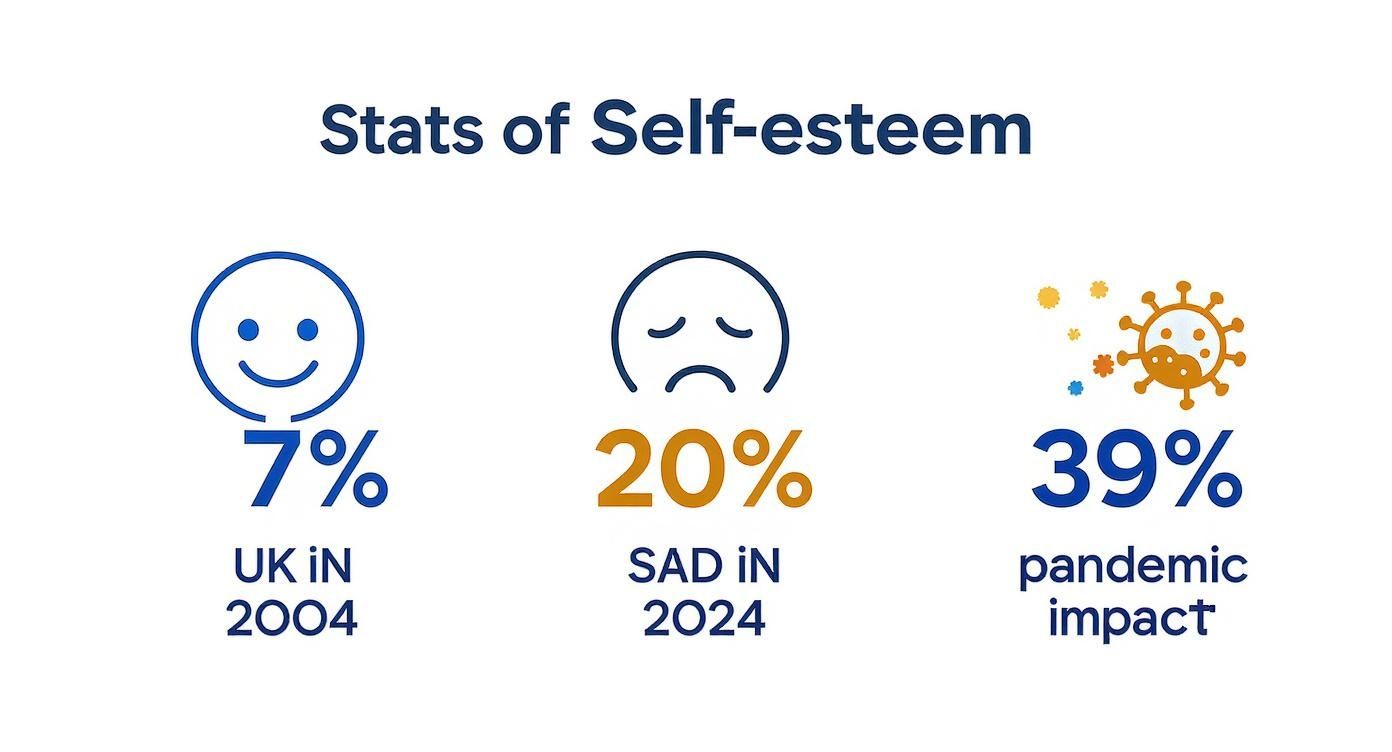
Seeing it laid out like this just reinforces how urgent it is to have practical, proactive tools to support our mental wellbeing.
A Practical and Accessible First Step
Tackling this decline needs a real mix of approaches, and self-esteem worksheets offer a fantastic, practical place to start. They aren't a magic wand, of course, but they act as a brilliant bridge to open up conversations about feelings that might otherwise stay bottled up.
Here’s how they can help:
- For Children: Worksheets give children a safe, non-confrontational way to pinpoint and express their feelings. A practical example would be an activity like drawing their "inner superhero," which can help them see their own strengths in a really fun and creative way.
- For Adults: These tools are perfect for challenging things like imposter syndrome and that nagging, negative inner voice. They offer a structured way to acknowledge your wins, big and small, and build the self-compassion that is so crucial for growth. A simple task like writing down three things you did well that day can be surprisingly effective.
It is really important to stress that while I'm sharing resources based on my own experience, I am not a mental health professional. These tools are here to support and complement, not replace, expert guidance.
If you have serious concerns about your own mental health or that of a loved one, please have a chat with your GP or a qualified professional. A worksheet can be a powerful piece of a wider wellbeing strategy, helping to lay the foundations for a healthier, kinder mindset.
How These Worksheets Actually Build Confidence
Ever wondered what makes a simple piece of paper with a few prompts so powerful? A worksheet on self esteem isn't some kind of magic trick; it's a structured exercise in guided self-reflection. These tools go way beyond vague ideas like 'just think positive' and get you into the practical, hands-on work of retraining your internal monologue.
Take a prompt like, 'Write down a compliment you received and how it made you feel'. This does more than just bring a happy memory to mind. It actively trains your brain to notice, accept, and actually internalise praise—a skill many people with low self-worth really struggle with. It’s a small but meaningful step towards changing how you process external validation.
The Psychology Behind the Prompts
Every activity on a well-designed worksheet is rooted in established psychological principles. They create a safe, private space to untangle complex thoughts and feelings, which is a massive help for children and teenagers who might find it hard to talk about what's going on inside.
- Cognitive Reframing: Many worksheets ask you to identify a negative thought and then find evidence against it. This is a core technique from Cognitive Behavioural Therapy (CBT), helping to challenge and reshape unhelpful thinking patterns over time.
- Strengths-Based Thinking: You'll often see activities focused on identifying personal strengths, achievements, and positive qualities. This approach deliberately shifts the focus away from perceived flaws, building a stronger, more balanced sense of self.
- Emotional Processing: Simply writing down feelings makes them feel more tangible and less overwhelming. A worksheet provides the structure to do this constructively, turning a jumble of emotions into something that can be understood and managed.
This is especially important here in the UK, where statistics show that one in six children aged 5 to 16 are identified as having a probable mental health problem. Low self-esteem is often a contributing factor, affecting everything from their schoolwork to their social confidence.
The table below breaks down a few common worksheet exercises and the psychological thinking behind them. It helps to see why they work, not just what they are.
Worksheet Activity and Its Psychological Benefit
| Worksheet Activity Example | Psychological Principle | What It Achieves |
|---|---|---|
| "My Strengths Tree" – Drawing a tree and writing a personal strength on each branch. | Strengths-Based Focus | Shifts attention from weaknesses to positive attributes, building a foundation of self-worth. |
| "Challenge the Critic" – Writing down a negative thought and then three pieces of evidence against it. | Cognitive Reframing (CBT) | Directly challenges and weakens the power of negative self-talk by using logic and evidence. |
| "Jar of Achievements" – Listing accomplishments, big or small, inside a drawn jar. | Positive Reinforcement | Creates a visual, tangible record of success, making it easier to recall and internalise personal wins. |
| "Feelings Wheel" – Colouring in sections of a wheel to match current emotions. | Emotional Identification | Helps individuals, especially children, name and normalise their feelings, reducing confusion and overwhelm. |
Seeing it laid out like this really shows how each prompt is designed with a specific, positive outcome in mind. It's about building skills, not just filling in boxes.
From Reflection to Action
The real magic of a worksheet on self esteem is how it bridges the gap between thinking and doing. It’s one thing to be told you should be kinder to yourself, but it's another thing entirely to have a clear, actionable task that guides you through the process.
These exercises create a tangible record of your progress. Looking back at completed worksheets can be incredibly affirming, showing you just how far you've come in your journey toward self-acceptance.
For these tools to be genuinely effective, they have to engage the user in a meaningful way. It's vital to apply adult learning theory principles, which stress that people learn best when they are actively involved. A good worksheet encourages participation and reflection, not just passive completion.
The goal isn't just to fill in the blanks; it's to spark a genuine moment of insight. When a child draws their 'inner superhero', they aren't just doodling; they are visually identifying the strengths they already possess.
This structured approach makes difficult conversations feel more approachable. It gives parents and educators a framework to talk about mental health in a way that feels supportive, not confrontational. For more practical ways to support this journey, check out our guide on other powerful self-esteem building exercises.
Ultimately, these simple tools help build a foundational habit of self-awareness and self-compassion, one prompt at a time.
Finding the Right Worksheet for Any Age
A one-size-fits-all approach rarely works in life, and it definitely doesn't work when it comes to nurturing self-esteem. A worksheet that captivates a six-year-old with colourful drawings will almost certainly fall flat with a teenager trying to navigate the complexities of social media.
The real key is to match the tool to the person's unique developmental stage and emotional world. This is what makes the experience feel relevant and genuinely helpful, rather than just another tick-box exercise. Selecting the right worksheet on self esteem isn’t just about the number on a birthday cake; it’s about understanding the specific challenges that come with each phase of life.
For a young child, the world is concrete and visual. For a teen, it’s all about identity and belonging. And for an adult, low self-worth might crop up around professional value or life purpose.
Activities for Young Children (Ages 5-8)
With young children, self-esteem is built through play, creativity, and figuring out their place in the family and the wider world. Worksheets for this age group need to be visual, simple, and fun. Forget complex language or abstract ideas. The goal is simply to help them identify positive feelings and personal strengths in a tangible way.
Think less about writing and more about doing. Visual activities are fantastic for engaging little ones and helping them express big feelings they don't yet have the words for.
Here are a few practical examples:
- Draw Your Inner Superhero: Ask the child to draw themselves as a superhero. Prompt them to add labels or just talk about their hero's special powers, like "Super Kindness," "Excellent Listening Ears," or "Mega Hugs." This creates a direct, powerful link between their positive traits and a fun, empowering image.
- My 'I Can' Jar: Give them a drawing of an empty jar and ask them to fill it with drawings or simple words for things they can do all by themselves. This could be anything from tying their shoelaces to helping set the table. It creates a brilliant visual record of their growing independence and competence.
- A Map of My Happy Place: This activity encourages a child to draw a place—real or imaginary—where they feel safe and happy. It helps them identify sources of comfort and security, which are the absolute foundations of healthy self-esteem.
Engaging Teenagers (Ages 13-18)
The teenage years can feel like a minefield of comparison, peer pressure, and the search for identity, often amplified by the constant scroll of social media. Any worksheet for this age group has to acknowledge these pressures without being preachy or condescending. The focus should be on critical thinking, authenticity, and celebrating what makes them unique.
Prompts should challenge perfectionism and encourage a more compassionate inner voice. Social media has a profound impact here; studies have shown that prolonged use can correlate with increased anxiety and lower self-esteem in adolescents.

A worksheet for a teenager needs to feel authentic and respect their intelligence. It should offer a private space for them to untangle the often-contradictory messages they receive from the world around them.
Effective prompts for teens could include:
- Social Media Reality Check: Create two columns. In one, they list things they admire about an online personality. In the other, they brainstorm the unseen realities (e.g., editing, sponsorships, filters, bad days). This is a great way to build critical media literacy.
- My 'Values' Compass: Instead of focusing purely on achievements, this worksheet asks them to identify their core values (like honesty, creativity, or loyalty). They then list recent actions that lined up with those values, grounding their self-worth in their character, not just their accomplishments.
- Rewriting the Inner Critic: This activity involves writing down a common negative thought (e.g., "I'm not as smart as everyone else") and then responding to it as if they were talking to a best friend. It’s a powerful way to practise self-compassion.
Worksheets for Adults
For adults, low self-esteem often shows up in different arenas—perhaps as imposter syndrome at work or in personal relationships that feel unbalanced. A worksheet on self esteem for adults can be more text-based and introspective, zeroing in on challenging long-held negative beliefs and recognising achievements that might have been brushed aside.
The goal here is to provide a structured way to reflect on both professional and personal growth. For an extensive collection of ideas, you can find a variety of worksheets on self-esteem tailored to different needs.
Here are some starting points:
- Overcoming Imposter Syndrome: A worksheet could prompt someone to list their professional qualifications, successful projects, and any positive feedback they've received from colleagues. The next step is to write down their imposter-syndrome fears and directly counter them with the evidence they just gathered.
- Acknowledging Your Journey: This activity involves drawing a life timeline and marking significant achievements, challenges overcome, and skills learnt along the way. It helps to visualise resilience and growth over time, offering a much broader perspective than just the present moment.
- Setting Boundaries Log: Many adults with low self-esteem struggle with people-pleasing. This worksheet provides a simple template to log situations where they successfully said 'no' or set a boundary, noting how it felt and what the positive outcomes were. This helps reinforce the real value of self-respect in relationships.
A Practical Guide For Parents And Educators
Knowing how to introduce and use a worksheet on self esteem is just as important as the worksheet itself. The right approach can turn a simple activity into a meaningful conversation, creating a safe, judgement-free space for a child or teen to open up. The real goal here isn’t a one-time fix; it's about building lasting habits of self-reflection.
This is all about fostering connection. It’s about how you respond, the questions you ask, and the environment you create. A gentle, empathetic approach will always win out over applying pressure, especially when you're dealing with a reluctant child or a wary teenager.
Creating a Safe Space For Conversation
Before you even pull out a worksheet, the setting is crucial. Find a calm, quiet time when neither of you is rushed or distracted. The last thing you want to do is bring it up during a conflict or right after a stressful event. The aim is to make this a positive, low-stakes routine.
Try framing the activity as something you can explore together. You might say, "I found this and thought it looked interesting. Shall we give it a go?" This makes it a shared experience, not a chore they have to complete for you. Leading by example is also incredibly powerful; consider filling one out yourself to show that vulnerability is a strength.
Navigating Different Responses
Children and teens will react in their own unique ways. Some will dive right in, while others might be hesitant, dismissive, or just give you short, one-word answers. How you handle these moments is key to building trust and keeping the lines of communication open.
Let's walk through some real-world scenarios:
- The Short Answer: If a child just writes "happy" and leaves it at that, resist the urge to immediately push for more. Instead, get curious. You could say, "Happy is a wonderful feeling. I wonder what kind of happy it was – like sunshine happy or quiet, cosy happy?" This opens the door without making them feel interrogated.
- The Negative Answer: If their worksheet is filled with self-critical thoughts, it's vital to validate their feelings first. Avoid jumping straight to, "That's not true!" An empathetic response like, "It sounds like that was a really tough thought to have. Thank you for sharing it with me," shows you're listening without judgement.
- The Reluctant Teenager: A teenager might dismiss the whole thing as "lame" or "pointless." Don't force it. You could leave it on their desk and say, "No worries at all. It's here if you ever feel like having a look." Sometimes, giving them the space and control to approach it on their own terms is the most effective strategy.
Your role isn't to 'fix' their answers but to be a curious and compassionate listener. The conversation that happens around the worksheet is often more valuable than the written words themselves.
Using Empathetic Conversation Starters
The language you use can either shut down a conversation or invite deeper reflection. Moving away from generic praise like "That's great!" to more thoughtful prompts encourages a genuine dialogue.
Here are a few phrases that can help get things flowing:
- "That's an interesting thought, can you tell me more about it?"
- "I've felt that way before too. It can be really hard."
- "What was it like to write that down?"
- "I'm really glad you shared that with me."
These openers show you are engaged and value their perspective, making them feel heard and understood. For parents looking for more ways to support their child's inner world, this guide to building your child's confidence offers a wealth of additional strategies.
Making It a Positive Routine
Consistency is key. Turning this into a regular, positive routine—perhaps for ten minutes every Sunday evening—helps normalise conversations about feelings. It becomes a predictable moment for connection, which is so important for children's mental wellbeing.
Remember, a worksheet is just one of many tools in the box. For other engaging ways to support emotional literacy, you can find a great selection of kids' mental health activities that complement this practice. The ultimate aim is to build a supportive home or school environment where self-reflection is seen as a normal and healthy part of life.
Building a Complete Self Esteem Toolkit
A self-esteem worksheet is a fantastic, focused starting point, but building true, lasting resilience often needs a wider support system. Think of the worksheet as one key tool. Now, let’s build the rest of the toolkit around it to create a more complete approach to wellbeing.
Real confidence is reinforced through daily habits, supportive conversations, and resources that echo the positive messages from the worksheets. When you combine structured reflection with other encouraging activities, you create a powerful environment for growth. This is about making self-worth a natural part of everyday life, not just a ten-minute exercise.
Expanding the Conversation with Mental Health Books
Books are a wonderful way to explore themes of self-worth in a gentle, narrative format. They provide characters and situations that children and teenagers can relate to, which helps normalise complex feelings and offer new perspectives.
Here are a few ideas for different age groups:
- For Young Children (Ages 4-7): Picture books that celebrate uniqueness are perfect. The Lion Inside by Rachel Bright is a lovely story about finding your voice. Look for stories about characters who embrace their differences, as these tales subtly teach self-acceptance.
- For Older Children (Ages 8-12): Chapter books featuring protagonists navigating school friendships and personal challenges can be incredibly affirming. Wonder by R.J. Palacio is a powerful example that shows children they aren't alone in their struggles.
- For Teenagers: Young adult novels that tackle identity and social pressures can open up vital conversations. The Perks of Being a Wallflower by Stephen Chbosky explores themes of belonging and mental health, helping teens build empathy for themselves and others.
Reading together creates a natural bridge for discussion, reinforcing the work being done with the self-esteem worksheet.
Simple Relaxation Tips to Manage Anxious Thoughts
Low self-esteem and anxiety often go hand-in-hand. When negative self-talk spirals, it can feel overwhelming. Simple mindfulness exercises can help calm the nervous system and bring a sense of peace, making it easier to engage with the positive work of a worksheet.
Here’s a simple "Box Breathing" technique:
- Breathe in slowly through your nose for a count of four.
- Hold your breath for a count of four.
- Breathe out slowly through your mouth for a count of four.
- Hold your breath again for a count of four.
Repeat this cycle four or five times. It's a discreet and effective tool that can be used anywhere to manage rising stress. Another quick tip is a brain dump, where you just get all your jumbled thoughts down on paper without judgement. The simple act of getting worries out of your head and onto a page can create instant mental clarity.
Normalising Mental Health in Daily Life
Making mental health a normal, everyday topic is one of the most powerful things we can do. Subtle, consistent messages of support can make a huge difference, especially in a world where children’s mental health is a growing concern. In fact, one in six children in the UK aged 5 to 16 are identified as having a probable mental health problem.
Please remember, I am not a mental health professional. These ideas are for support and to complement professional advice. If you are worried about your own or a loved one’s mental health, it is essential to seek help from a doctor or a qualified therapist.
Subtle tools like mental health apparel with positive affirmations can act as gentle, wearable reminders of self-worth. A hoodie or t-shirt with a phrase like "It's Okay Not to Be Okay" helps to normalise these conversations and challenge stigma in a quiet but powerful way. This also has a wider societal benefit. The cost of poor mental health to UK businesses is estimated to be as high as £56 billion per year, highlighting the urgent need for a more open and supportive culture around wellbeing for all ages.
Common Questions About Self Esteem Worksheets
As we've seen, a good worksheet on self esteem can be a brilliant, gentle tool for nurturing confidence. That said, it's completely normal to have a few questions before you dive in. I've gathered some of the most common queries here to give you clear, practical answers so you can feel confident using these resources.
Let's get you set up for success.
How Often Should We Use These Worksheets?
This is a great question, and the honest answer is there’s no strict timetable. What really matters is consistency, not frequency.
For children, trying one worksheet a week can be a lovely way to build a gentle, predictable routine. It becomes a dedicated time for reflection, not just more homework, creating a safe space for them to open up.
For adults, maybe it's something you pull out during a monthly self-care review, or perhaps you just reach for one when you feel your confidence dipping. The key is to treat these worksheets as a supportive friend, not another obligation on your to-do list. If it feels helpful, keep the routine; if it starts to feel like a chore, it’s absolutely fine to take a break.
What if My Child Refuses to Do the Worksheet?
First off, don't panic. Resistance is a completely normal reaction, especially from teenagers. The most important thing is not to force it, as that can create a negative feeling around opening up about tough stuff.
Instead, you could try a different approach. Why not lead by example? Fill one out for yourself and leave it somewhere they might see it. You could even offer to do one together, sharing some of your own thoughts to get the ball rolling.
If they still say no, respect their decision. Sometimes, the simple act of offering support is what matters most. You can always revisit the idea later or try another tool, like reading a book that touches on similar themes.
Are Online Worksheets as Good as Printable Ones?
Both have their strengths, and the best choice really comes down to the person using them.
Printable worksheets offer a lovely, tactile, screen-free experience that many people find grounding. For younger children especially, the physical act of writing can help them process thoughts more deeply.
On the other hand, online worksheets are super convenient and might appeal more to tech-savvy teens and adults.
The effectiveness isn't in the medium but in the quality of the prompts and the person's engagement with them. The most important thing is creating a quiet, reflective space, whether you're using a pen or a keyboard.
When Should I Seek Professional Help?
This is a critical point. A worksheet on self esteem is an excellent tool for building and looking after good mental hygiene, but it is not a substitute for professional medical help.
It is vital to consult a GP or a qualified mental health professional if you or your child is experiencing:
- Persistent low mood or anxiety.
- Significant changes in behaviour, appetite, or sleep patterns.
- Feelings of hopelessness or worthlessness.
These worksheets are here for support and self-reflection, not for diagnosing or treating clinical conditions like depression or anxiety disorders.
Disclaimer: I must stress that I am not a mental health professional, and the information provided in this article is for educational purposes only. If you are worried about your own or someone else’s mental health, seeking professional guidance from a doctor is always the most responsible and caring step to take.
Think of these tools as a supportive companion to professional advice, not a replacement for it.
At Little Fish Books, we believe in providing gentle, supportive resources to help nurture emotional wellbeing in children and young people. From engaging books to thoughtful activities, our goal is to make conversations about feelings a normal and positive part of family life. Discover our full range of tools and start building your family's emotional toolkit today at https://thatsokay.co.uk.