
Worry Monster Ideas: How to Help a Child With Worries
Share
A worry monster is a simple, playful way to help children talk about their worries. Children draw or make a friendly monster, write or draw their worries, and "feed" them to the monster. It turns something scary and invisible into something they can see, share and put down for a while.
Here's how to use a worry monster at home or in the classroom, plus other gentle ways to help anxious, nervous or shy children aged 3 to 8.
Why children need help with worries
Young children worry about all sorts of things: starting school, being away from a parent, a friendship falling out, the dark, or something they overheard on the news. Many don't have the words to explain what's wrong. Instead, worries show up as tummy aches, trouble sleeping, clinginess, tears or refusing to try new things.
Worries tend to grow when they stay hidden. Giving children a simple, safe way to share them is often the first step to making them feel smaller.
How to use a worry monster
- Make or draw your monster. It could be a drawing, a decorated tissue box with a mouth cut out, or a soft toy with a zip pocket. Let your child design it. The friendlier and sillier, the better.
- Explain its job. "Worry monsters love eating worries. When you feed it a worry, it looks after it for you."
- Share a worry. Your child draws or writes a worry (or tells you and you write it) and posts it into the monster.
- Talk about it later. Read the worries together at a calm moment, perhaps once a week. You'll learn what's on your child's mind and can talk about what might help.
In the classroom, a worry monster works well as a quiet way for children to share worries they wouldn't say out loud. Check it regularly and follow up gently with any child who needs support.
Other ways to help a worried child
- Name the feeling. "It sounds like you're feeling nervous about tomorrow." Naming a worry helps children understand what's happening in their body.
- Don't rush to fix it. Listen first. Sometimes children just need to feel heard.
- Breathe together. Slow breathing, like smelling a flower and blowing out a candle, helps a worried body feel calmer.
- Make a worry time. A short, set time each day to talk about worries can stop them spilling into bedtime.
- Read stories about feelings. Characters who feel worried help children see they're not the only ones.
Small brave steps
For children who avoid things because of worry, a brave steps ladder can help. Break a big scary thing into small steps, from easiest at the bottom to hardest at the top. For example, for a child nervous about a party:
- Talk about the party and who will be there
- Look at a photo of the venue
- Walk past the venue together
- Go to the party with a grown-up for ten minutes
- Stay for the whole party
Celebrate each step, however small. Being brave doesn't mean not feeling worried. It means trying anyway, a little at a time.
Supporting shy children
Shyness and worry often go together. Shy children need time, not pressure. Let them watch before joining in, give them a job to do in a group, and avoid labelling them as "the shy one". Praise effort ("You said hello, that was brave") rather than outcome.
When to get extra support
If worries are stopping your child from going to school, sleeping, eating or doing things they used to enjoy, or if they seem to be getting worse, speak to your GP, health visitor or your child's school. Early support makes a big difference.
A printable worry monster pack
The That's Okay When I Feel Worried Pack is an instant PDF download with a My Worry Monster drawing activity, a My Brave Steps ladder, nervous and shy feeling posters, four calm breathing cards and colouring pages. It stars the friendly feelings creatures from the That's Okay picture books, designed for ages 3 to 8.
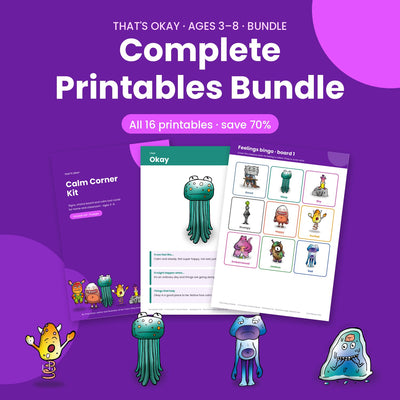
You might also like the Calm Breathing Cards, or get every pack in the Complete Printables Bundle. Or start with the free Feelings Starter Pack.