
10 Practical Positive Behaviour Support Strategies for Children in 2025
In an increasingly complex world, supporting our children's mental and emotional wellbeing is paramount. Recent statistics highlight a growing mental health crisis among young people in the UK, with 1 in 5 children having a probable mental disorder. This issue is amplified by pressures from social media and academic expectations. This isn't just a home or school issue; the long-term cost of unaddressed mental health challenges can significantly impact businesses through lost productivity and increased healthcare costs, estimated to cost UK employers up to £56 billion a year. Proactively addressing behaviour is not about punishment, but about understanding needs and teaching skills for life.
This article moves beyond reactive discipline to explore proactive, empowering positive behaviour support strategies. We will delve into 10 practical, evidence-based methods designed to build resilience, foster emotional literacy, and create a supportive environment where children can flourish. From Positive Reinforcement to Restorative Practices, you will find actionable techniques that focus on the 'why' behind a child's actions, rather than just the action itself.
These strategies provide a foundational toolkit for parents, carers, and educators alike, helping you to nurture positive development and address challenging behaviours constructively. While this guide offers practical support, it is not a substitute for professional medical advice. I am not a mental health professional. If you have serious concerns about a child’s mental health, it is essential to seek help from a qualified healthcare professional, such as a GP or child psychologist. Let’s explore how to build a framework for success.
1. Positive Reinforcement
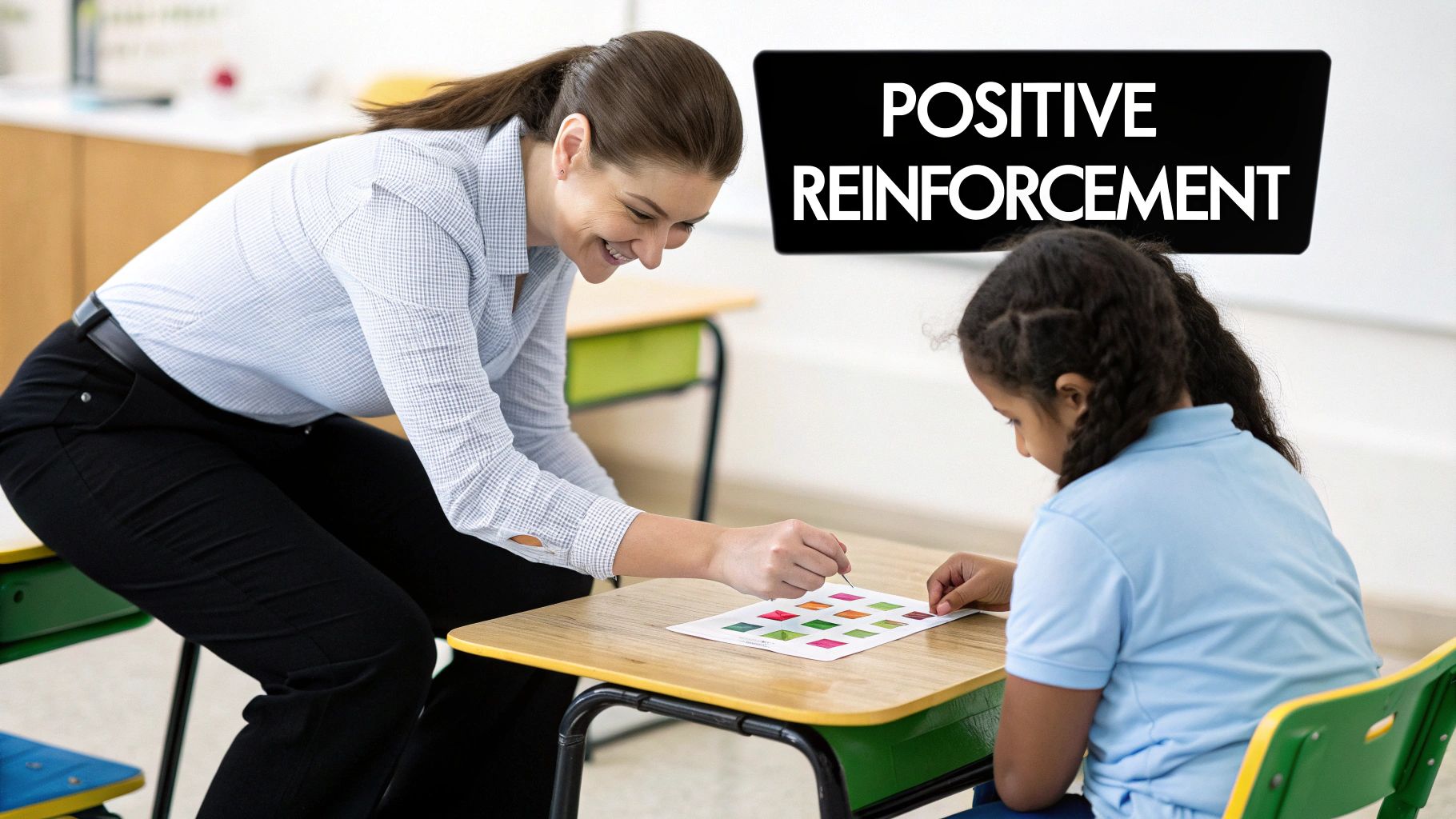
Positive reinforcement is a foundational behavioural technique that strengthens desired behaviours by adding a favourable consequence immediately after the behaviour occurs. Popularised through the work of psychologists like B.F. Skinner, this approach is a cornerstone of positive behaviour support strategies because it proactively builds skills and encourages positive actions, rather than just reacting to challenging ones. The core principle is simple: when a behaviour is followed by something rewarding, the individual is more likely to repeat that behaviour in the future.
How to Implement Positive Reinforcement
This strategy is effective because it focuses on what the child is doing right, which can significantly boost their self-esteem and internal motivation. For practical applications with young children, you might explore various preschool reward system ideas to find what works best.
- Identify Meaningful Reinforcers: Rewards are not one-size-fits-all. While one child might value extra screen time, another may prefer choosing the family film or receiving verbal praise. A practical example is noticing a child tidied their room without being asked and offering them 30 minutes of their favourite game as a reward.
- Be Immediate and Specific: For the connection to be clear, deliver the reinforcement right after the desired behaviour. Instead of a generic "good job," say, "I love how you shared your toys with your sister without being asked."
- Vary the Rewards: To maintain effectiveness and avoid a child becoming bored or fixated on a single reward, it’s wise to vary the reinforcers.
- Fade Rewards Over Time: The ultimate goal is for the positive behaviour to become intrinsically rewarding. As the behaviour becomes a habit, you can gradually reduce the frequency of external rewards.
2. Antecedent-Based Interventions
Antecedent-based interventions are proactive positive behaviour support strategies designed to prevent challenging behaviours before they even start. Rather than reacting to an issue, this approach involves modifying the environment or circumstances that precede the behaviour, known as antecedents. By identifying and adjusting these triggers, we can effectively set a child up for success, making positive choices the easier and more natural path to take. The core principle is about creating a supportive setting where the need for challenging behaviour is minimised.
How to Implement Antecedent-Based Interventions
This strategy is highly effective because it addresses the root cause of a behaviour, not just the symptom. It empowers adults to be proactive problem-solvers, fostering a calmer and more predictable environment for everyone.
- Identify Triggers: The first step is to observe and understand what typically precedes the challenging behaviour. For example, does a child become overwhelmed in noisy environments or when instructions are too complex? A practical example is noticing a child often has an outburst just before bedtime. The trigger (antecedent) might be the sudden transition from playtime to quiet time.
- Establish Clear Routines: Consistency and predictability are key. Using visual schedules, timers, and giving clear warnings before transitions (e.g., "In five minutes, it will be time to tidy up") can significantly reduce anxiety and resistance.
- Offer Choices: Providing limited, acceptable choices helps children feel a sense of control and autonomy. Instead of demanding, "Put your coat on now," try, "Would you like to wear your blue coat or your red one?"
- Adapt the Environment: Simple changes can make a huge difference. This could involve adjusting lighting, reducing noise levels, providing a quiet corner for breaks, or breaking a large task into smaller, more manageable steps.
3. Functional Behaviour Assessment (FBA)
A Functional Behaviour Assessment (FBA) is a systematic, problem-solving process for understanding the reasons behind challenging behaviours. Instead of just looking at the behaviour itself, an FBA investigates the "why." It operates on the principle that all behaviour serves a purpose. By identifying this purpose, or function, we can develop more effective and compassionate positive behaviour support strategies that teach new skills rather than simply trying to suppress an action. This approach is crucial for creating tailored interventions that address the root cause of a child's difficulties.
How to Conduct a Functional Behaviour Assessment
The goal of an FBA is to gather information to form a hypothesis about why a behaviour occurs. This often involves looking at what happens immediately before (antecedent) and after (consequence) the behaviour. Understanding this pattern is the key to creating a successful behaviour support plan.
- Gather Information from Multiple Sources: Collect data through direct observation in different settings, interviews with parents and teachers, and by using standardised rating scales. A complete picture is essential.
- Look for Patterns: Analyse the data to identify when and where the behaviour is most likely to happen. Is it during a specific subject, at a certain time of day, or with particular people? For example, you might observe that a child’s disruptive behaviour consistently occurs during unstructured group activities.
- Identify the Behaviour's Function: Most behaviours serve one of four main functions: to gain attention, to escape or avoid a task or situation, to get a tangible item or activity, or to meet a sensory need.
- Develop a Hypothesis: Based on your findings, create a clear "best guess" statement, such as: "When faced with a difficult maths worksheet, the student disrupts the class to be sent out, thereby escaping the task." This hypothesis will guide your intervention.
4. Token Economy Systems
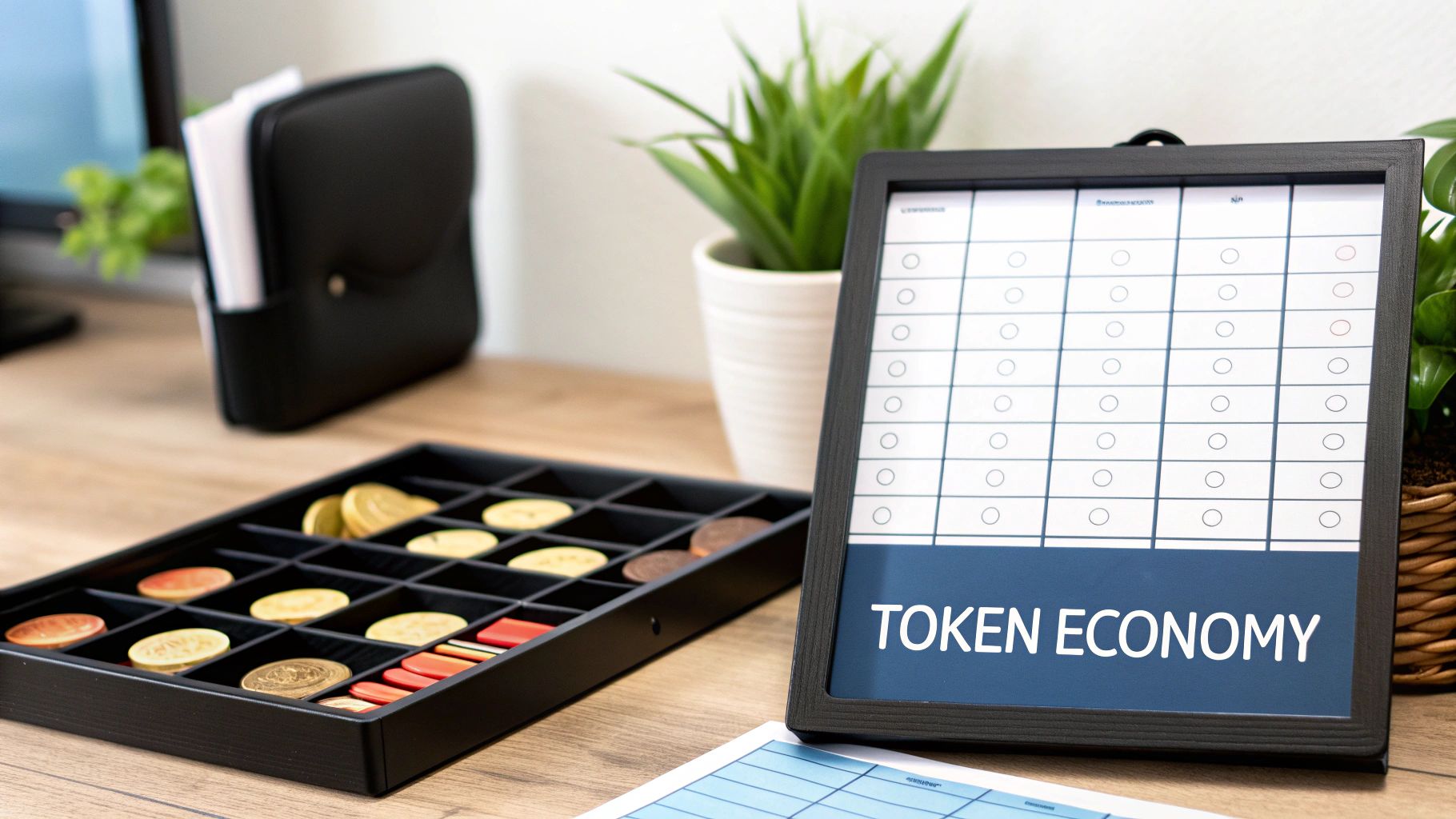
A token economy system is a structured reinforcement method where individuals earn tokens for exhibiting desired behaviours. These tokens, which act as a form of currency, can later be exchanged for a choice of meaningful rewards, such as preferred items or special activities. This approach is one of the most effective positive behaviour support strategies because it bridges the gap between an action and its reward, teaching delayed gratification in a concrete, visual way. It systematically encourages positive choices by making the connection between good behaviour and positive outcomes clear and consistent.
How to Implement a Token Economy System
Token economies are highly adaptable and can be seen in various settings, from classroom point systems like ClassDojo to structured programmes in residential care. They work by providing immediate, tangible feedback (a token) for positive behaviour, which is highly motivating for many children and young people.
- Establish Clear Behaviours and Rewards: Define the specific, observable behaviours that will earn tokens. A practical example is creating a chart where a child earns a star (token) for each morning they get ready for school on time without arguments.
- Set Achievable Exchange Rates: Ensure the cost of rewards is reasonable. After earning five stars, the child might exchange them for a trip to the park or choosing a film for family night. A child should be able to earn enough tokens for a small reward fairly quickly to maintain motivation.
- Use a Visual Tracker: A chart on the wall or a simple jar where tokens are collected makes progress visible and helps keep the child engaged with their goals.
- Be Consistent: For the system to be effective, all caregivers or educators involved must award tokens consistently for the target behaviours.
- Plan for Fading: The ultimate goal is for the positive behaviour to become self-sustaining. Gradually increase the number of tokens needed for rewards or require more complex behaviours to encourage intrinsic motivation.
5. Social Skills Training
Social skills training is a proactive strategy that involves the direct teaching and practising of appropriate social behaviours, communication skills, and interpersonal problem-solving. This approach, popularised by figures like Arnold Goldstein and Michelle Garcia Winner, is a key component of positive behaviour support strategies because it addresses the root cause of many behavioural challenges: a deficit in social understanding. Rather than simply managing behaviour, it equips individuals with the tools they need to navigate social situations successfully, building confidence and fostering positive relationships.
How to Implement Social Skills Training
This strategy is highly effective because it breaks down complex social interactions into manageable steps. By providing explicit instruction, children can learn the "unwritten rules" of social engagement that they may not pick up intuitively. There are many engaging social skills activities for kids that can make this learning process fun and natural.
- Use Explicit Teaching: Clearly explain the social skill, breaking it down into simple, observable steps. For conflict resolution, this might involve steps like "Stop and take a deep breath," "Use an 'I feel' statement," and "Listen to the other person's view."
- Provide Practice Opportunities: Role-playing and structured group activities, like a "lunch bunch" for isolated students, offer safe environments to practise new skills before applying them in real-world scenarios. A practical example is acting out how to ask another child to join in a game on the playground.
- Use Natural Peer Models: Encourage children to learn by observing peers who demonstrate strong social skills. Point out positive examples in a non-judgemental way.
- Plan for Generalisation: A skill learned in a therapy room is only useful if it can be applied elsewhere. Discuss with the child how they can use their new communication skills at home, on the playground, or during family events.
6. Self-Monitoring and Self-Management
Self-monitoring and self-management are empowering positive behaviour support strategies that teach individuals to become active participants in their own behavioural development. This approach shifts the focus from external control to internal accountability, encouraging a child or young person to observe, record, and evaluate their own actions against a set standard. The goal is to build crucial life skills like self-regulation, self-awareness, and personal responsibility, thereby reducing reliance on constant adult supervision.
How to Implement Self-Monitoring and Self-Management
This strategy is highly effective for fostering independence and is a cornerstone of developing executive functioning skills. By learning to track their own progress, children gain a deeper understanding of their behaviour and its impact, which is a significant step towards lasting change.
- Define Clear, Observable Behaviours: Begin by choosing one or two specific behaviours to track. For instance, instead of "be more responsible," use "put my school bag away after school."
- Use Simple Tracking Tools: The method for recording should be straightforward. Simple checklists, a jar with marbles, tally marks on a chart, or even a basic journaling app can work well. A practical example is giving a child a small wristband counter to click each time they remember to raise their hand in class instead of shouting out.
- Teach the Process Explicitly: Do not assume a child knows how to self-monitor. Model how to observe the behaviour and record it accurately. Practise together and provide regular, supportive feedback on their recording, not just the behaviour itself.
- Connect Monitoring to Meaningful Goals: Help the individual see how tracking their behaviour helps them achieve something they care about, like earning a privilege or feeling proud of their accomplishments.
- Gradually Increase Independence: As the child becomes more proficient and the behaviour improves, you can slowly fade your prompts and check-ins, allowing them to take full ownership of the process.
7. Restorative Practices
Restorative practices are a community-oriented approach that shifts the focus from punishment to repairing harm and rebuilding relationships. Popularised by pioneers like Howard Zehr, this strategy addresses the root causes of conflict by bringing together everyone affected to collectively find a resolution. It is one of the most powerful positive behaviour support strategies for fostering empathy, accountability, and a stronger sense of community, teaching children that their actions impact others and that they have the power to make things right.
How to Implement Restorative Practices
This approach is highly effective for resolving conflicts, from playground disagreements to more serious incidents, because it gives a voice to all parties. It helps build a culture of mutual respect and understanding, which is crucial for a child's social and emotional development. For those in educational settings, exploring the full scope of restorative practices in schools can provide a structured framework for implementation.
- Use Restorative Circles: Facilitate discussions where each person has a chance to speak without interruption. A practical example: after two children argue over a toy, a teacher brings them together to each explain how the argument made them feel and what they think would make it right.
- Focus on Repairing Harm: The central question should be "How can we make things right?" rather than "Who is to blame and what is their punishment?" This encourages collaborative problem-solving.
- Ensure Voluntary Participation: True resolution can only happen when all parties, including the one who caused harm, willingly participate in the process.
- Start Small: Begin by applying restorative approaches to lower-level conflicts. This builds skills and trust among staff and children before tackling more complex issues.
- Follow a Structured Dialogue: Use specific, guiding questions like, "What happened?", "Who has been affected?", and "What needs to happen to repair the harm?".
8. Visual Supports and Structured Environments
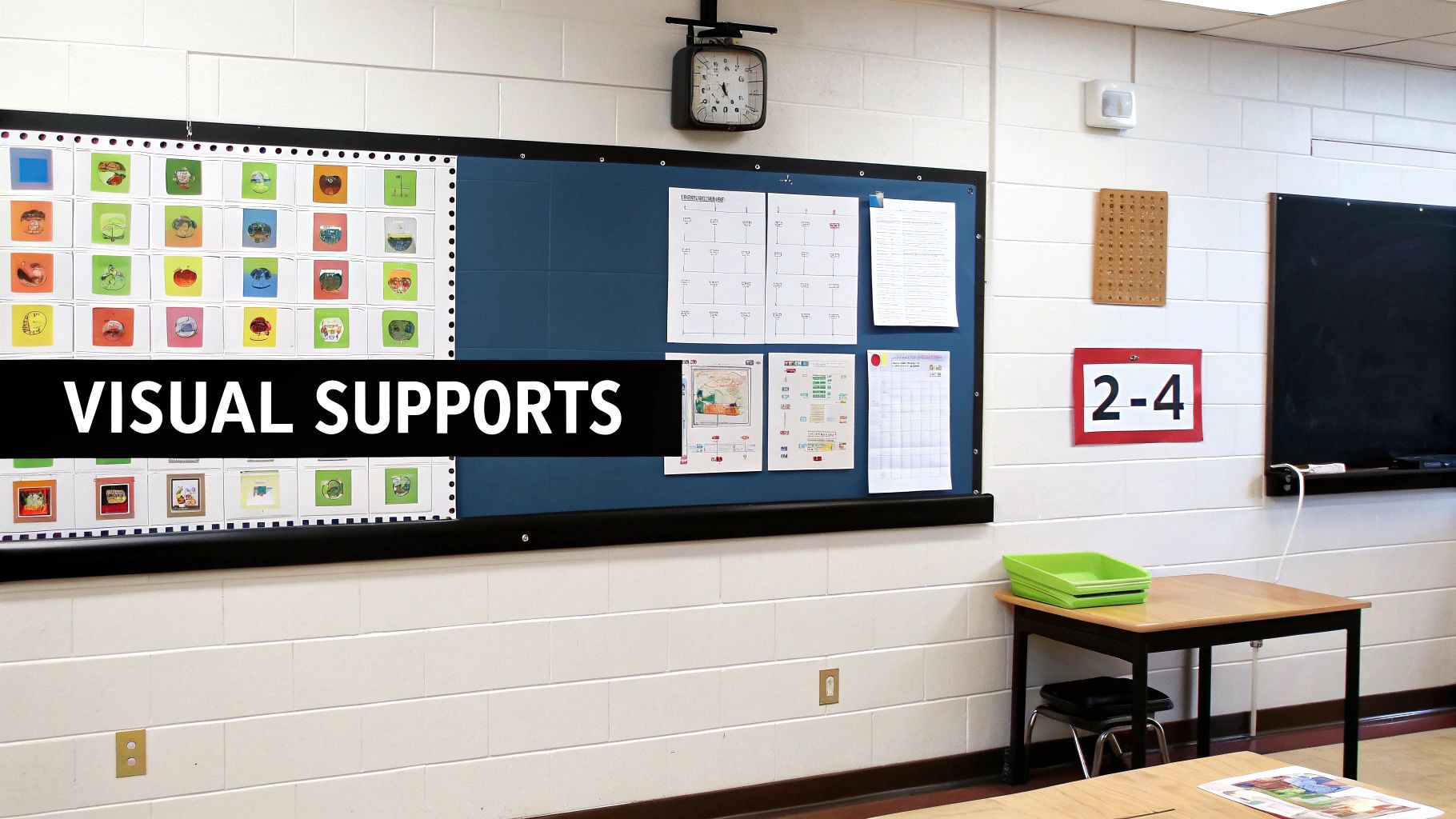
Visual supports and structured environments are powerful positive behaviour support strategies that use visual aids and physical organisation to make expectations clear, reduce anxiety, and guide appropriate actions. This approach translates abstract concepts like "time" or "first, then" into concrete, understandable formats, which is particularly beneficial for individuals with autism, ADHD, or communication challenges. By organising the environment and providing visual cues, we create a predictable world where individuals feel more secure and capable.
How to Implement Visual Supports and Structured Environments
This strategy empowers individuals by giving them the tools to understand their day and navigate tasks independently. It's not about control; it's about providing clarity that fosters self-regulation and confidence. For practical applications of visual aids in various settings, explore how engaging magnetic and dry erase boards can be utilised effectively.
- Make Visuals Clear and Simple: Use age-appropriate images or symbols that are easily understood. A practical example is a 'getting ready for bed' chart with pictures for each step: putting on pyjamas, brushing teeth, and reading a book.
- Introduce and Teach: Don't just place a visual schedule on the wall and expect it to work. Actively teach the individual how to use it, referring to it together throughout the day until it becomes a routine.
- Ensure Accessibility: Place visual aids at the individual’s eye level in relevant locations. A 'how to wash your hands' chart should be by the sink, and a daily schedule should be in a central, easily referenced spot.
- Keep It Organised: A cluttered visual field can be just as confusing as no visuals at all. Ensure the supports are organised and present only the necessary information to avoid overwhelming the user. A designated, structured space like a calm-down corner can also use visuals to guide relaxation; you can discover many useful calm-down corner ideas here.
9. Culturally Responsive Behavioural Support
Culturally responsive behavioural support involves adapting strategies to honour and incorporate a child's cultural identity, values, and communication styles. This approach recognises that what is considered 'positive' behaviour can vary across cultures. It ensures that expectations and interventions are meaningful, respectful, and effective for diverse populations. By acknowledging cultural context, we create a more inclusive and equitable environment where all children can thrive, making it one of the most vital modern positive behaviour support strategies.
How to Implement Culturally Responsive Behavioural Support
This strategy is effective because it builds on the strengths and assets of a child's background, fostering a stronger sense of belonging and connection. It moves beyond a one-size-fits-all model, promoting understanding and reducing the risk of cultural misunderstandings leading to misperceived behavioural issues.
- Involve Families and Community: Actively partner with families to develop behavioural expectations. A practical example is a school inviting parents from various cultural backgrounds to a workshop to discuss communication styles and discipline values, then incorporating this feedback into the school’s behaviour policy.
- Examine Implicit Bias: Regularly review discipline data to identify any disparities among different cultural groups. This can reveal unconscious biases in how behaviour is interpreted and addressed.
- Use Varied Communication Methods: Recognise that communication styles differ. Incorporate non-verbal cues, storytelling, and bilingual resources to ensure messages are understood and respected by everyone.
- Provide Ongoing Training: Educators and caregivers benefit from professional development on cultural competence and anti-bias practices to better understand and support the children in their care.
10. Differential Reinforcement Procedures
Differential reinforcement is a sophisticated set of positive behaviour support strategies designed to reduce challenging behaviours by reinforcing more appropriate ones. Instead of focusing on punishment, these procedures systematically strengthen desired actions until they replace the unwanted behaviour. This approach is highly effective because it actively teaches the child what to do rather than just what not to do, fostering skill development and self-regulation. It acknowledges that a behaviour serves a purpose and provides a better way to meet that need.
How to Implement Differential Reinforcement
This method involves several specific techniques. For example, Differential Reinforcement of Alternative Behaviour (DRA) involves reinforcing a replacement behaviour, such as praising a child for asking for a toy instead of snatching it. Another is Differential Reinforcement of Incompatible Behaviour (DRI), where you reinforce an action that physically cannot happen at the same time as the problem behaviour, like rewarding a child for sitting calmly in their seat (which is incompatible with running around the room).
- Identify a Clear Replacement: Determine a specific, positive behaviour you want to see instead of the challenging one. Ensure the child is capable of performing this new skill. A practical example for a child who shouts out in class is to teach them to raise their hand, and only provide attention (reinforcement) when they use the hand-raising skill.
- Start with a Rich Schedule: When you first introduce the strategy, provide reinforcement frequently and immediately every time the desired behaviour occurs to build a strong association.
- Monitor and Track Progress: Keep a simple log of the challenging and replacement behaviours. This data will show you if the strategy is working and when adjustments are needed.
- Ensure Consistency: For this approach to be effective, everyone involved with the child, from parents to teachers, must use the same procedure consistently. This predictability helps the child learn faster.
Positive Behaviour Support — 10-Strategy Comparison
| Strategy | Implementation Complexity 🔄 | Resource Requirements ⚡ | Expected Outcomes ⭐ | Ideal Use Cases 📊 | Key Advantages & Tips 💡 |
|---|---|---|---|---|---|
| Positive Reinforcement | Low — simple contingency design; needs consistency | Low — minimal materials; individual reinforcers | Increased desired behaviours; improved motivation and self‑esteem | Classrooms, workplaces, homes, diverse groups | Builds positive associations; cost‑effective. Tip: deliver immediate, specific praise and gradually fade rewards. |
| Antecedent-Based Interventions | Moderate — planning and environment changes required | Moderate — physical/visual modifications and staff time | Fewer problem behaviours; smoother routines and transitions | Preventative classroom design, routines, transition periods | Proactive prevention reduces reactive interventions. Tip: use visual schedules and prepare environment based on assessment. |
| Functional Behaviour Assessment (FBA) | High — systematic multi‑method process; time‑consuming | High — trained staff, observation tools, weeks of data | Precise function identification; targeted, higher‑success interventions | Persistent/problem behaviours, special education eligibility | Increases intervention effectiveness and legal rigour. Tip: use multiple data sources and involve stakeholders. |
| Token Economy Systems | Moderate — structured setup and ongoing management | Moderate — tokens/charts, reward menus, staff training | Sustained behaviour change; teaches delayed reinforcement and planning | Group settings, classrooms, residential or institutional programmes | Transparent and scalable; fosters delayed gratification. Tip: start with frequent exchanges and reasonable exchange rates. |
| Social Skills Training | Moderate — requires structured lessons and practice | Moderate — skilled instructors, time for role‑play and feedback | Improved social competence, peer relationships, reduced social anxiety | Small groups, autism support, at-risk youth programmes | Directly teaches missing skills; improves inclusion. Tip: model, rehearse, and plan for generalisation. |
| Self‑Monitoring & Self‑Management | Moderate — training‑intensive initially, then autonomous | Low–Moderate — apps/trackers and training time | Increased self‑regulation, independence, intrinsic motivation | Older students/clients, behaviour change needing autonomy | Promotes internal accountability and generalisation. Tip: start simple, teach explicitly, pair initially with external reinforcement. |
| Restorative Practices | High — facilitator skills and cultural change needed | High — trained facilitators, time, stakeholder engagement | Reduced recidivism; repaired relationships; stronger community culture | Conflict resolution, school discipline alternatives, community settings | Repairs harm and builds empathy. Tip: train staff, start with lower‑level cases, ensure voluntary participation and confidentiality. |
| Visual Supports & Structured Environments | Low–Moderate — design and upkeep required | Low — print/materials and time to update | Reduced anxiety and confusion; better transitions and independence | Autism, ADHD, special education, routines/transitions | Low‑cost and effective across abilities. Tip: use clear age‑appropriate visuals, teach use, avoid visual clutter. |
| Culturally Responsive Behavioural Support | High — requires cultural competence and system changes | High — professional development, community partnership | Increased relevance, buy-in, reduced discipline disparities, better outcomes | Diverse school communities, equity-focused reform | Validates identities and improves engagement. Tip: involve families/community, conduct cultural asset mapping, provide ongoing PD. |
| Differential Reinforcement Procedures | Moderate — careful planning and consistent implementation | Moderate — staff training, monitoring, reinforcers | Reduces problem behaviours without punishment; teaches replacements | Classrooms, clinical behaviour plans, targeted behaviour change | Evidence‑based, flexible, non‑punitive. Tip: define clear replacement behaviours, start with rich schedules and thin gradually. |
Your Next Steps in Fostering Positive Growth
Navigating the landscape of childhood behaviour can feel complex, but as we have explored, a proactive and compassionate approach can make all the difference. The ten positive behaviour support strategies detailed in this guide, from Positive Reinforcement to Culturally Responsive Practices, are not isolated tactics. They are interconnected tools that form a comprehensive framework for understanding and nurturing the young people in our lives. By shifting our focus from merely managing challenging behaviour to actively teaching and reinforcing positive alternatives, we empower children with the skills they need to thrive.
The core principle unifying these methods is a commitment to seeing beyond the behaviour to the underlying need or skill deficit. Whether you are conducting a Functional Behaviour Assessment (FBA) to understand the 'why' behind an action, or implementing a Token Economy to motivate progress, the goal remains the same: to build a foundation of trust, communication, and mutual respect. This approach fosters an environment where children feel safe, understood, and capable of growth.
Key Takeaways for Lasting Impact
To truly embed these strategies into your daily interactions, it is crucial to move from theory to consistent practice. Here are the most important takeaways to guide your journey:
- Be Proactive, Not Reactive: Strategies like Antecedent-Based Interventions and creating structured environments with Visual Supports are powerful because they prevent challenges before they arise. Focus on setting children up for success.
- Teach, Don't Just Tell: Many behavioural issues stem from a lack of skills. Invest time in explicit Social Skills Training and Self-Management techniques. This transforms discipline from a punitive act into a learning opportunity.
- Consistency is Crucial: For any of these positive behaviour support strategies to be effective, they must be applied consistently across different settings and by all caregivers. This predictability helps children understand expectations and feel secure.
- Seek to Understand: Always start with curiosity. Before reacting, ask yourself what the child is trying to communicate through their behaviour. This empathetic mindset is the cornerstone of effective support.
Turning Knowledge into Action
Implementing these concepts is a marathon, not a sprint. Start small by choosing one or two strategies that resonate most with your situation and commit to applying them consistently. Perhaps you will begin by introducing a simple rewards chart or focusing on praising specific positive behaviours you notice throughout the day. Remember to celebrate small victories, both for the child and for yourself.
It is also vital to acknowledge the broader context of a child's wellbeing, especially in an era where social media and academic pressures can significantly impact mental health. Simple relaxation tips, like practising deep breathing exercises together (breathe in for four counts, hold for four, breathe out for six) or designating a quiet 'calm-down corner' in your home, can be incredibly beneficial. Normalising conversations around feelings and mental health is equally important. Wearing mental health apparel or having positive affirmation posters can act as gentle, everyday reminders to be kind to our minds.
A Note on Professional Support: The information provided in this article is for educational purposes and is not a substitute for professional medical or psychological advice. I am not a mental health professional. If you have serious concerns about a child's mental health or behaviour, it is essential to seek help from your GP or a qualified practitioner who can provide a formal assessment and tailored support plan.
Ready to continue the conversation about emotional wellbeing with your child? Resources like children's books can be an excellent way to open up discussions about feelings in an accessible way. The resources at Little Fish Books are specifically designed to complement these positive behaviour support strategies, using engaging stories and activities to teach emotional literacy. Explore our collection of mental health books and tools at Little Fish Books to help build your child's resilience and emotional intelligence today.