
Template for a Safety Plan: Your Guide to Mental Health Support
So, what exactly is a template for a safety plan? Think of it as a personal roadmap, a guide co-created to help someone find their way through moments of intense emotional distress or crisis. It's a structured but deeply personal document that outlines an individual's unique warning signs, go-to coping strategies, and a list of trusted people to call on for support. It's not about waiting for a crisis to happen; it’s about having a clear, proactive plan to manage difficult feelings before they escalate.
Why A Safety Plan Is A Vital Tool For Youth Mental Health
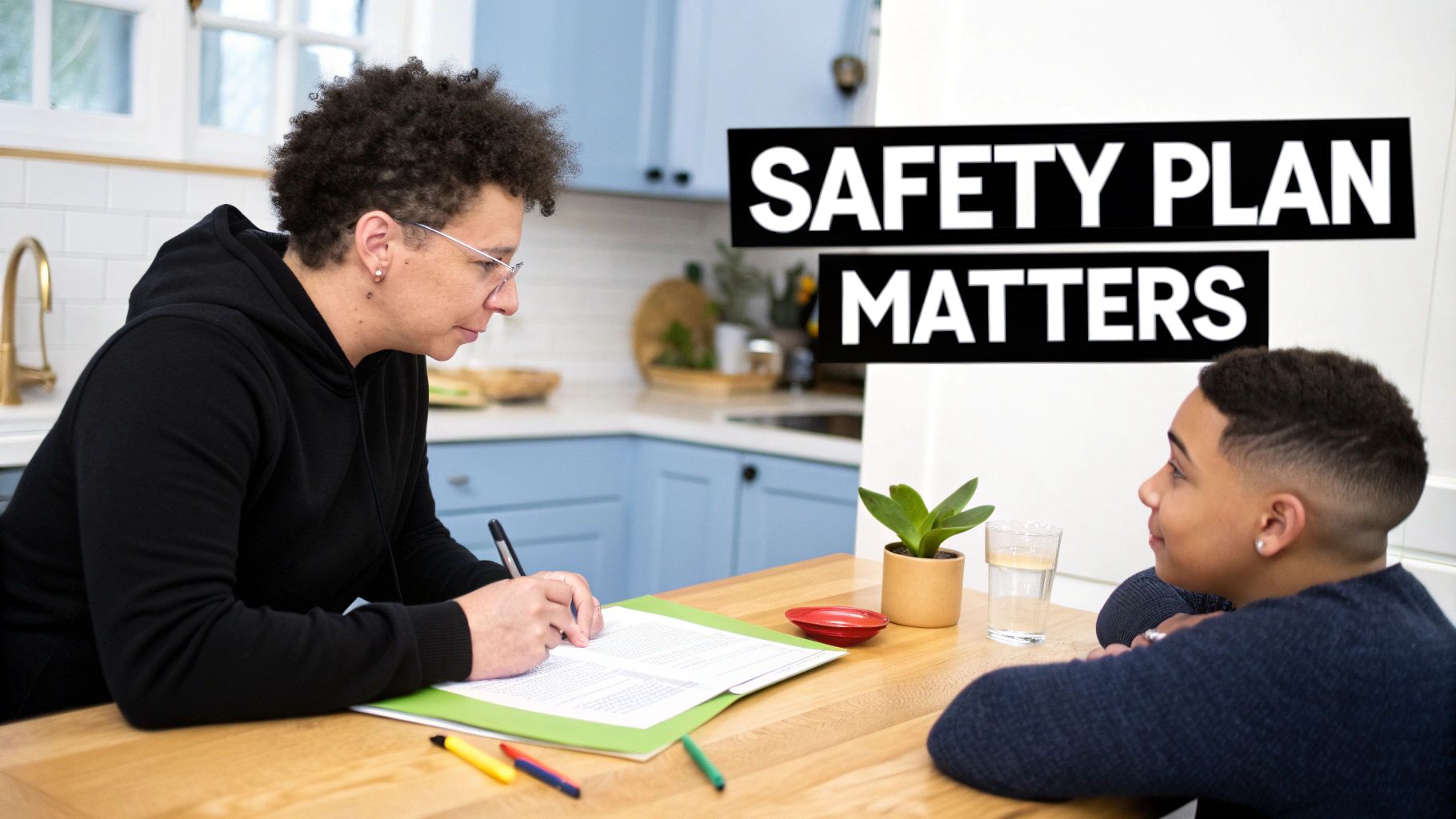
We live in an age where children and young people face immense pressure, and talking openly about mental health has never been more crucial. The rise in youth anxiety is a real concern, often fuelled by things like the relentless highlight reel of social media that can leave them feeling inadequate or overwhelmed.
But a mental health safety plan isn't just for emergencies. It's a powerful tool for building emotional resilience every single day. The very act of creating one together opens up a vital conversation about feelings, triggers, and what actually helps. It transforms vague worries into a concrete, actionable guide they can turn to.
The Growing Need for Proactive Support
The latest figures paint a sobering picture. It's estimated that one in six children aged 5-16 in the UK now has a probable mental health problem. This statistic alone highlights just how urgently we need accessible tools that families and educators can put to use right away. For any adult concerned about a child's wellbeing, creating a safety plan is an empowering first step.
It all comes down to a simple, core principle: a child's wellbeing has to come first. This guide is built on that idea, echoing the sentiment of putting Safety First Grades Later to ensure their emotional health is prioritised over academic or social pressures.
The knock-on effect of poor mental health is staggering, too. It’s estimated that mental ill-health costs UK businesses up to £56 billion per year in absenteeism and lost productivity. By equipping young people with these coping skills early, we’re not just supporting them now; we’re investing in a healthier, more resilient future workforce.
Important Disclaimer: Please remember, I am not a mental health professional. This guide and the provided template for a safety plan are for informational purposes only. They are not a substitute for professional medical advice. If you are worried about a child's mental health, please consult a GP or a qualified professional.
Simple Steps for Everyday Wellbeing
Beyond a formal document, weaving simple relaxation techniques into a daily routine can make a world of difference. These don't need to be complicated and can easily become healthy habits:
- Mindful Breathing: Just taking five slow, deep breaths can instantly calm the nervous system.
- A 'Happy' Playlist: Putting together a list of uplifting songs can be a brilliant mood-shifter.
- Creative Expression: Drawing, writing, or even just colouring can be a fantastic emotional outlet. You can find more ideas in our resources for mental health support for young people.
Supporting a young person's mental health can also mean exploring mental health books that gently introduce emotional intelligence concepts, or even wearing mental health apparel that promotes positive messages. The right book can open up a new perspective, while mental health apparel can act as both a conversation starter and a quiet, personal reminder to be kind to yourself.
The Core Components Of An Effective Safety Plan
Before you even think about putting pen to paper, it helps to understand what makes a safety plan actually work. Getting a handle on the basic building blocks can make the whole process feel much less intimidating.
A good plan isn't some rigid clinical document. Think of it more as a personalised first-aid kit for feelings, written in simple, everyday language that a young person can connect with. The real goal here is to create a living guide that you build together, one that empowers them to recognise and navigate their own emotions.
At its heart, a safety plan is about moving from a feeling of total overwhelm to a clear sequence of manageable steps. By breaking it down into distinct parts, a child can see a way forward, even when their thoughts feel tangled and chaotic. Each part naturally flows into the next, creating a solid structure they can lean on when things get tough.
To really get to grips with what a plan needs, let's look at the 5 key pillars. I've put together a quick table to show what each pillar means and how it looks in practice.
The 5 Key Pillars of a Youth Safety Plan
| Pillar | What It Means | Simple Example |
|---|---|---|
| 1. Warning Signs | Recognising the personal thoughts, feelings, or behaviours that signal a crisis is starting. | "I start feeling a heavy weight in my tummy and don't want to talk to anyone." |
| 2. Self-Soothing | Simple actions the young person can do by themselves, right away, to feel calmer. | "I can take 5 deep 'belly breaths' or wrap myself in my weighted blanket." |
| 3. Healthy Distractions | Positive, engaging activities to shift their focus away from distressing thoughts. | "I will put on my favourite playlist and build with my space LEGO set for 15 minutes." |
| 4. Support Network | Identifying trusted people they can reach out to for help and comfort. | "I can call my older cousin, or show Mum the 'I need help' emoji we agreed on." |
| 5. Professional Help | Knowing who to contact when they are still feeling unsafe, including crisis lines. | "If I still feel scared, I will call Childline on 0800 1111." |
These pillars create a ladder, helping a young person climb out of a difficult headspace one step at a time. Now, let's explore each of these in a bit more detail.
Identifying Personal Warning Signs
This first part is like an "emotional weather forecast." It’s all about helping a young person tune into the subtle (and sometimes not-so-subtle) clues that they're starting to feel distressed or overwhelmed. These are totally unique to each person.
For one child, a warning sign might be:
- Suddenly going quiet and losing interest in their favourite video game.
- Feeling a tightness in their chest or a "fizzy" feeling in their hands.
- Pulling away from family chats at the dinner table.
For another, it could be getting snappy with their friends or feeling like they just can't focus on their homework. The trick is to identify their specific triggers and early signals without any judgement. This allows them to catch the feelings early and take action.
Building a Toolkit of Coping Strategies
Once the warning signs are clear, the next step is to brainstorm internal coping strategies. These are simple actions the young person can do all on their own, right in the moment, to help soothe themselves. Think of them as immediate, first-response tools.
This section is all about self-regulation and feeling grounded. We explore lots of these in our guide to understanding coping strategies for children, which is a great place to find more ideas.
Practical examples might include:
- Mindful Breathing: Taking five slow, deep breaths, feeling their tummy rise and fall.
- Sensory Grounding: Using the 5-4-3-2-1 method: name 5 things they can see, 4 they can touch, 3 they can hear, 2 they can smell, and 1 they can taste.
- Positive Self-Talk: Quietly repeating a comforting phrase like, "This is a big feeling, but it will pass."
These strategies are so important because they give a young person a sense of control right when their emotions feel like they're spinning out of control.
The Power of Healthy Distractions
Sometimes, the most helpful thing is to simply change the channel in your brain. This part of the safety plan lists healthy, engaging activities that can offer a temporary escape from distressing thoughts. The more specific you can be, the better.
So, instead of a vague "watch a film," it becomes "watch Harry Potter and the Prisoner of Azkaban." Rather than just "listen to music," it could be "put on my ‘Chill Out’ playlist on Spotify."
Other great examples could be:
- Building with a specific LEGO set they love.
- Cuddling the family dog or cat for ten minutes.
- Getting lost in a puzzle or reading a chapter of a favourite book.
These activities provide a much-needed mental break, giving the intense feelings a chance to dial down.
Mapping a Support Network
This final, crucial piece involves listing trusted people and professional services to call on when the other strategies just aren't cutting it. It creates a clear, easy-to-follow plan for who to turn to for help.
This isn't just about parents or carers. It could include a favourite auntie, a school counsellor, or a trusted older sibling. The plan should also have the numbers for professional resources like Childline or the YoungMinds textline, ensuring there's always access to outside support.
A safety plan is a proactive tool for emotional first aid. It acknowledges that difficult feelings happen and provides a clear, step-by-step guide to navigate them safely, empowering the young person with agency over their own mental wellbeing.
Building The Safety Plan With A Young Person

Alright, this is where the theory turns into something real and practical. We've talked about the building blocks of a safety plan, but now comes the most important bit: actually sitting down with a young person and putting their plan together.
This isn’t about just filling in a form; it’s a conversation. The entire goal is to create a calm, collaborative space where they feel heard, respected, and most importantly, in control. This document is created with them, not for them. Their own words, ideas, and feelings are what will give this plan its real power when they need it most.
How you start this conversation is everything. It sets the tone for the entire process and can make the difference between a supportive exercise and something that feels like an interrogation.
Starting The Conversation Gently
Picking the right moment is crucial. Don’t try to launch into this chat in the middle of a stressful school morning or right after a big argument. Look for a calm, quiet time when you know you won’t be interrupted.
You could open with something gentle, like, "I've been thinking about how everyone has really big feelings sometimes, me included. I was wondering if we could create a kind of toolkit together for those times, just so you have a plan ready when you need it. What do you think?"
This approach frames it as a proactive and totally normal part of looking after ourselves—no different from having a first-aid kit for a scraped knee. It helps to remove any stigma and presents it as a practical tool for their emotional health.
Remember, the single most important element is collaboration. If a young person feels that this is being done to them, they are far less likely to turn to it in a moment of need. Their ownership is vital for the plan's success.
Filling Out The Template Section By Section
Using a downloadable template can give you a great structure to follow, making sure you don't miss any of the essential pillars we've discussed. Let’s walk through how to approach each section with some age-appropriate prompts and real-world examples.
Section 1: Warning Signs
For a younger child, you might ask, "What does it feel like in your body just before you get really sad or angry? Does your tummy feel fluttery, or do your hands get all tight?" With a teenager, you can be a bit more direct: "What are some of the first thoughts or feelings you notice when you start to feel overwhelmed?"
- Child Example: "My head feels fuzzy and I want to hide under my duvet."
- Teen Example: "I start scrolling endlessly on my phone and ignore messages from my friends."
Section 2: Self-Soothing Strategies
This section is all about immediate, calming actions they can do by themselves. The key here is to get incredibly specific.
- Child Example: "Cuddle with Pip the dog for five minutes," or "Wrap myself up in my fuzzy blue blanket."
- Teen Example: "Listen to my ‘Rainy Day’ playlist on Spotify with my headphones on," or "Do a 10-minute guided breathing exercise on the Calm app."
Another fantastic technique for this section is body mapping, which helps a young person connect physical sensations to their emotions. You can explore a body mapping template to better understand feelings and use it as a powerful complementary tool during this conversation.
The Importance Of Building Coping Skills Early
Tackling mental health in childhood isn't just about managing the struggles they're facing right now; it's a massive investment in their future. The impact of unaddressed mental ill-health can be profound. It has now become a leading barrier to employment in the UK, with one study finding that 53% of economically inactive working-age adults cited depression, bad nerves, or anxiety as the main reason. Incredibly, mental health limitations for those aged 16-34 have quadrupled over the past decade. You can discover more about these findings on the Imperial College London website.
By creating a safety plan early on, we help children build crucial coping skills that can lessen this long-term impact. We're equipping them to better navigate life's challenges and thrive in their future workplaces and personal lives.
Section 3: Healthy Distractions
This is all about shifting focus. Brainstorm a list of activities they genuinely enjoy that can completely absorb their attention.
- Child Example: "Build a huge tower with my magnet tiles," or "Watch one episode of Bluey."
- Teen Example: "Journal for 10 minutes using a specific prompt," or "Practise my guitar for 20 minutes."
Section 4: My Support Network
Here, you'll map out their circle of trust. Who can they actually talk to? This list should absolutely include people both inside and outside the immediate family.
- Child Example: "Talk to Mum or Dad," or "Call Grandma on her mobile."
- Teen Example: "Text my best friend, Chloe," or "Talk to Mr. Evans, my favourite teacher at school."
Section 5: Professional Help & Keeping Safe
This final part is about making their environment safe and listing professional contacts. For a teenager, this might involve a conversation about them temporarily giving their phone to a parent if they're worried about their online activity during a crisis.
This is also where you list the essential crisis numbers. Make sure they are UK-specific and clearly labelled.
- Childline: 0800 1111
- Samaritans: 116 123
- YoungMinds Crisis Messenger: Text YM to 85258
Once the plan is finished, decide together where it should live. A copy on their bedroom wall and a photo of it on their phone ensures it's always within reach. This isn't just a piece of paper; it's their personal guide, a testament to their own strength, and a clear path for navigating those difficult moments.
Putting The Plan Into Action And Keeping It Relevant
 Creating the safety plan is a monumental step, but let's be honest: a plan is only as good as its accessibility and relevance. It needs to move from being just a document on a desk to a lived, breathing tool that a young person can actually turn to in a moment of distress.
This is where we get really practical, ensuring the plan becomes a reliable part of their emotional first-aid kit.
Making The Safety Plan Accessible
When a child is overwhelmed, the last thing they need is to hunt for a piece of paper. The plan should be right there, a constant and reassuring presence. The key is to make it visible and always available.
So, where should the plan live? Think about using more than one of these options together:
- A Physical Copy: Pin it to a corkboard in their bedroom. Stick it on the inside of their wardrobe door or keep it tucked in the front of a journal. This makes it a tangible, visible reminder of their own strength and the support they have.
- A Digital Version: This is a must for older children and teens. Get them to take a clear photo of the plan and save it as a ‘favourite’ in their phone's photo album. They could even set it as their lock screen for a while. It’s private, and it ensures the plan is always with them.
It's also worth deciding who else should have a copy. With the young person’s full permission, of course. Sharing the plan with another trusted adult—like a favourite relative, a school counsellor, or a form tutor—creates a wider, more consistent circle of support. This ensures that the key adults in their life know exactly how to help in the way the young person has asked.
The most effective template for a safety plan is one that is used. Practising the steps during moments of calm can demystify the process and build muscle memory, making it feel more natural and automatic to reach for when distress hits.
Practising And Reviewing The Plan
Just like a fire drill, running through the safety plan when everyone is calm makes it so much easier to remember during a real emergency.
You can practise by role-playing a simple scenario. Gently ask, "If you started to feel that 'heavy tummy' feeling, what's the first thing on our plan we could try together?" This simple act reinforces the strategies and builds confidence.
It's also crucial to treat the plan as a living document, not a one-time exercise. A child’s life, their challenges, and the things that bring them comfort all change over time. What worked as a coping strategy six months ago might not be as effective today.
Schedule a gentle, low-pressure check-in every few months. Frame it positively: "Let's take a look at our plan and see if there are any new ideas we want to add or things we want to update." This ensures the plan evolves alongside them, remaining a powerful and relevant tool.
The Bigger Picture Of Youth Mental Health
This proactive approach is so important when we look at the state of youth mental health. With one in six children in the UK now having a probable mental health problem, equipping them with personalised, practical tools isn't just helpful; it's essential.
The pressures from social media and school can be immense, and a safety plan provides a concrete anchor in a sometimes-turbulent sea.
Remember that supporting a child's mental health extends beyond the plan itself. Encouraging simple relaxation tips, like deep breathing or listening to a calming playlist, can build daily resilience. Exploring mental health books can open up conversations about feelings in a gentle way, while some find that mental health apparel with positive messaging acts as a personal, comforting reminder.
A Gentle Reminder: As I've mentioned before, I am not a mental health professional. This guidance is for informational purposes. If you have any serious concerns about a child's mental health, please seek advice from a GP or a qualified professional. Your doctor is the best starting point for getting the right support.
Knowing When To Seek Professional Help
A safety plan is an incredibly powerful tool for navigating those tough, overwhelming moments. But it's crucial to remember what it is—and what it isn't. Think of it as a first-aid kit for emotional crises, not a substitute for proper clinical care.Knowing when to move from self-management to professional help is one of the most important parts of keeping a young person safe. This isn't a sign of failure; it's a sign of strength and proactive care. Trust your gut. If you feel like things are getting too much to handle, or the safety plan just isn't cutting it anymore, it’s time to reach out.
Red Flags: When It’s Time to Call a Professional
Some behaviours and patterns are clear signals that more specialised support is needed. If you notice any of the following, please don't wait. Contact your GP, a therapist, or a crisis service right away.
- Escalating Behaviours: The young person's actions are getting riskier or more intense. The coping strategies in their plan, which used to work, are no longer effective.
- Persistent Low Mood: A constant feeling of sadness, irritability, or hopelessness that hangs around for more than two weeks without a break.
- Big Changes in Daily Life: This could look like a sudden drop in school performance, pulling away from friends and hobbies they once loved, or major shifts in their sleeping or eating habits.
- Expressing Suicidal Thoughts: Any mention of wanting to die or self-harm has to be taken with the utmost seriousness. Contact a professional or a crisis line immediately.
We also have to talk about the wellbeing of the adults in a child's life. Burnout is real, and stress is at epidemic levels in UK workplaces, with a staggering 79% of British workers reporting they regularly face it. Parents and educators are often in high-stress roles, and it's vital to realise that your own mental health is the foundation for supporting others. A good safety plan acknowledges this and includes knowing when the adults also need to seek help. For more insights, have a look at these workplace mental health statistics on pmac.uk.
Reputable UK-Based Support Services
Part of being prepared is having a list of professional contacts ready before you need them. Here are some excellent, reputable UK-based organisations you can turn to for immediate support and advice.
- YoungMinds: A fantastic resource with tons of information for young people and parents. Their Parents Helpline is available at 0808 802 5544.
- The Samaritans: They provide confidential, non-judgemental support for anyone experiencing distress or despair. You can call them 24/7 on 116 123.
- Childline: A free, private service for anyone under 19 in the UK. Their number is 0800 1111.
Important Reminder: As I've said throughout this guide, I am not a mental health professional. This information is here to support and guide you. If you are worried about a child's immediate safety, do not hesitate to call 999 or take them to A&E.
When looking into support options, it can sometimes be helpful to understand how these services are funded, for example through things like the Substance Use and Mental Health Block Grants. Preparing for that first GP appointment can feel a bit intimidating, but it doesn't have to be. Simply writing down your main concerns and a few examples of behaviour changes can give the conversation structure and help you feel more in control.
Got Questions About Safety Plans? We’ve Got Answers
It’s completely natural to have a few questions when you’re putting together a template for a safety plan. This is important stuff. Let’s walk through some of the common things parents and carers wonder about, giving you clear, practical answers so you feel more confident supporting the young person in your life.
What's The Right Age To Start A Safety Plan?
This is a brilliant question, and the answer isn't about hitting a specific birthday. It’s all about matching the plan to their developmental stage and what they can understand.
For younger kids, maybe around 6 to 10 years old, a formal document is probably a bit much. Instead, think about creating a 'calm-down corner' in your home or a 'happy box'. You can fill it with sensory toys, pictures of loved ones, or their favourite soft toy. The goal is exactly the same: helping them put a name to their 'big feelings' and find a way to feel safe and comforted.
With older children and teenagers, a more detailed, written plan that you create together often works really well. The key is always to use language they get and to give them tools they feel genuinely empowered to use themselves.
What If My Teenager Refuses To Make A Plan?
First off, don't panic. Resistance from teenagers is incredibly common and usually isn't about the plan itself. Often, it’s coming from their natural drive for independence or just feeling completely overwhelmed by the idea of talking about mental health. Forcing it will only backfire.
Try a gentler approach instead. A great way in is to model your own coping strategies. You could say something like, "Work was really stressful today, so I'm going for a walk to clear my head. What sort of things help you when you feel a bit frazzled?"
Another idea is to frame it as a 'just-in-case' tool, almost like a fire escape plan but for feelings. If they’re still not ready, let it go for now. Just keeping the lines of communication open and making sure they know you're there to listen is a huge win.
Your job is to offer a safe space for the conversation. If a young person isn't ready for a formal plan, the most supportive thing you can do is respect that, keep the door open, and make sure they know who their trusted adults are.
How Should I Share The Plan With My Child's School?
Bringing their school into the loop can create a vital, consistent circle of support. But this step absolutely must start with their permission, especially with teenagers. Respecting their privacy is non-negotiable.
Explain why it could be helpful. You could try, "It might be really useful for Mr Davies to know what helps you calm down, just in case you ever feel overwhelmed during a lesson."
Once you have their okay, arrange a quiet chat with a trusted staff member—their form tutor, head of year, or the school counsellor are all good choices. Give them a copy of the plan and walk them through the key bits, especially the warning signs and the calming strategies that work best. This single proactive step can make a massive difference to their school day.
Is A Digital Or Physical Copy Of The Plan Better?
Honestly, the best format is whichever one the young person is most likely to actually use. Both have their pros and cons, so using a combination is often the perfect solution.
A physical copy pinned to their bedroom wall or tucked into a journal acts as a constant, visible reminder that they have a plan and that people have their back. It's a tangible symbol of their own strength.
On the other hand, a digital copy on their phone offers privacy and means the plan is always with them, wherever they go. A simple, effective trick is to take a photo of the completed plan and save it as a ‘favourite’ in their photo album. Using both gives them the best of both worlds—a constant reminder at home and immediate access when they're out and about.
At Little Fish Books, we're dedicated to providing resources that nurture emotional literacy and wellbeing in young people. From downloadable activity sheets to books that open up important conversations about feelings, our goal is to support you and your family. Explore our collection of tools designed to help children recognise and manage their emotions at https://thatsokay.co.uk.