
What is developmental trauma? A Clear Guide to Impact and Healing
Developmental trauma isn't about a single, terrifying event. It’s the quiet, cumulative impact of ongoing hardship during a child’s most vulnerable years. Think of things like neglect, abuse, or serious family problems that chip away at a child's fundamental sense of safety and connection. This guide is here to bring some clarity to its profound effects and, more importantly, how we can offer real, meaningful support.
Understanding Developmental Trauma Beyond a Definition
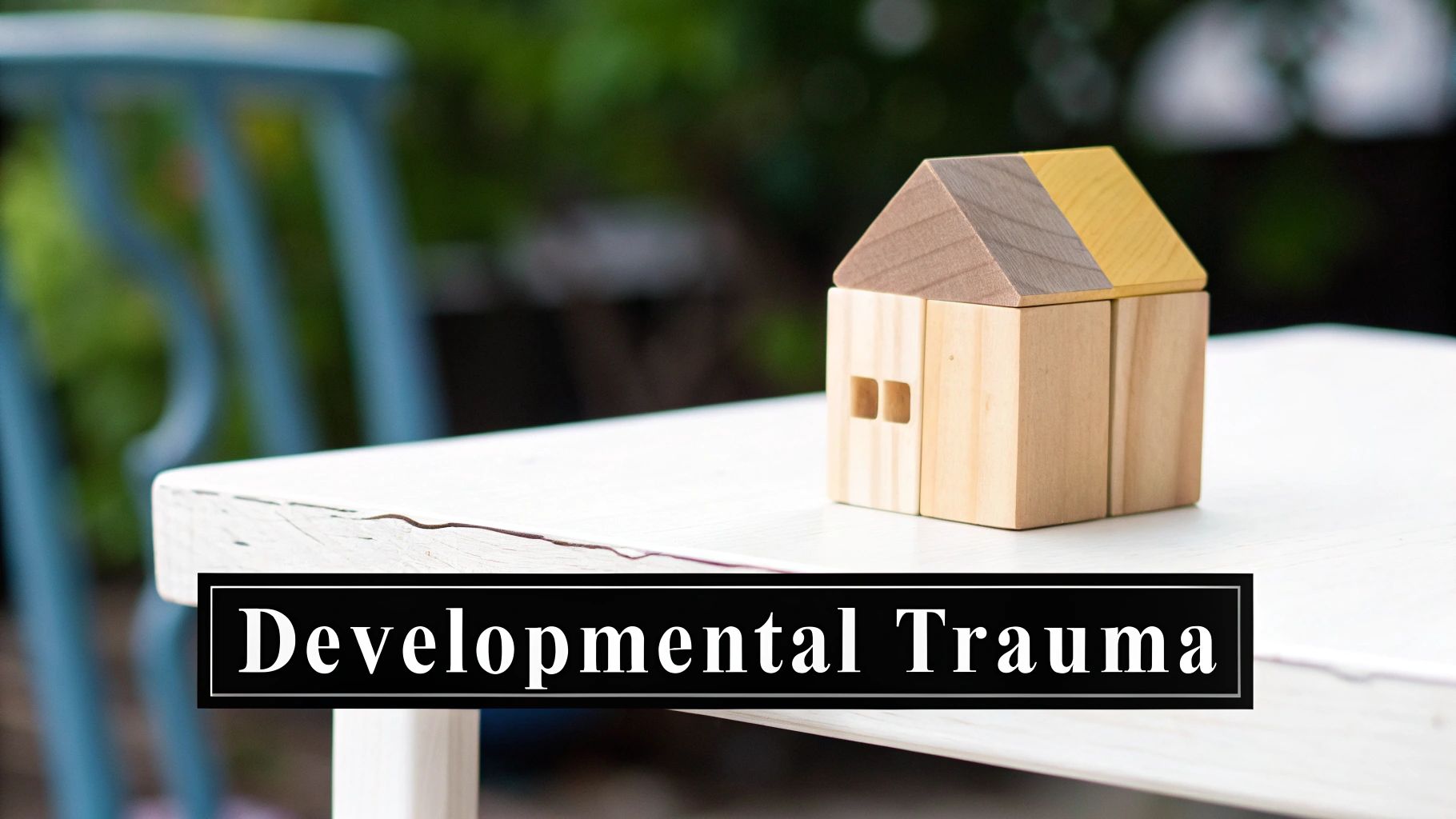
When we hear ‘trauma’, our minds often jump to a single, shocking moment—a car crash, a natural disaster, a sudden loss. Those experiences are absolutely traumatic, but developmental trauma works differently. It’s less like a sudden earthquake that causes obvious damage and more like a slow, persistent damp that quietly weakens a house’s entire foundation over many years.
This kind of trauma takes root during those critical windows of childhood and adolescence when the brain is still being built. It’s the result of being repeatedly exposed to harmful experiences, often within the very relationships that are supposed to be safe and nurturing. The constant drip of stress from these situations can fundamentally alter how a child’s brain, emotions, and even their body develops. A practical example is a child who consistently witnesses arguments at home; they may not be the target, but the constant atmosphere of fear shapes their developing nervous system to be on high alert.
The Scale of the Issue in the UK
The fallout from these early adverse experiences is more widespread than many of us realise. In the UK, it is estimated that one in three children will experience a potentially traumatic event by the age of 18. Developmental trauma often grows from repeated abuse and neglect, and its shadow stretches across a huge portion of the UK population.
It’s a sobering reality, but recent data from the Crime Survey for England and Wales revealed that a shocking 29.0% of adults aged 18 and over—that’s around 13.6 million people—had experienced at least one form of abuse before they turned 18. These aren't just numbers; they represent millions of childhoods shaped by fear and instability.
This isn't just a personal tragedy for those affected. The effects ripple outwards, impacting everything from individual mental health to our public services. Mental ill health costs UK businesses an estimated £56 billion each year through absenteeism, presenteeism, and staff turnover, with many of these issues having their roots in unresolved childhood trauma.
Important Disclaimer: This article is for informational purposes only. It is not a substitute for professional medical advice, diagnosis, or treatment. I am not a mental health professional; if you are worried about your own or a child's mental health, please consult a GP or a qualified professional.
Why This Conversation Matters
Opening up conversations about mental health, and especially about the roots of our struggles, has never been more important. Addressing mental health early is not just compassionate; it's a critical investment in our collective future, fostering healthier communities and a more productive workforce. For a really powerful look into the science of trauma and its lifelong effects, the book What Happened To You? by Oprah Winfrey and Dr Bruce Perry is an invaluable read.
Shifting the question from "What's wrong with you?" to "What happened to you?" is the first, crucial step towards healing. It’s about understanding the ‘why’ behind difficult behaviours so we can start creating environments built on safety, connection, and trust. To continue exploring this supportive approach, you can read our guide on what trauma-informed care is and why it's so important.
How Trauma Shapes a Child's Developing Brain

To really get to the heart of what is developmental trauma, we have to look at what’s happening inside a child’s growing brain. Think of it like a house being built from the ground up. The foundations and basic wiring – the bits responsible for survival – have to be laid down first. Only then can the more complex upper floors, like reasoning and emotional control, be added on top.
Now, imagine a rogue contractor comes along. Chronic stress and trauma act just like that, disrupting the whole building process. It messes with the wiring (the neural pathways) and weakens the very foundations (the brain's architecture).
When a child is constantly on high alert, their brain’s main job becomes survival. It diverts all its resources to staying safe, fundamentally reshaping its own development to be on constant guard for the next threat. This isn’t a choice; it’s a biological necessity. The brain learns from experience, and if those experiences are terrifying, it wires itself for a world that feels incredibly unsafe.
The Brain's Alarm System on High Alert
Developmental trauma can knock key areas of the brain completely out of sync. The constant flood of stress hormones changes how these different parts function and, crucially, how they talk to each other.
Let’s meet the key players:
- The Amygdala (The Smoke Alarm): This is the brain’s fear centre. In a child living with trauma, the amygdala becomes overactive and hypersensitive, like a smoke alarm that goes off at the slightest hint of steam. It starts screaming "danger!" everywhere, even in safe situations.
- The Hippocampus (The Memory Filing Cabinet): This part helps us process and file away our memories, giving them context. Chronic stress can actually shrink the hippocampus, making it incredibly difficult for a child to organise their experiences. Traumatic memories don’t get filed away properly; they stay fragmented, raw, and can feel like they are happening again and again in the present moment.
- The Prefrontal Cortex (The Air Traffic Controller): Sitting right at the front of the brain, this is our control tower for planning, reasoning, and managing big feelings. It’s also one of the last parts of the brain to fully develop. When the amygdala’s alarm is constantly blaring, the prefrontal cortex simply can’t get a word in. This makes it tough for a child to calm down, think through consequences, or control their impulses.
Living in Fight, Flight, or Freeze
When a brain is wired for survival, a child often gets stuck in a state of 'fight, flight, or freeze'. These aren't just naughty behaviours; they are deep-rooted, automatic survival responses to what feels like a life-or-death threat.
A child might lash out (fight). For example, a student who feels criticised by a teacher might shout or throw a book not out of defiance, but because their brain perceives the criticism as a threat. They might run away or avoid things at all costs (flight). Or they might just seem to shut down, go blank, and disconnect from everything around them (freeze).
These are clever adaptations, not choices. Seeing these behaviours through the lens of brain science helps us shift from a place of judgement to one of compassion. We start to see a child who is struggling to survive, not one who is choosing to be difficult.
The impact of these brain changes goes far beyond emotional outbursts. It fundamentally affects a child's ability to trust others, build healthy relationships, and feel safe in their own skin. Understanding the powerful role of early relationships is essential, which is why learning about what is attachment theory provides such a vital piece of the puzzle for healing.
The ripple effects of these early experiences are enormous. We know that mental ill health costs UK employers up to £56 billion a year, with so many of these struggles having roots in childhood adversity. Supporting children’s mental health isn't just the right thing to do; it’s a critical investment in our collective future.
Recognising the Signs of Developmental Trauma
Knowing that developmental trauma reshapes a child’s brain is one thing. But what does that actually look like in day-to-day life? It’s rarely straightforward. Often, the signs are mistaken for defiance, anxiety, or plain old ‘bad behaviour’.
The tricky part is that these signs shift and change as a child grows. What you see in a toddler looks completely different from what you’ll see in a teenager, making it incredibly difficult to connect the dots unless you know what you’re looking for.
This isn’t about trying to make a diagnosis from an armchair. It’s about learning to see behaviour for what it often is: a desperate signal. It’s a cry for help that points to a much deeper struggle rooted in their earliest experiences. When we can see that, our response can shift from frustration to empathy.
Signs of Developmental Trauma by Age Group
To make sense of these shifting behaviours, it helps to see them laid out by age. A child's developmental stage heavily influences how their inner turmoil shows up on the outside. This table offers a glimpse into the common signs you might observe, helping you spot potential red flags.
| Age Group | Potential Behavioural Signs | Potential Emotional and Social Signs |
|---|---|---|
| Infants & Toddlers (0-4) | Unexplained physical issues (feeding/digestive trouble); either hypervigilant (easily startled, hard to soothe) or unusually passive and quiet. | Difficulty forming a secure bond; can be overly clingy and distressed or appear detached and show little preference for their main caregiver. |
| Primary School (5-11) | Intense emotional outbursts over small triggers (meltdowns, aggression); sudden struggles with schoolwork, concentration, and memory. | Trouble making or keeping friends; often misinterprets social cues as threatening; may withdraw completely or try to control play. |
| Teenagers (12-18) | Increased risk-taking (substance use, reckless behaviour); self-harm; significant changes in eating or sleeping patterns. | Deep social withdrawal from friends and family; expresses a bleak or hopeless outlook on the future; may seem chronically irritable or angry. |
Remember, these are just signposts, not certainties. Many of these behaviours can have other causes. The key is to look for patterns and consider them within the wider context of a child’s history and environment.
A Closer Look: Infants and Toddlers (Ages 0-4)
In the very first years of life, the signs of developmental trauma are often physical and relational. A baby’s main job is to figure out that their caregiver is a safe base, but when that process is disrupted, their whole system gets thrown off kilter.
You might notice a baby who is incredibly difficult to soothe—they might be hyper-alert, constantly startled, or cry inconsolably. On the flip side, you might see a baby who is unnervingly quiet, passive, and seems almost checked out. Other physical signs can pop up too, like persistent feeding issues or digestive problems that don’t have a clear medical cause.
A Closer Look: Primary School Children (Ages 5-11)
When children hit school age, the impact of early trauma really starts to show up in how they manage their emotions and get along with others. The structure and social demands of the classroom can shine a spotlight on struggles that weren’t as obvious at home.
You might see huge emotional reactions to seemingly small things—a massive meltdown because they got a maths problem wrong, for example. This happens because their brain’s ‘smoke alarm’ is faulty and constantly firing. Academically, a child who was doing just fine might suddenly struggle to focus or remember things. It’s not because they aren’t trying; it’s because their brain is busy scanning for threats, leaving little room for learning.
The scale of this is staggering. We're not talking about a handful of children. A report from the UK Trauma Council reveals that nearly 1 in 5 UK children (18.6%) go through some form of maltreatment. These are the very conditions that lay the groundwork for developmental trauma. You can dig deeper into their findings on the impact of complex trauma on children.
A Closer Look: Teenagers (Ages 12-18)
By the time a child reaches their teenage years, the signs can get even more complex and are often brushed off as ‘typical teenage angst’. But for a young person carrying the weight of developmental trauma, these behaviours run much deeper. They’re driven by a profound sense of pain, shame, and hopelessness.
You might see an increase in risky behaviours—things like substance misuse, reckless acts, or early sexual activity. This isn’t just rebellion; it’s often a desperate attempt to numb the emotional agony or feel some sense of control. Others might pull away completely, isolating themselves from friends and family. A deep sense of hopelessness can set in, making them feel like they are fundamentally broken and that things will never get better.
Today’s world, with the impossible perfection plastered all over social media, can feel like pouring salt in an open wound. For a teenager already battling feelings of worthlessness from past trauma, the constant comparison on platforms like Instagram and TikTok can make their isolation feel absolute, making it harder than ever to ask for help.
Developmental Trauma Versus PTSD: Understanding the Difference
It’s easy to hear the words ‘trauma’ and ‘PTSD’ used as if they mean the same thing, but when we’re talking about what happens in early childhood, the difference is absolutely vital. Getting to grips with the distinction between developmental trauma and Post-Traumatic Stress Disorder (PTSD) is one of the first, most important steps in finding the right support for a child who is struggling.
Let’s try an analogy. Think of single-incident PTSD as the aftermath of a lightning strike. It’s a sudden, terrifying, and very specific event—a car accident, a house fire, a natural disaster. The damage is clear, and the healing, while incredibly tough, focuses on processing that one overwhelming moment.
Developmental trauma, on the other hand, is much more like the slow, relentless erosion caused by years of rain. It isn’t about one single event. It’s the result of chronic, ongoing harm that happens within the very relationships that are supposed to be safe. We’re talking about things like neglect, emotional abuse, or growing up around domestic violence. This kind of ongoing adversity quite literally shapes the architecture of a child's developing brain and their fundamental sense of who they are.
This infographic gives a snapshot of how developmental trauma can interrupt crucial milestones at different stages of a child's growth.

As the diagram shows, trauma doesn’t just cause distress; it can derail the natural progression of development, affecting everything from an infant's ability to bond with a caregiver to a teenager's search for a stable identity.
Comparing Developmental Trauma and Single-Incident PTSD
To really see why this matters, it helps to put the two side-by-side. The impact of these two types of trauma shows up in fundamentally different ways. The core wounds, the symptoms, and therefore the most effective paths to healing are just not the same.
The table below breaks down the key distinctions between developmental trauma, which often leads to Complex PTSD (C-PTSD), and the more widely known single-incident PTSD.
| Characteristic | Developmental Trauma (C-PTSD) | Single-Incident PTSD |
|---|---|---|
| Nature of Trauma | Chronic, repeated, and relational (e.g., ongoing neglect or abuse). | A single, overwhelming event (e.g., a serious accident or assault). |
| Core Symptoms | Struggles with self-concept, emotional regulation, relationships, and trust. | Re-experiencing the event (flashbacks, nightmares), avoidance, and hypervigilance. |
| Impact on Self | Leads to a deeply negative self-view, shame, and a feeling of being broken. | The sense of self is often intact but shaken by the traumatic event. |
| Treatment Focus | Building safety, repairing attachment, and developing emotional skills. | Processing the specific traumatic memory and managing arousal symptoms. |
Mistaking one for the other can lead to support strategies that simply miss the mark, leaving a child feeling misunderstood and unseen.
Why This Distinction Is So Crucial for Healing
Recognising what is developmental trauma as something distinct from single-incident PTSD isn’t just about getting the label right—it's everything when it comes to a child's healing. Therapies designed for classic PTSD often focus on processing a specific, traumatic memory. But for a child with developmental trauma, there isn’t just one memory to process.
Their trauma is woven into the very fabric of their development. The healing journey, therefore, must focus on building the foundational skills that were disrupted: a sense of safety, the ability to trust others, and the capacity to manage big, overwhelming emotions.
Trying to tackle developmental trauma with the wrong set of tools can be ineffective at best and, at worst, can even be re-traumatising. By understanding this critical difference, parents, educators, and professionals can seek out and provide the relational, patient, and skill-building support these children truly need to not just cope, but to heal and thrive.
Practical Ways to Support a Child's Healing Journey
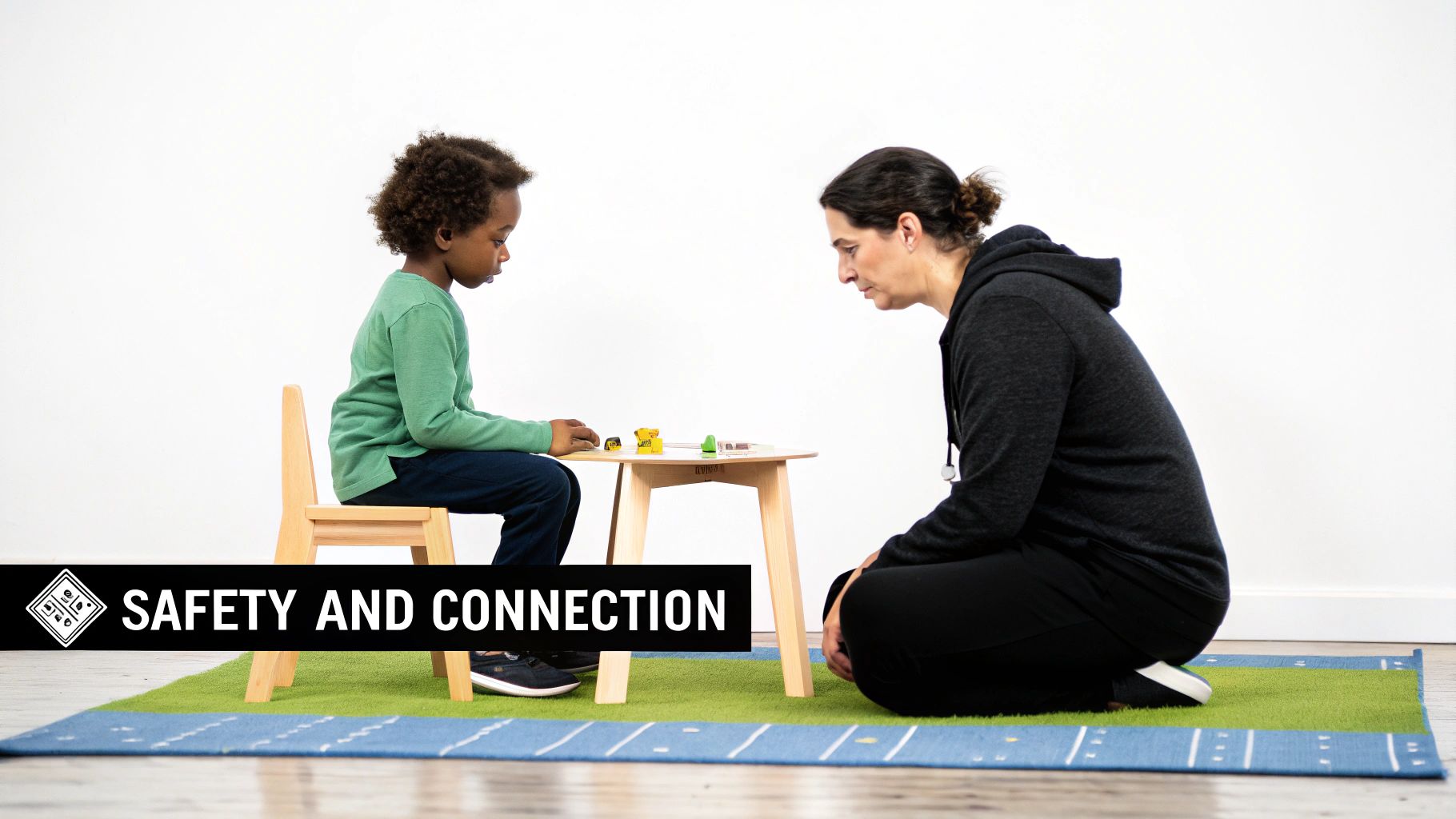
Understanding what developmental trauma is, is one thing. But the real question is always: what can I actually do to help? The good news is that healing isn’t about grand, dramatic gestures or searching for a quick fix. It’s built in the small, consistent, everyday moments that slowly piece back together a child’s sense of safety and self-worth.
Think of it as a marathon, not a sprint. This journey asks for patience, heaps of empathy, and a real commitment to creating an environment where a child can finally feel secure enough to let their guard down. The focus always comes back to three core pillars: creating safety, building connection, and teaching emotional skills.
It's so important to remember that while these strategies can make a world of difference, they are not a substitute for professional support. I’m not a mental health professional, and if you have serious concerns about a child’s wellbeing, the most supportive thing you can do is seek advice from a GP or a qualified therapist.
Creating a Safe and Predictable World
For a child whose world has felt chaotic, unpredictable, and scary, predictability is like medicine. When they know what to expect, their brain's overactive alarm system can finally begin to stand down.
-
Consistent Routines: Simple, reliable routines for waking up, meals, and bedtime create a comforting, dependable rhythm. This predictability helps to calm the nervous system because the child isn't constantly burning mental energy just trying to figure out what’s coming next.
-
Firm but Fair Boundaries: Clear, consistent boundaries aren’t about control; they’re about safety. When a child knows exactly where the lines are and trusts that you will hold them kindly but firmly, it sends a powerful message: you are a reliable and protective adult.
These small acts of consistency build a foundation of safety, signalling to the child's brain that the world can be a trustworthy place after all.
Building Trust Through Connection
Healing from developmental trauma happens within the safety of a relationship. Being emotionally present and truly available is the most powerful tool you have.
This means putting your phone down and giving your full attention, even if it's just for a few minutes at a time. It’s about listening not just to their words, but to the feelings swirling underneath them. One of the most vital skills here is co-regulation, which is a simple idea: you share your calm to help soothe their storm.
When a child is completely overwhelmed, you can just sit with them quietly, speak in a gentle tone, and model slow, deep breaths. You're basically lending them your regulated nervous system until theirs can find its own balance again.
The need for this kind of support is profound. A landmark study in Northern Ireland found that 60% of adults had experienced at least one traumatic childhood event, and nearly 1 in 5 had endured four or more. This research directly links these adverse childhood experiences (ACEs) to long-term mental and physical health struggles. You can learn more about the widespread impact of childhood trauma.
Teaching Emotional Literacy
Children who have lived through developmental trauma often struggle to understand or even name their overwhelming feelings. Giving them the language for their emotions is a huge step towards helping them feel more in control.
You can do this by gently naming feelings for them: "It looks like you’re feeling really frustrated right now," or "I can see that made you feel sad." Using tools like mental health books can be a brilliant, gentle way to start these conversations. Stories about characters who manage big emotions help children feel seen and less alone in their struggles. Even simple things like mental health apparel with positive messages can act as a quiet, everyday reminder of their own strength and self-compassion.
Simple relaxation techniques are also incredibly helpful to practise together:
- Mindful Breathing: Teach them 'box breathing'. Breathe in for a count of four, hold for four, breathe out for four, and then hold again for four. It's a simple, rhythmic pattern that can calm the nervous system.
- Sensory Activities: Things like playing with dough, snuggling under a weighted blanket, or listening to calming music can help ground a child in the present moment and soothe an overstimulated nervous system.
For those grappling with the lasting physical effects of past experiences, learning how to release stored trauma can be a vital piece of the healing puzzle. These practical, body-based techniques help ease the physical tension that so often goes hand-in-hand with emotional pain, offering a real path towards greater calm and wellbeing.
When and How to Seek Professional Help
While the support you provide at home is the absolute bedrock of a child's healing, there are times when bringing in a professional is the crucial next step. Knowing when and how to take that step can feel incredibly daunting, but please know this: it’s a sign of profound strength and the most loving action you can take.
So, when is it time? You should consider seeking help when you notice a child's struggles are escalating or starting to significantly impact their daily life. This might look like behaviours becoming unmanageable at home or school, a deep and persistent distress that just doesn't seem to ease, or a noticeable withdrawal from friends, activities, and relationships they once loved.
Taking the First Steps in the UK
Navigating the mental health system can feel like trying to solve a complex puzzle, but there are clear places to start.
Your General Practitioner (GP) is usually the best first port of call. They can listen to your concerns, rule out any underlying physical health issues that might be contributing, and make a referral to Child and Adolescent Mental Health Services (CAMHS) if it seems appropriate.
Another fantastic resource is your child's school. Request a meeting with their teacher and the Special Educational Needs Coordinator (SENCO). They see your child in a completely different environment and can offer valuable insights. More importantly, they can work alongside you to create a consistent support plan that spans both home and school.
Important Disclaimer: I am not a mental health professional. This content is for informational purposes only and should not be used as a substitute for professional medical advice. If you are worried about a child's mental health, please speak to a doctor or a qualified mental health professional. It is essential to seek help if you are worried.
Understanding Different Therapy Options
Once you're on the path to getting support, you might hear about different therapeutic approaches. It can feel like a whole new language. Two common and highly effective methods for children who have experienced developmental trauma are:
-
Dyadic Developmental Psychotherapy (DDP): This isn't just about the child; it focuses on strengthening the parent-child relationship itself. The therapist helps to build attachment and trust through an approach built on Playfulness, Acceptance, Curiosity, and Empathy (often called PACE).
-
Play Therapy: For younger children who can't easily put their big feelings into words, play is their natural language. A trained therapist uses play to help children explore their experiences, make sense of confusing emotions, and develop healthier coping skills, all within a safe, contained environment.
The journey to find the right support can sometimes feel long, but it's a vital investment in a child’s long-term wellbeing. For more guidance on this, our article on finding the right mental health support for young people offers additional insights and resources to help you along the way.
Remember, reaching out for help is not an admission of failure; it is an act of hope.
A Few Common Questions About Developmental Trauma
As you get to grips with what developmental trauma really means, it’s natural for more questions to pop up. Let's tackle some of the most common ones that parents, carers, and educators often ask.
Can a child experience trauma from things other than abuse?
Yes, absolutely. While abuse and neglect are often what first come to mind, developmental trauma can take root from any kind of chronic, overwhelming stress in a child's early life.
Think of it this way: a child’s sense of safety is like the foundation of a house. Experiences like growing up with a parent who has a severe mental illness, living in a home with substance abuse or domestic violence, or even the prolonged illness or sudden loss of a caregiver can create deep, persistent cracks in that foundation. The key factor is the constant disruption to a child's feeling of safety and connection, which overwhelms their ability to cope.
Is it possible for a child to fully recover?
Healing is definitely a journey, not a destination, but the answer is a hopeful yes. With the right support, children can not only heal but also build incredible resilience. The brain’s ability to change and adapt—something scientists call neuroplasticity—is truly amazing.
Recovery isn't about erasing the past. It's about creating safe, stable, and nurturing relationships that help a child rebuild trust and feel secure again. Through therapy and a supportive network at home and school, children learn to process what happened, manage big feelings, and develop a positive sense of who they are. It’s like helping them rewrite the internal rulebook that trauma created.
How do I talk to my child's school about their trauma?
This can feel daunting, but a collaborative approach is always best. Start by asking for a quiet, private meeting with their teacher and the school's Special Educational Needs Coordinator (SENCO).
Instead of leading with labels, focus on your child's specific needs and behaviours. You could try saying something like, "We've noticed [specific behaviour], and we believe it's connected to some difficult early experiences. We'd love to work together to find the best ways to support them in the classroom." Sharing insights from any professionals involved and asking about the school’s own approach to trauma-informed care can help you build a consistent and effective plan together.
Important Disclaimer: I am not a mental health professional. This information is for educational purposes and is not a substitute for professional medical advice. If you are worried about a child’s mental health, please speak to a doctor or qualified professional.
At Little Fish Books, we create resources designed to gently open up these important conversations. Our collection of mental health books for children, alongside our supportive apparel, can help build the emotional literacy that is so crucial for healing. Explore our tools to support the young people in your life at https://thatsokay.co.uk.